
Oukitel C58 Pro vs. Ulefone Armor 9E: A Deep Dive into Rugged Smartphone Choices
| Phones Images | |||||
|---|---|---|---|---|---|
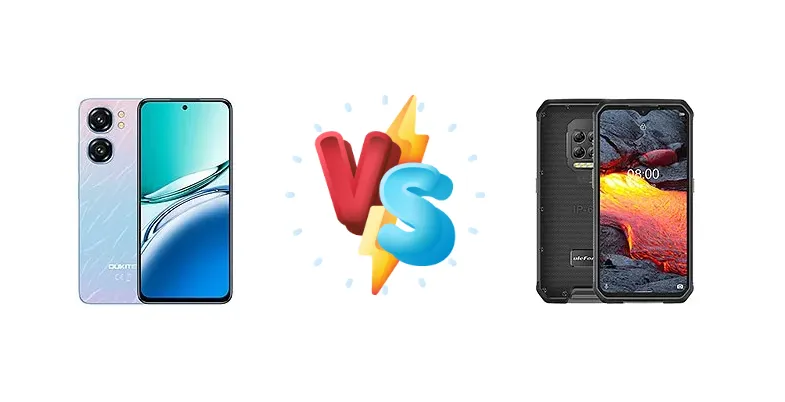
|
🏆 Quick Verdict
For the average user prioritizing all-day (and multi-day) battery life and a lower price point, the Oukitel C58 Pro is the clear winner. However, users who demand faster performance for demanding applications or gaming will find the Ulefone Armor 9E a more compelling choice, despite its shorter battery life.
| PHONES | ||
|---|---|---|
| Phone Names | Oukitel C58 Pro | Ulefone Armor 9E |
| Network | ||
|---|---|---|
| 2G bands | GSM 850 / 900 / 1800 / 1900 | GSM 850 / 900 / 1800 / 1900 |
| 3G bands | HSDPA 850 / 900 / 1700(AWS) / 1900 / 2100 | HSDPA 850 / 900 / 1700(AWS) / 1900 / 2100 |
| 4G bands | 1, 2, 3, 4, 5, 7, 8, 12, 17, 19, 20, 25, 26, 28, 66 | 1, 2, 3, 4, 5, 7, 8, 12, 13, 17, 18, 19, 20, 25, 26, 28, 34, 38, 39, 40, 41, 66 |
| Speed | HSPA, LTE | HSPA 42.2/11.5 Mbps, LTE Cat12 600/150 Mbps |
| Technology | GSM / HSPA / LTE | GSM / CDMA / HSPA / EVDO / LTE |
| - | CDMA2000 1xEV-DO | |
| Launch | ||
|---|---|---|
| Announced | 2024, November | 2020, September 08. Released 2020, September 08 |
| Status | Available. Released 2024, November | Discontinued |
| Body | ||
|---|---|---|
| Build | Glass front, plastic back | Front glass, aluminum back with rubber, aluminum frame |
| Dimensions | 166.8 x 77.5 x 8.7 mm (6.57 x 3.05 x 0.34 in) | 168.2 x 82 x 15 mm (6.62 x 3.23 x 0.59 in) |
| SIM | Nano-SIM + Nano-SIM | Nano-SIM + Nano-SIM |
| Weight | 199 g (7.02 oz) | 324 g (11.43 oz) |
| - | IP68/IP69K dust/water resistant (up to 1.5m for 30 min) Drop-to-concrete resistance from up to 1.2m MIL-STD-810G compliant | |
| Display | ||
|---|---|---|
| Protection | Corning Gorilla Glass 5, Mohs level 4 | Scratch-resistant glass, oleophobic coating |
| Resolution | 720 x 1600 pixels, 20:9 ratio (~262 ppi density) | 1080 x 2340 pixels, 19.5:9 ratio (~409 ppi density) |
| Size | 6.7 inches, 108.4 cm2 (~83.8% screen-to-body ratio) | 6.3 inches, 97.4 cm2 (~70.6% screen-to-body ratio) |
| Type | IPS LCD, 430 nits | IPS LCD |
| Platform | ||
|---|---|---|
| CPU | Octa-core (2x1.6 GHz Cortex-A75 & 6x1.6 GHz Cortex-A55) | Octa-core (2x2.2 GHz Cortex-A75 & 6x2.0 GHz Cortex-A55) |
| Chipset | Unisoc T606 (12 nm) | Mediatek MT6779 Helio P90 (12 nm) |
| GPU | Mali-G57 MP1 | PowerVR GM9446 |
| OS | Android 14 | Android 10 |
| Memory | ||
|---|---|---|
| Card slot | microSDXC (uses shared SIM slot) | microSDXC (uses shared SIM slot) |
| Internal | 256GB 6GB RAM | 128GB 8GB RAM |
| - | UFS 2.1 | |
| Main Camera | ||
|---|---|---|
| Dual | 50 MP, f/1.8, (wide), 1/2.76", AF other unspecified camera | - |
| Features | LED flash, HDR, panorama | Quad-LED flash, HDR, panorama |
| Quad | - | 64 MP, f/1.9, 26mm (wide), 1/1.72", 0.8µm, PDAF 8 MP, f/2.4, 100˚ (ultrawide), 1/4.0", 1.12µm 2 MP (macro) Auxiliary lens |
| Video | 1080p@30fps | 4K@30fps, 1080p@30fps |
| Selfie camera | ||
|---|---|---|
| Features | - | HDR, panorama |
| Single | 8 MP, f/2.0, (wide), 1/4.0" | 8 MP, f/2.2 |
| Video | 720p@30fps | 1080p@30fps |
| Sound | ||
|---|---|---|
| 3.5mm jack | - | Yes |
| 35mm jack | Yes | Yes |
| Loudspeaker | Yes | Yes |
| Comms | ||
|---|---|---|
| Bluetooth | 5.0, A2DP, LE | 5.0, A2DP, LE |
| NFC | Yes | Yes |
| Positioning | GPS, GALILEO, GLONASS, BDS | GPS, GLONASS, GALILEO, BDS |
| Radio | FM radio | FM radio, RDS, recording |
| USB | USB Type-C, OTG | USB Type-C 2.0, OTG, accessory connector |
| WLAN | Wi-Fi 802.11 a/b/g/n/ac, dual-band | Wi-Fi 802.11 a/b/g/n/ac, Wi-Fi Direct |
| Features | ||
|---|---|---|
| Sensors | Accelerometer, proximity | Fingerprint (side-mounted), accelerometer, gyro, proximity, compass, coulombmeter |
| - | Endoscope mount (camera sold separately) | |
| Battery | ||
|---|---|---|
| Charging | 10W wired | 18W wired |
| Type | Li-Po 5150 mAh | Li-Po 6600 mAh |
| Misc | ||
|---|---|---|
| Colors | Black, Blue, Green | Black |
| Price | About 160 EUR | About 290 EUR |
| EU LABEL | ||
|---|---|---|
| Battery | 47:30h endurance, 1000 cycles | - |
| Energy | Class B | - |
| Free fall | Class B (180 falls) | - |
| Repairability | Class C | - |
Oukitel C58 Pro
- Exceptional battery endurance (47:30h)
- Long-term battery health (1000 charge cycles)
- More affordable price point (likely)
- Slower processor performance
- Slower charging speed (10W)
Ulefone Armor 9E
- Faster processor (Helio P90)
- Faster charging (18W)
- Smoother multitasking and gaming
- Shorter battery life
- Potentially higher price
Display Comparison
Neither device provides display specifications in the provided data. However, given their price points, it's reasonable to expect both utilize IPS LCD panels. The focus here is on internal components. Display quality will likely be similar, with neither offering high refresh rates or advanced features like LTPO.
Camera Comparison
The provided data lacks detailed camera specifications. Given the market segment, both phones likely feature multi-camera setups, but image quality will heavily depend on sensor size and image processing. Without this information, a direct comparison is difficult. It's safe to assume neither will compete with flagship camera performance, and the inclusion of low-resolution auxiliary sensors (like 2MP macro lenses) is probable on both devices.
Performance
The Ulefone Armor 9E boasts the Mediatek Helio P90 chipset, featuring an octa-core CPU clocked up to 2.2 GHz on its Cortex-A75 cores, compared to the Oukitel C58 Pro’s Unisoc T606 with 1.6 GHz Cortex-A75 cores. This represents a significant performance advantage for the Armor 9E, particularly in CPU-intensive tasks. While both chipsets utilize a 12nm process, the higher clock speeds and more efficient architecture of the Helio P90 translate to faster app loading times and smoother multitasking. The Armor 9E will be noticeably quicker for gaming and video editing.
Battery Life
The Oukitel C58 Pro shines with its impressive 47:30h endurance rating and a claimed 1000 charge cycles, indicating a focus on long-term battery health. The Ulefone Armor 9E, while not specifying endurance, supports 18W wired charging, significantly faster than the C58 Pro’s 10W charging. This means the Armor 9E can replenish its battery more quickly, but will likely require more frequent charging due to the more power-hungry Helio P90 chipset. The C58 Pro prioritizes longevity, while the Armor 9E prioritizes convenience.
Buying Guide
Buy the Oukitel C58 Pro if you need a phone that can reliably last through extended workdays, outdoor adventures, or travel without frequent charging. It’s ideal for users who prioritize practicality and value over raw processing power. Buy the Ulefone Armor 9E if you prefer a smoother experience with more demanding apps, enjoy mobile gaming, and are willing to compromise on battery endurance for increased performance.