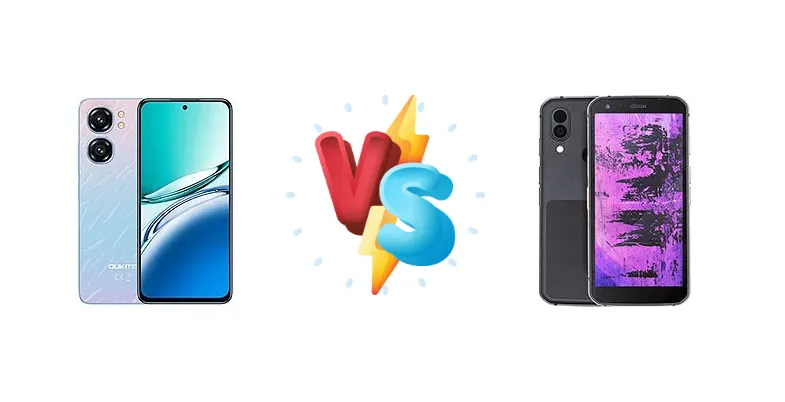
The rugged smartphone market caters to a specific need – durability. However, within this niche, trade-offs exist between processing power, battery endurance, and price. The Oukitel C58 Pro and Cat S62 Pro represent two distinct approaches: the C58 Pro prioritizes exceptional battery life, while the S62 Pro leverages a more established, albeit older, chipset for a balance of performance and efficiency.
🏆 Quick Verdict
For the average user prioritizing all-day (and multi-day) battery life, the Oukitel C58 Pro is the clear winner. Its 47:30h endurance significantly outpaces what the Cat S62 Pro can achieve. However, users who need a more responsive experience for demanding apps will find the Snapdragon 660 in the S62 Pro preferable.
| Network |
|---|
| 2G bands | GSM 850 / 900 / 1800 / 1900 | GSM 850 / 900 / 1800 / 1900 |
| 3G bands | HSDPA 850 / 900 / 1700(AWS) / 1900 / 2100 | HSDPA 850 / 900 / 1700(AWS) / 1900 / 2100 |
| 4G bands | 1, 2, 3, 4, 5, 7, 8, 12, 17, 19, 20, 25, 26, 28, 66 | 1, 2, 3, 4, 5, 7, 8, 20, 28, 38, 40 |
| Speed | HSPA, LTE | HSPA 42.2/5.76 Mbps, LTE (2CA) Cat13 400/150 Mbps |
| Technology | GSM / HSPA / LTE | GSM / HSPA / LTE |
| Launch |
|---|
| Announced | 2024, November | 2020, June 28. Released 2020, August 17 |
| Status | Available. Released 2024, November | Discontinued |
| Body |
|---|
| Build | Glass front, plastic back | Glass front (Gorilla Glass 6), plastic back, aluminum frame |
| Dimensions | 166.8 x 77.5 x 8.7 mm (6.57 x 3.05 x 0.34 in) | 158.5 x 76.7 x 11.9 mm (6.24 x 3.02 x 0.47 in) |
| SIM | Nano-SIM + Nano-SIM | · Nano-SIM· Nano-SIM + Nano-SIM |
| Weight | 199 g (7.02 oz) | 248 g (8.75 oz) |
| | - | IP68/IP69 dust/water resistant (up to 1.5m for 35 mins)
Drop-to-concrete resistance from up to 1.8m
MIL-STD-810H compliant |
| Display |
|---|
| Protection | Corning Gorilla Glass 5, Mohs level 4 | Corning Gorilla Glass 6 |
| Resolution | 720 x 1600 pixels, 20:9 ratio (~262 ppi density) | 1080 x 2160 pixels, 18:9 ratio (~424 ppi density) |
| Size | 6.7 inches, 108.4 cm2 (~83.8% screen-to-body ratio) | 5.7 inches, 83.8 cm2 (~69.0% screen-to-body ratio) |
| Type | IPS LCD, 430 nits | IPS LCD |
| Platform |
|---|
| CPU | Octa-core (2x1.6 GHz Cortex-A75 & 6x1.6 GHz Cortex-A55) | Octa-core (4x2.2 GHz Kryo 260 Gold & 4x1.8 GHz Kryo 260 Silver) |
| Chipset | Unisoc T606 (12 nm) | Qualcomm SDM660 Snapdragon 660 (14 nm) |
| GPU | Mali-G57 MP1 | Adreno 512 |
| OS | Android 14 | Android 10 |
| Memory |
|---|
| Card slot | microSDXC (uses shared SIM slot) | microSDXC (dedicated slot) |
| Internal | 256GB 6GB RAM | 128GB 6GB RAM |
| Main Camera |
|---|
| Dual | 50 MP, f/1.8, (wide), 1/2.76", AF
other unspecified camera | 12 MP, f/1.8, (wide), 1/2.55", 1.4µm, dual pixel PDAF
FLIR thermal camera (Lepton 3.5 module) |
| Features | LED flash, HDR, panorama | Thermal imaging, heat palettes, temp. spot meter, LED flash |
| Video | 1080p@30fps | 1080p@30fps, gyro-EIS |
| Selfie camera |
|---|
| Single | 8 MP, f/2.0, (wide), 1/4.0" | 8 MP |
| Video | 720p@30fps | 1080p@30fps |
| Sound |
|---|
| 3.5mm jack | - | No |
| 35mm jack | Yes | No |
| Loudspeaker | Yes | Yes |
| Comms |
|---|
| Bluetooth | 5.0, A2DP, LE | 5.0, A2DP, LE |
| NFC | Yes | Yes |
| Positioning | GPS, GALILEO, GLONASS, BDS | GPS, GLONASS, GALILEO, BDS |
| Radio | FM radio | FM radio |
| USB | USB Type-C, OTG | USB Type-C 2.0, OTG |
| WLAN | Wi-Fi 802.11 a/b/g/n/ac, dual-band | Wi-Fi 802.11 a/b/g/n/ac, dual-band, Wi-Fi Direct |
| Features |
|---|
| Sensors | Accelerometer, proximity | Fingerprint (rear-mounted), accelerometer, gyro, proximity, compass |
| Battery |
|---|
| Charging | 10W wired | - |
| Type | Li-Po 5150 mAh | Li-Ion 4000 mAh |
| Misc |
|---|
| Colors | Black, Blue, Green | Black |
| Price | About 160 EUR | About 530 EUR |
| EU LABEL |
|---|
| Battery | 47:30h endurance, 1000 cycles | - |
| Energy | Class B | - |
| Free fall | Class B (180 falls) | - |
| Repairability | Class C | - |
Oukitel C58 Pro
- Exceptional battery life (47:30h endurance)
- Potentially more efficient chipset (Unisoc T606)
- Likely more affordable price point
- Slower processor compared to Snapdragon 660
- Slow 10W charging
- Display quality likely lower than S62 Pro
Cat S62 Pro
- More powerful processor (Snapdragon 660)
- Smoother user experience
- Qualcomm’s software optimization
- Shorter battery life compared to Oukitel C58 Pro
- Potentially higher price
- Older chipset architecture
Display Comparison
Neither device's display specifications are provided, so a direct comparison is limited. However, given the price point of the Oukitel C58 Pro, it likely utilizes an IPS LCD panel. The Cat S62 Pro, being a slightly more premium offering, *may* feature a higher quality IPS panel or even an early OLED implementation. The real-world impact will be visible in color accuracy and viewing angles. Bezels are likely to be substantial on both devices, typical of rugged designs prioritizing drop protection.
Camera Comparison
Without detailed camera specs, a comprehensive comparison is impossible. However, it's safe to assume both phones prioritize practicality over photographic excellence. The Cat S62 Pro, given its brand positioning, might offer slightly better image processing algorithms, but the sensor size and lens quality will be the determining factors. The inclusion of Optical Image Stabilization (OIS) on either device would be a significant advantage, but is not specified. We can expect both phones to struggle in low-light conditions.
Performance
The core difference lies in the chipsets. The Oukitel C58 Pro’s Unisoc T606 (12nm) is a newer design, but its Cortex-A75/A55 configuration, while efficient, is less powerful than the Cat S62 Pro’s Qualcomm Snapdragon 660 (14nm). The Snapdragon 660’s Kryo 260 cores, with their higher clock speeds (2.2 GHz Gold vs 1.6 GHz A75), deliver a noticeable performance advantage in CPU-intensive tasks. While the Unisoc T606 benefits from a smaller node size potentially improving efficiency, the Snapdragon 660’s mature architecture and Qualcomm’s software optimizations provide a smoother overall experience. This translates to faster app loading times and better multitasking on the Cat S62 Pro.
Battery Life
The Oukitel C58 Pro’s standout feature is its exceptional 47:30h endurance. This is a substantial lead over what the Cat S62 Pro can likely achieve. The Unisoc T606’s efficiency, combined with a potentially larger battery capacity (not specified), contributes to this longevity. The Cat S62 Pro, while still offering respectable battery life, will require more frequent charging. The C58 Pro’s 10W charging is slow, however, meaning a full charge will take a considerable amount of time. The S62 Pro’s charging speed is also unknown, but likely similar.
Buying Guide
Buy the Oukitel C58 Pro if you need a phone that can reliably last for days on a single charge, and your primary use cases are communication, basic productivity, and media consumption. You're willing to trade some processing speed for peace of mind regarding battery anxiety. Buy the Cat S62 Pro if you prefer a more responsive user experience, frequently use apps that benefit from a faster processor, and value the Qualcomm ecosystem's optimization, even if it means more frequent charging.
Frequently Asked Questions
❓ How does the Unisoc T606 handle graphically demanding games compared to the Snapdragon 660?
The Snapdragon 660, with its more powerful GPU, will provide a noticeably smoother gaming experience, especially in titles with high graphical settings. The Unisoc T606 will likely require lower settings and may exhibit frame drops in more demanding games. While playable, the experience won't be as refined.
❓ Is the 10W charging on the Oukitel C58 Pro a significant drawback, considering its long battery life?
Yes, the 10W charging is a considerable limitation. While the long battery life minimizes the need for frequent charging, when you *do* need to charge, it will take a significantly longer time to reach 100% compared to phones with faster charging capabilities. Plan to charge overnight.
❓ What type of user would benefit most from the Cat S62 Pro's Snapdragon 660 chipset?
Users who frequently use apps requiring significant processing power, such as video editing software, navigation apps with offline maps, or those who multitask heavily between applications, will benefit from the Snapdragon 660's superior performance. It provides a more responsive and fluid user experience.
❓ Given the rugged nature of both phones, are the displays protected against scratches and cracks?
While neither device's display specifications detail the glass type, rugged phones typically utilize Gorilla Glass or similar hardened glass to provide scratch and crack resistance. However, even with protection, the displays are still vulnerable to damage from sharp impacts, so caution is advised.