
Oukitel C57s vs. Ulefone Armor X10 Pro: A Deep Dive into Budget Smartphone Choices
| Phones Images | |||||
|---|---|---|---|---|---|
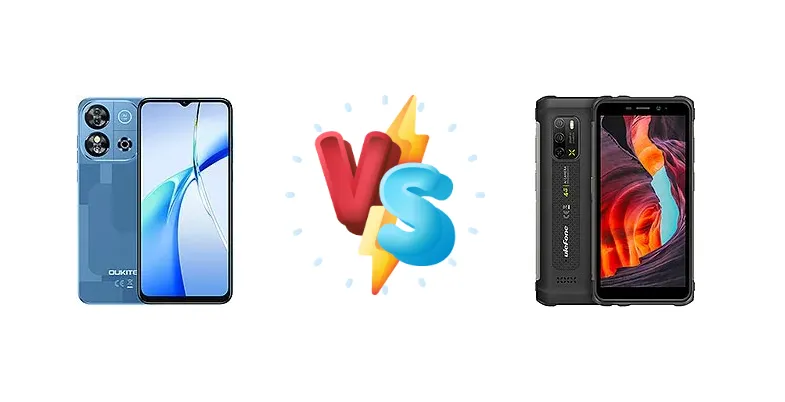
|
🏆 Quick Verdict
For the average user prioritizing efficiency and potentially longer battery life, the Oukitel C57s is the better choice. While the Ulefone Armor X10 Pro boasts a faster processor, its 12nm process and 10W charging represent compromises that may not justify the performance gain for everyday tasks.
| PHONES | ||
|---|---|---|
| Phone Names | Oukitel C57s | Ulefone Armor X10 Pro |
| Network | ||
|---|---|---|
| 2G bands | GSM 850 / 900 / 1800 / 1900 | GSM 850 / 900 / 1800 / 1900 |
| 3G bands | HSDPA 850 / 900 / 1700(AWS) / 1900 / 2100 | HSDPA 850 / 900 / 1700(AWS) / 1900 / 2100 |
| 4G bands | 1, 2, 3, 4, 5, 7, 8, 12, 17, 19, 20, 25, 26, 28, 66 | 1, 2, 3, 4, 5, 7, 8, 12, 13, 17, 18, 19, 20, 25, 26, 28 |
| Speed | HSPA, LTE | HSPA 21/5.76 Mbps, LTE Cat6 300/150 Mbps |
| Technology | GSM / HSPA / LTE | GSM / HSPA / LTE |
| Launch | ||
|---|---|---|
| Announced | 2024, October | 2022, March 10 |
| Status | Available. Released 2024, October | Available. Released 2022, March 10 |
| Body | ||
|---|---|---|
| Dimensions | 165.8 x 76.6 x 9.4 mm (6.53 x 3.02 x 0.37 in) | 158.2 x 76.7 x 14.6 mm (6.23 x 3.02 x 0.57 in) |
| SIM | Nano-SIM + Nano-SIM | Nano-SIM + Nano-SIM |
| Weight | 215 g (7.58 oz) | 256 g (9.03 oz) |
| - | IP68/IP69K dust/water resistant (up to 1.5m for 30 min) Drop-to-concrete resistance from up to 1.2m MIL-STD-810G compliant | |
| Display | ||
|---|---|---|
| Protection | Corning Gorilla Glass 5 | - |
| Resolution | 576 x 1280 pixels, 20:9 ratio (~215 ppi density) | 720 x 1440 pixels, 18:9 ratio (~295 ppi density) |
| Size | 6.52 inches, 102.6 cm2 (~80.8% screen-to-body ratio) | 5.45 inches, 76.7 cm2 (~63.2% screen-to-body ratio) |
| Type | IPS LCD, 400 nits | IPS LCD |
| Platform | ||
|---|---|---|
| CPU | Octa-core (4x1.6 GHz Cortex-A55 & 4x1.2 GHz Cortex-A55) | Octa-core 2.0 GHz Cortex-A53 |
| Chipset | Unisoc SC9863A (28 nm) | Mediatek MT6762 Helio P22 (12 nm) |
| GPU | IMG8322 | PowerVR GE8320 |
| OS | Android 14 (Go edition) | Android 11 |
| Memory | ||
|---|---|---|
| Card slot | microSDXC (dedicated slot) | microSDXC (dedicated slot) |
| Internal | 64GB 2GB RAM | 64GB 4GB RAM |
| - | eMMC 5.1 | |
| Main Camera | ||
|---|---|---|
| Dual | - | 20 MP, f/1.8, 26mm (wide), 1/2.78", 1.0µm, PDAF Auxiliary lens |
| Features | LED flash, panorama | Dual-LED flash |
| Single | 13 MP, f/2.2, (wide), 1/3.06", AF | 5 MP, f/2.2 |
| Video | 1080p@30fps | 1080p@30fps |
| Selfie camera | ||
|---|---|---|
| Features | - | HDR |
| Single | 5 MP, f/2.2, (wide), 1/5.0" | 5 MP, f/2.2 |
| Video | 720p@30fps | 1080p@30fps |
| Sound | ||
|---|---|---|
| 3.5mm jack | - | Yes |
| 35mm jack | Yes | Yes |
| Loudspeaker | Yes | Yes |
| Comms | ||
|---|---|---|
| Bluetooth | 4.2, A2DP, LE | 5.0, A2DP, LE |
| NFC | No | Yes |
| Positioning | GPS, GALILEO, GLONASS | GPS, GLONASS, GALILEO, BDS |
| Radio | FM radio | FM radio, RDS, recording |
| USB | USB Type-C 2.0, OTG | USB Type-C 2.0, OTG |
| WLAN | Wi-Fi 802.11 b/g/n | Wi-Fi 802.11 a/b/g/n/ac, dual-band, Wi-Fi Direct |
| Features | ||
|---|---|---|
| Sensors | Accelerometer | Accelerometer, proximity, compass |
| Battery | ||
|---|---|---|
| Charging | - | 10W wired |
| Type | Li-Ion 4300 mAh | Li-Po 5180 mAh |
| Misc | ||
|---|---|---|
| Colors | Grey, Blue, Purple, Gold | Black/Gray |
| Price | About 110 EUR | About 170 EUR |
Oukitel C57s
- Potentially longer battery life due to efficient usage scenarios.
- Lower cost is likely, given the less advanced chipset.
- May run cooler under sustained load.
- Slower CPU and GPU performance.
- Less responsive user interface.
- May struggle with multitasking.
Ulefone Armor X10 Pro
- Faster CPU and GPU performance for smoother app usage.
- More responsive user interface.
- Better suited for light gaming.
- Less battery life due to the less efficient chipset.
- Slower 10W charging.
- May run warmer under load.
Display Comparison
Neither device boasts a standout display. Both likely utilize IPS LCD panels, common in this price bracket. However, the lack of detailed display specs necessitates focusing on the chipsets' ability to drive the UI smoothly. The C57s' Unisoc SC9863A may struggle more with complex animations compared to the X10 Pro's Helio P22, potentially resulting in a less fluid visual experience. Bezels are expected to be substantial on both devices, given their cost.
Camera Comparison
Camera performance is likely to be similar on both devices, with both likely featuring a primary sensor paired with basic auxiliary lenses. The absence of detailed sensor information suggests both will struggle in low-light conditions. Any 2MP macro or depth sensors included are unlikely to provide significant image quality improvements. Image processing will likely be basic on both, prioritizing speed over detail. The X10 Pro’s slightly more powerful ISP (Image Signal Processor) within the Helio P22 might offer marginally better noise reduction.
Performance
The Ulefone Armor X10 Pro’s Mediatek Helio P22, fabricated on a 12nm process, offers a clear advantage in raw CPU performance with its 2.0 GHz Cortex-A53 cores compared to the Oukitel C57s’ Unisoc SC9863A’s 1.6 GHz and 1.2 GHz Cortex-A55 cores. This translates to faster app launch times and smoother multitasking. However, the Unisoc chip’s 28nm process is significantly less efficient, potentially leading to higher power consumption. The X10 Pro’s GPU will also outperform the C57s, but neither is suitable for demanding games. RAM configurations are unknown, but will be a significant factor in real-world performance.
Battery Life
Battery capacity is not specified for either device, but the Unisoc SC9863A’s less efficient 28nm process in the Oukitel C57s will likely result in shorter battery life despite potentially having a larger capacity. The Ulefone Armor X10 Pro’s 12nm Helio P22 offers better power efficiency. However, the X10 Pro is limited to 10W wired charging, meaning a full charge will take considerably longer than a device with faster charging capabilities. This slower charging speed is a significant drawback for users who need to quickly top up their battery.
Buying Guide
Buy the Oukitel C57s if you need a phone primarily for basic communication, social media, and light web browsing, and value battery life and efficiency. Buy the Ulefone Armor X10 Pro if you occasionally play less demanding mobile games or require slightly faster app loading times, and are willing to accept potentially shorter battery life and slower charging.