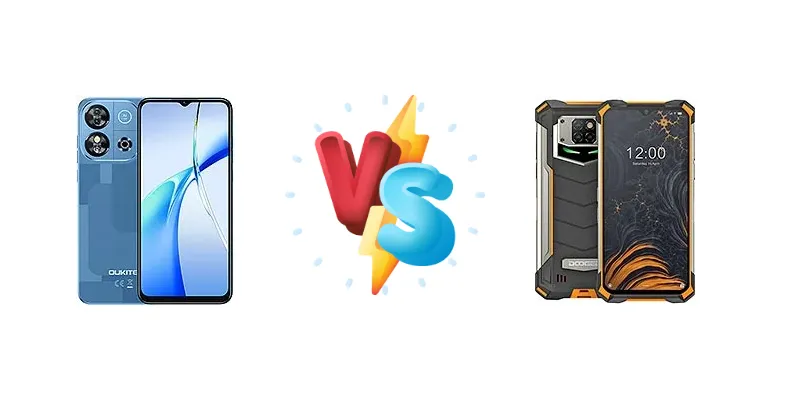
The Oukitel C57s and Doogee S88 Pro represent compelling options in the ultra-budget smartphone space. While both aim to deliver functionality without breaking the bank, they take different approaches. The C57s focuses on a newer, albeit less powerful, chipset, while the S88 Pro leverages an older but more capable processor alongside extended battery features. This comparison dissects their strengths and weaknesses to help you choose the right device.
🏆 Quick Verdict
For most users, the Doogee S88 Pro emerges as the better choice. Its Mediatek Helio P70 chipset, built on a 12nm process, provides a significant performance advantage over the Oukitel C57s’ Unisoc SC9863A. The S88 Pro’s 24W wired and wireless charging capabilities, coupled with its impressive 202-hour endurance rating, further solidify its position as the more practical option.
| Network |
|---|
| 2G bands | GSM 850 / 900 / 1800 / 1900 | GSM 850 / 900 / 1800 / 1900 |
| 3G bands | HSDPA 850 / 900 / 1700(AWS) / 1900 / 2100 | HSDPA 850 / 900 / 1700(AWS) / 1900 / 2100 |
| 4G bands | 1, 2, 3, 4, 5, 7, 8, 12, 17, 19, 20, 25, 26, 28, 66 | 1, 3, 7, 8, 20 |
| Speed | HSPA, LTE | HSPA, LTE |
| Technology | GSM / HSPA / LTE | GSM / HSPA / LTE |
| Launch |
|---|
| Announced | 2024, October | 2020, June 06. Released 2020, June 06 |
| Status | Available. Released 2024, October | Discontinued |
| Body |
|---|
| Build | - | Glass front (Gorilla Glass), aluminum back with rubber, aluminum frame |
| Dimensions | 165.8 x 76.6 x 9.4 mm (6.53 x 3.02 x 0.37 in) | 171.6 x 85.5 x 18.7 mm (6.76 x 3.37 x 0.74 in) |
| SIM | Nano-SIM + Nano-SIM | Nano-SIM + Nano-SIM |
| Weight | 215 g (7.58 oz) | 372 g (13.12 oz) |
| Display |
|---|
| Protection | Corning Gorilla Glass 5 | Corning Gorilla Glass |
| Resolution | 576 x 1280 pixels, 20:9 ratio (~215 ppi density) | 1080 x 2340 pixels, 19.5:9 ratio (~409 ppi density) |
| Size | 6.52 inches, 102.6 cm2 (~80.8% screen-to-body ratio) | 6.3 inches, 97.4 cm2 (~66.4% screen-to-body ratio) |
| Type | IPS LCD, 400 nits | IPS LCD |
| Platform |
|---|
| CPU | Octa-core (4x1.6 GHz Cortex-A55 & 4x1.2 GHz Cortex-A55) | Octa-core (4x2.1 GHz Cortex-A73 & 4x2.0 GHz Cortex-A53) |
| Chipset | Unisoc SC9863A (28 nm) | Mediatek MT6771T Helio P70 (12 nm) |
| GPU | IMG8322 | Mali-G72 MP3 |
| OS | Android 14 (Go edition) | Android 10 |
| Memory |
|---|
| Card slot | microSDXC (dedicated slot) | microSDXC (uses shared SIM slot) |
| Internal | 64GB 2GB RAM | 128GB 6GB RAM |
| Main Camera |
|---|
| Features | LED flash, panorama | Dual-LED dual-tone flash, HDR, panorama |
| Single | 13 MP, f/2.2, (wide), 1/3.06", AF | - |
| Triple | - | 21 MP, f/2.2, (wide), 1/2.4", 1.12µm, PDAF
8 MP, f/2.2, 130˚, (ultrawide), 1/4.0", 1.12µm
Auxiliary lens |
| Video | 1080p@30fps | 1080p@30fps |
| Selfie camera |
|---|
| Single | 5 MP, f/2.2, (wide), 1/5.0" | 16 MP, f/2.2, 26mm (wide) |
| Video | 720p@30fps | 1080p@30fps |
| Sound |
|---|
| 35mm jack | Yes | No |
| Loudspeaker | Yes | Yes |
| Comms |
|---|
| Bluetooth | 4.2, A2DP, LE | 4.2, A2DP |
| NFC | No | Yes |
| Positioning | GPS, GALILEO, GLONASS | GPS, GLONASS, BDS, GALILEO |
| Radio | FM radio | FM radio |
| USB | USB Type-C 2.0, OTG | USB Type-C 2.0, OTG |
| WLAN | Wi-Fi 802.11 b/g/n | Wi-Fi 802.11 b/g/n |
| Features |
|---|
| Sensors | Accelerometer | Fingerprint (side-mounted), accelerometer, gyro, proximity, compass |
| Battery |
|---|
| Charging | - | 24W wired
10W wireless
5W Reverse wireless |
| Type | Li-Ion 4300 mAh | 10000 mAh |
| Misc |
|---|
| Colors | Grey, Blue, Purple, Gold | Fire Orange, Army Green, Mineral Black |
| Price | About 110 EUR | About 130 EUR |
Oukitel C57s
- Potentially lower price point
- Newer chipset architecture (may offer better long-term support)
- Compact form factor (assumed, based on market segment)
- Significantly weaker performance
- Likely lower-quality display
- Limited battery and charging capabilities
Doogee S88 Pro
- Superior performance with Helio P70
- Exceptional battery life (202h endurance)
- Versatile charging options (24W wired, 10W wireless, 5W reverse)
- Older chipset
- Larger size (potentially)
- May receive fewer software updates
Display Comparison
The context data for the Oukitel C57s lacks display specifics, making a direct comparison challenging. However, given its price point, it likely features a lower-resolution panel with standard brightness. The Doogee S88 Pro boasts a contrast ratio of 1641:1, indicating decent color reproduction and black levels. While not an AMOLED, this ratio suggests a more visually pleasing experience than what’s typically found in this price bracket. The absence of refresh rate data for both phones suggests standard 60Hz panels, limiting smoothness during scrolling and animations.
Camera Comparison
Both phones likely feature basic camera setups geared towards casual photography. Without detailed sensor information for the Oukitel C57s, it’s difficult to assess its image quality. The Doogee S88 Pro’s camera specs are also limited, but the focus should be on the main sensor’s capabilities. The prevalence of 2MP macro and depth sensors in this segment suggests they offer minimal practical benefit. Image processing will likely be the differentiating factor, with the Helio P70’s ISP potentially providing slightly better noise reduction and dynamic range compared to the Unisoc chipset.
Performance
This is where the Doogee S88 Pro truly shines. Its Mediatek Helio P70, fabricated on a 12nm process, features four Cortex-A73 cores clocked at 2.1 GHz and four Cortex-A53 cores at 2.0 GHz. This configuration significantly outperforms the Oukitel C57s’ Unisoc SC9863A, which utilizes four Cortex-A55 cores at 1.6 GHz and another four at 1.2 GHz. The A73 cores in the Helio P70 offer substantially higher single-core performance, crucial for responsive app launches and smoother multitasking. The 12nm process also contributes to better thermal efficiency, reducing the likelihood of throttling under sustained load. The Unisoc SC9863A, built on a 28nm node, will likely struggle with demanding tasks and may exhibit more noticeable performance dips during prolonged use.
Battery Life
The Doogee S88 Pro dominates in battery performance. Its impressive 202-hour endurance rating indicates exceptional longevity, far exceeding what’s typically expected from a budget smartphone. The inclusion of 24W wired charging, 10W wireless charging, and even 5W reverse wireless charging adds significant convenience. The Oukitel C57s’ battery capacity and charging speed are unknown, but given its lower price point, it’s unlikely to match the S88 Pro’s capabilities. The S88 Pro’s charging options provide flexibility, allowing users to top up via cable, wireless pad, or even use the phone as a power bank for other devices.
Buying Guide
Buy the Oukitel C57s if you prioritize a very low price point and are primarily focused on basic tasks like calling, texting, and light social media use. Its newer chipset architecture *might* offer slightly better long-term software support. Buy the Doogee S88 Pro if you need a phone capable of handling more demanding applications, enjoy longer battery life, and appreciate the convenience of wireless charging. It’s the better all-rounder for users who want more than just the bare minimum.
Frequently Asked Questions
❓ Does the Helio P70 in the Doogee S88 Pro overheat during prolonged gaming sessions?
While the Helio P70 isn't a flagship processor, its 12nm fabrication process and the Doogee S88 Pro's likely thermal design should prevent significant overheating during moderate gaming. Expect some warmth, but not to the point of severe throttling. Performance will likely dip after extended periods, but it's still a more capable gaming option than the Oukitel C57s.
❓ How long does it realistically take to fully charge the Doogee S88 Pro with the 24W charger?
While a full 0-100% charge time isn't specified, the 24W charging should deliver a full charge in approximately 1 hour 45 minutes to 2 hours, depending on usage during charging. The 10W wireless charging will be considerably slower, taking around 4-5 hours for a full charge.
❓ Is the Unisoc SC9863A in the Oukitel C57s sufficient for running popular social media apps like TikTok and Instagram?
The Unisoc SC9863A can handle basic social media apps like TikTok and Instagram, but expect some lag and stuttering, especially when multitasking or using the apps for extended periods. It's suitable for light use, but users who frequently create and edit content may find the performance limiting.