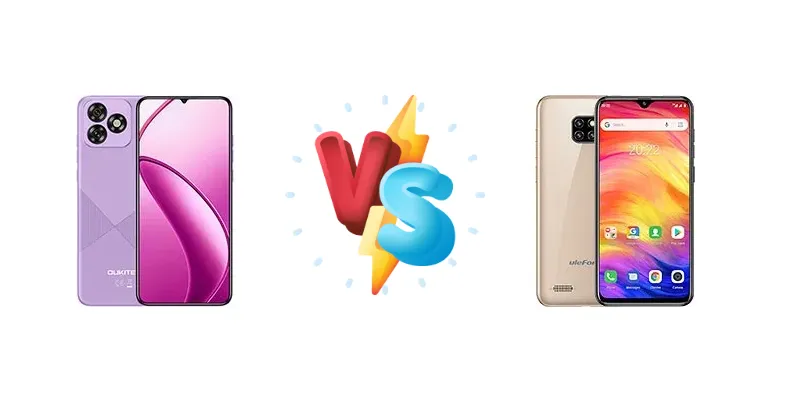
The Oukitel C53 and Ulefone S11 represent the extreme end of the smartphone price spectrum. Both aim to deliver basic functionality at an incredibly low cost, but they take different approaches to achieving this. The C53 prioritizes battery endurance with a newer, albeit low-power, octa-core processor, while the S11 relies on a more established, though older, quad-core chipset. This comparison will dissect the key differences to determine which phone offers the best value.
🏆 Quick Verdict
For the average user prioritizing longevity and multitasking, the Oukitel C53 is the better choice. Its Unisoc SC9863A chipset, despite lower clock speeds, benefits from eight cores compared to the Ulefone S11’s quad-core Mediatek MT6580, resulting in a smoother experience with multiple apps open and a significantly longer battery life of 39:35h.
| Network |
|---|
| 2G bands | GSM 850 / 900 / 1800 / 1900 | GSM 850 / 900 / 1800 / 1900 |
| 3G bands | HSDPA 900 / 2100 | HSDPA 850 / 900 / 1900 / 2100 |
| 4G bands | 1, 3, 5, 7, 8, 19, 20, 38, 40, 41 | - |
| Speed | HSPA, LTE | HSPA 21.1/5.76 Mbps |
| Technology | GSM / HSPA / LTE | GSM / HSPA |
| Launch |
|---|
| Announced | 2024, June | 2019, April. Released 2019, April |
| Status | Available. Released 2024, June | Discontinued |
| Body |
|---|
| Dimensions | 165.7 x 76.8 x 8.9 mm (6.52 x 3.02 x 0.35 in) | 156.1 x 73.7 x 9.7 mm (6.15 x 2.90 x 0.38 in) |
| SIM | Nano-SIM | Nano-SIM + Micro-SIM |
| Weight | 215 g (7.58 oz) | 177.5 g (6.28 oz) |
| Display |
|---|
| Protection | Corning Gorilla Glass 5, Mohs level 4 | - |
| Resolution | 720 x 1612 pixels, 20:9 ratio (~267 ppi density) | 600 x 1280 pixels (~232 ppi density) |
| Size | 6.6 inches, 104.6 cm2 (~82.2% screen-to-body ratio) | 6.1 inches, 92.3 cm2 (~80.2% screen-to-body ratio) |
| Type | IPS LCD, 400 nits | IPS LCD |
| Platform |
|---|
| CPU | Octa-core (4x1.6 GHz Cortex-A55 & 4x1.2 GHz Cortex-A55) | Quad-core 1.3 GHz Cortex-A7 |
| Chipset | Unisoc SC9863A (28 nm) | Mediatek MT6580 (28 nm) |
| GPU | IMG8322 | Mali-400 |
| OS | Android 14 | Android 8.1 Oreo (Go edition) |
| Memory |
|---|
| Card slot | microSDXC (dedicated slot) | microSDXC (uses shared SIM slot) |
| Internal | 64GB 4GB RAM | 32GB 3GB RAM |
| | - | eMMC 5.1 |
| Main Camera |
|---|
| Features | LED flash, panorama | LED flash, HDR |
| Single | 13 MP, f/2.2, (wide), 1/3.06", AF | - |
| Triple | - | 8 MP, f/1.8, (wide), AF
2 MP
2 MP |
| Video | 1080p@30fps | 720p@30fps |
| Selfie camera |
|---|
| Single | 5 MP, f/2.2, (wide), 1/5.0" | 5 MP |
| Video | 720p@30fps | 720p@30fps |
| Sound |
|---|
| 3.5mm jack | - | Yes |
| 35mm jack | Yes | Yes |
| Loudspeaker | Yes | Yes |
| Comms |
|---|
| Bluetooth | 4.2, A2DP, LE | 4.0, A2DP |
| NFC | No | No |
| Positioning | GPS, GALILEO, GLONASS | GPS |
| Radio | FM radio | Stereo FM radio, RDS, recording |
| USB | USB Type-C 2.0, OTG | microUSB 2.0 |
| WLAN | Wi-Fi 802.11 a/b/g/n | Wi-Fi 802.11 b/g/n |
| Features |
|---|
| Sensors | Accelerometer | Accelerometer, proximity |
| Battery |
|---|
| Type | Li-Po 4000 mAh | Li-Po 3500 mAh |
| Misc |
|---|
| Colors | Grey, Blue, Purple, Green | Black, Gold, Twilight |
| EU LABEL |
|---|
| Battery | 39:35h endurance, 1000 cycles | - |
| Energy | Class B | - |
| Free fall | Class B (180 falls) | - |
| Repairability | Class C | - |
Oukitel C53
- Significantly longer battery life (39:35h endurance)
- Octa-core processor for better multitasking
- Potentially longer battery lifespan (1000 charge cycles)
- Lower individual core clock speeds
- Likely limited camera performance (no specs provided)
Ulefone S11
- Potentially lower price point
- Established Mediatek chipset
- Simpler software experience (potentially)
- Quad-core processor limits multitasking
- Inferior battery life compared to Oukitel C53
- Older Cortex-A7 architecture is less efficient
Display Comparison
Neither device’s display specifications are provided, so a direct comparison is impossible. However, given their price points, both likely utilize low-resolution LCD panels. The focus here will be on the chipset’s ability to drive the display efficiently. The C53’s octa-core processor *may* offer slightly smoother scrolling and animations, even with a similar panel, due to its increased processing power.
Camera Comparison
No camera specifications are provided for either device. Given the target market, it’s safe to assume both phones feature basic camera sensors. Without details on sensor size, aperture, or image processing, a meaningful comparison is impossible. Users should expect limited low-light performance and average image quality from both devices.
Performance
The core difference lies in the CPU architecture. The Oukitel C53’s Unisoc SC9863A features an octa-core configuration with four Cortex-A55 cores clocked at 1.6 GHz and another four at 1.2 GHz. This contrasts sharply with the Ulefone S11’s Mediatek MT6580, which utilizes a quad-core Cortex-A7 setup at 1.3 GHz. While the A7 cores are individually faster, the C53’s eight A55 cores provide superior multitasking capabilities. The A55 architecture is also more power-efficient, contributing to the C53’s impressive battery life. The 28nm fabrication process is shared between both chipsets, meaning thermal efficiency differences will be minimal, but the C53’s core count will be more noticeable in real-world usage.
Battery Life
The Oukitel C53 boasts an exceptional 39:35 hours of endurance, a significant advantage over what the Ulefone S11 likely offers. This is directly attributable to the more efficient Unisoc SC9863A chipset and its eight power-saving Cortex-A55 cores. The C53 also claims 1000 charge cycles, suggesting a focus on long-term battery health. While charging wattage isn’t specified for either device, the C53’s endurance rating indicates it can extract significantly more usage from a single charge, reducing the need for frequent top-ups.
Buying Guide
Buy the Oukitel C53 if you need a phone that can reliably last through a full day – and then some – of moderate use, and if you occasionally switch between several apps. It’s ideal for users who prioritize battery life and basic multitasking over demanding applications. Buy the Ulefone S11 if you primarily need a phone for calls, texts, and very light browsing, and are willing to sacrifice performance and battery life for a potentially lower price point (depending on current sales).
Frequently Asked Questions
❓ Will the Oukitel C53 struggle with popular social media apps like Facebook and WhatsApp?
While not a powerhouse, the Oukitel C53’s octa-core processor should handle Facebook and WhatsApp without significant issues. However, expect some loading times and occasional lag when switching between apps. The Ulefone S11 may exhibit more noticeable slowdowns with these apps due to its quad-core processor.
❓ Is the Unisoc SC9863A chipset known for overheating under load?
The Unisoc SC9863A is a low-power chipset designed for basic smartphone tasks. Overheating is unlikely, even under sustained use. Its 28nm process and relatively low clock speeds contribute to its thermal efficiency. The Ulefone S11’s Mediatek MT6580 is also unlikely to overheat, but its older architecture may become a bottleneck before thermal throttling occurs.
❓ How does the 1000 charge cycle claim on the Oukitel C53 translate to real-world battery health?
The 1000 charge cycle claim suggests the battery is designed to retain a significant portion of its capacity after being fully charged and discharged 1000 times. This indicates a focus on long-term battery health, meaning the C53’s battery should degrade slower than a typical budget smartphone.