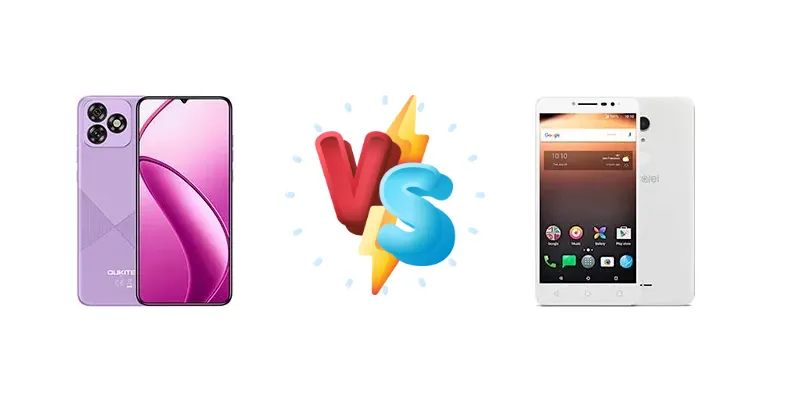
The Oukitel C53 and alcatel A3 XL represent the extreme end of the budget smartphone spectrum. Both aim to deliver essential functionality at a minimal cost, but they take drastically different approaches to achieving this. The C53 prioritizes longevity with a massive battery and newer, though still modest, processor architecture, while the A3 XL relies on a more established, albeit older, chipset. This comparison will dissect their strengths and weaknesses to determine which offers the best value.
🏆 Quick Verdict
For the average user prioritizing long-term usability and battery life, the Oukitel C53 emerges as the clear winner. Its significantly superior battery endurance (39:35h) and more modern Cortex-A55 architecture, despite lower clock speeds, provide a smoother and more reliable experience than the aging Mediatek MT8735B in the alcatel A3 XL.
| Network |
|---|
| 2G bands | GSM 850 / 900 / 1800 / 1900 | GSM 850 / 900 / 1800 / 1900 - SIM 1 & SIM 2 |
| 3G bands | HSDPA 900 / 2100 | HSDPA 850 / 900 / 1900 / 2100 |
| 4G bands | 1, 3, 5, 7, 8, 19, 20, 38, 40, 41 | 1, 3, 7, 8, 20, 28 |
| Speed | HSPA, LTE | HSPA 42.2/5.76 Mbps, LTE Cat4 150/50 Mbps |
| Technology | GSM / HSPA / LTE | GSM / HSPA / LTE |
| Launch |
|---|
| Announced | 2024, June | 2017, January. Released 2017, July |
| Status | Available. Released 2024, June | Discontinued |
| Body |
|---|
| Dimensions | 165.7 x 76.8 x 8.9 mm (6.52 x 3.02 x 0.35 in) | 165 x 82.5 x 7.9 mm (6.50 x 3.25 x 0.31 in) |
| SIM | Nano-SIM | Single SIM (Micro-SIM) or Dual SIM (Micro-SIM, dual stand-by) |
| Weight | 215 g (7.58 oz) | - |
| Display |
|---|
| Protection | Corning Gorilla Glass 5, Mohs level 4 | - |
| Resolution | 720 x 1612 pixels, 20:9 ratio (~267 ppi density) | 720 x 1280 pixels, 16:9 ratio (~245 ppi density) |
| Size | 6.6 inches, 104.6 cm2 (~82.2% screen-to-body ratio) | 6.0 inches, 99.2 cm2 (~72.9% screen-to-body ratio) |
| Type | IPS LCD, 400 nits | IPS FL LCD |
| Platform |
|---|
| CPU | Octa-core (4x1.6 GHz Cortex-A55 & 4x1.2 GHz Cortex-A55) | Quad-core 1.1 GHz Cortex-A7 |
| Chipset | Unisoc SC9863A (28 nm) | Mediatek MT8735B |
| GPU | IMG8322 | Mali-T720MP2 |
| OS | Android 14 | Android 7.0 (Nougat) |
| Memory |
|---|
| Card slot | microSDXC (dedicated slot) | microSDHC (dedicated slot) |
| Internal | 64GB 4GB RAM | 8GB 2GB RAM, 16GB 2GB RAM |
| Main Camera |
|---|
| Features | LED flash, panorama | LED flash, HDR, panorama |
| Single | 13 MP, f/2.2, (wide), 1/3.06", AF | 8 MP or 13 MP, AF |
| Video | 1080p@30fps | 1080p@30fps |
| Selfie camera |
|---|
| Single | 5 MP, f/2.2, (wide), 1/5.0" | 5 MP or 8 MP |
| Video | 720p@30fps | - |
| Sound |
|---|
| 3.5mm jack | - | Yes |
| 35mm jack | Yes | Yes |
| Loudspeaker | Yes | Yes |
| Comms |
|---|
| Bluetooth | 4.2, A2DP, LE | 4.2, A2DP, LE |
| NFC | No | No |
| Positioning | GPS, GALILEO, GLONASS | GPS |
| Radio | FM radio | FM radio |
| USB | USB Type-C 2.0, OTG | microUSB 2.0, OTG |
| WLAN | Wi-Fi 802.11 a/b/g/n | Wi-Fi 802.11 b/g/n, Wi-Fi Direct |
| Features |
|---|
| Sensors | Accelerometer | Fingerprint (rear-mounted), accelerometer, proximity |
| Battery |
|---|
| Type | Li-Po 4000 mAh | Li-Ion 3000 mAh, non-removable |
| Misc |
|---|
| Colors | Grey, Blue, Purple, Green | Sideral Gray/Silver, White/Silver, White/Blue, White/Fuchsia, White/Yellow, Gold |
| Models | - | 9008X, 9008A, 9008J, 9008T |
| Price | - | About 180 EUR |
| EU LABEL |
|---|
| Battery | 39:35h endurance, 1000 cycles | - |
| Energy | Class B | - |
| Free fall | Class B (180 falls) | - |
| Repairability | Class C | - |
Oukitel C53
- Exceptional battery life (39:35h endurance)
- More modern and efficient Cortex-A55 architecture
- Octa-core CPU for improved multitasking
- Unisoc chipset is less well-known than Mediatek
- Likely basic camera performance
alcatel A3 XL
- Potentially larger screen size ('XL' designation)
- Lower upfront cost
- Established Mediatek chipset
- Outdated Cortex-A7 CPU architecture
- Significantly lower battery life (estimated)
- Quad-core CPU limits multitasking
Display Comparison
Neither device boasts a standout display. Given the context data focuses on internal components, we can infer both likely utilize basic IPS LCD panels common in this price bracket. The A3 XL's 'XL' designation suggests a larger screen size, potentially beneficial for media consumption, but without specific resolution or brightness data, it's difficult to assess the visual experience. The Oukitel C53's focus on battery life suggests a potentially more conservative display power draw, which could translate to slightly better overall endurance.
Camera Comparison
Without detailed camera specifications, a direct comparison is challenging. However, it’s safe to assume both phones feature basic camera setups geared towards casual photography. Given the price point, image quality will likely be heavily reliant on software processing rather than advanced hardware. The presence of a 2MP macro camera on either device is largely a marketing gimmick, offering minimal practical benefit. The Oukitel C53’s potential for slightly better image processing due to the more capable chipset could give it a marginal edge.
Performance
The core difference lies in the CPU and chipset. The Oukitel C53’s Unisoc SC9863A, built on a 28nm process, features an octa-core configuration (4x1.6 GHz Cortex-A55 & 4x1.2 GHz Cortex-A55). This contrasts sharply with the alcatel A3 XL’s Mediatek MT8735B, a quad-core 1.1 GHz Cortex-A7 processor. While the A7 cores are clocked slightly higher, the Cortex-A55 architecture in the C53 is significantly more efficient and offers improved performance per clock cycle. The octa-core setup also provides better multitasking capabilities. The 28nm node of the Unisoc chip, while not cutting-edge, is comparable to the MT8735B and doesn't introduce a significant thermal disadvantage.
Battery Life
This is where the Oukitel C53 truly shines. Its reported 39:35h endurance is exceptional for a budget smartphone, indicating a substantial battery capacity and efficient power management. The Unisoc SC9863A’s Cortex-A55 cores contribute to this efficiency. The alcatel A3 XL, lacking specific battery endurance data, is expected to offer significantly less runtime. While charging wattage isn’t specified for either device, the C53’s longer endurance mitigates the need for extremely fast charging.
Buying Guide
Buy the Oukitel C53 if you need a phone that can reliably last through a full day – and then some – of moderate use, and if you value a more modern processor architecture for improved efficiency. Buy the alcatel A3 XL if you absolutely require the lowest possible upfront cost and are willing to compromise significantly on performance and battery life. It's a viable option for a secondary device or for users with extremely limited needs.
Frequently Asked Questions
❓ Will the Unisoc SC9863A in the Oukitel C53 struggle with demanding apps like Facebook or YouTube?
While not a powerhouse, the Unisoc SC9863A with its Cortex-A55 cores is sufficient for basic app usage like Facebook and YouTube. Expect some loading times and occasional stuttering, but it should be functional for everyday tasks. The octa-core configuration helps manage these apps better than the quad-core Mediatek chip in the A3 XL.
❓ How many years of software updates can I realistically expect from either the Oukitel C53 or the alcatel A3 XL?
Realistically, expect minimal software updates for both devices. Budget smartphones typically receive limited support. It's unlikely either phone will receive major Android version updates. Security patches may be infrequent. The Oukitel C53, being a slightly newer device, *might* receive a marginally longer support window, but don't rely on it.
❓ Is the battery in the Oukitel C53 rated for a specific number of charge cycles, and what does that mean for its long-term health?
The Oukitel C53 is rated for 1000 charge cycles. This means the battery is guaranteed to retain a significant portion of its original capacity after being fully charged and discharged 1000 times. After this point, the battery's capacity will gradually decline, resulting in shorter runtime. However, 1000 cycles represent several years of typical use.