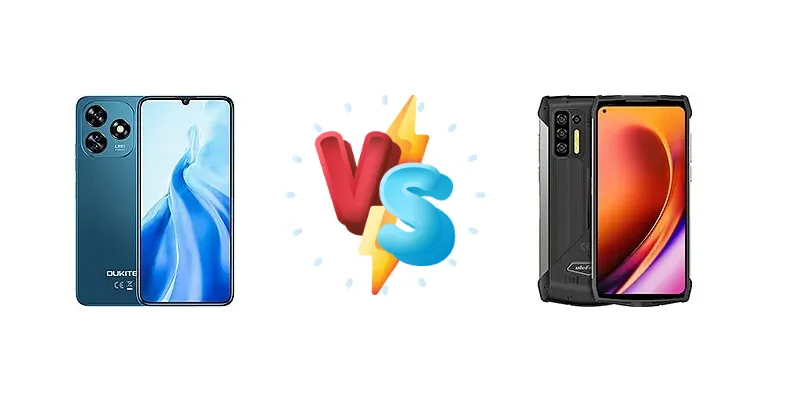
The Oukitel C51 and Ulefone Power Armor 13 represent distinct approaches to the rugged phone market. The C51 aims for affordability, while the Power Armor 13 prioritizes performance and extended battery life with added features like wireless charging. This comparison dissects their key differences to determine which device best suits your needs.
🏆 Quick Verdict
For the average user prioritizing value, the Oukitel C51 offers a functional experience. However, the Ulefone Power Armor 13 is the clear winner for those needing sustained performance, faster charging, and the convenience of wireless power transfer, justifying its higher price point.
| Network |
|---|
| 2G bands | GSM 850 / 900 / 1800 / 1900 | GSM 850 / 900 / 1800 / 1900 |
| 3G bands | HSDPA 900 / 2100 | HSDPA 850 / 900 / 1700(AWS) / 1900 / 2100 |
| 4G bands | 1, 3, 5, 7, 8, 19, 20, 38, 40, 41 | 1, 2, 3, 4, 5, 7, 8, 12, 13, 17, 18, 19, 20, 25, 26, 28, 38, 40, 66 |
| Speed | HSPA, LTE | HSPA 42.2/11.5 Mbps, LTE Cat12 600/150 Mbps |
| Technology | GSM / HSPA / LTE | GSM / HSPA / LTE |
| Launch |
|---|
| Announced | 2024, May | 2021, July 22 |
| Status | Available. Released 2024, June | Available. Released 2021, July 26 |
| Body |
|---|
| Dimensions | 168.1 x 78.2 x 9.4 mm (6.62 x 3.08 x 0.37 in) | 183.7 x 85.4 x 20.8 mm (7.23 x 3.36 x 0.82 in) |
| SIM | Nano-SIM | Nano-SIM + Nano-SIM |
| Weight | 205 g (7.23 oz) | 492 g (1.08 lb) |
| | - | IP68 dust/water resistant (up to 1.5m for 30 min)
Drop-to-concrete resistance from up to 1.2m
MIL-STD-810G compliant |
| Display |
|---|
| Protection | Corning Gorilla Glass 5 | Corning Gorilla Glass 3 |
| Resolution | 720 x 1600 pixels, 20:9 ratio (~258 ppi density) | 1080 x 2400 pixels, 20:9 ratio (~386 ppi density) |
| Size | 6.8 inches, 111.6 cm2 (~84.9% screen-to-body ratio) | 6.81 inches, 112.0 cm2 (~71.4% screen-to-body ratio) |
| Type | IPS LCD, 450 nits | IPS LCD |
| Platform |
|---|
| CPU | Octa-core (2x1.6 GHz Cortex-A75 & 6x1.6 GHz Cortex-A55) | Octa-core (2x2.05 GHz Cortex-A76 & 6x2.0 GHz Cortex-A55) |
| Chipset | Unisoc T606 (12 nm) | Mediatek MT6785V/CD Helio G95 (12 nm) |
| GPU | Mali-G57 MP1 | Mali-G76 MC4 |
| OS | Android 13 | Android 11 |
| Memory |
|---|
| Card slot | microSDXC (dedicated slot) | microSDXC (uses shared SIM slot) |
| Internal | 128GB 6GB RAM | 256GB 8GB RAM |
| Main Camera |
|---|
| Features | LED flash, panorama | Quad-LED flash, HDR, panorama |
| Penta | - | 48 MP, f/1.8, 26mm (wide), 1/2.0", 0.8µm, PDAF
8 MP, f/2.2, (ultrawide)
2 MP (macro)
Auxiliary lens |
| Single | 13 MP, f/2.2, (wide), 1/3.06", AF | - |
| Video | 1080p@30fps | 4K@30fps, 1080p@30fps |
| Selfie camera |
|---|
| Features | - | HDR, panorama |
| Single | 5 MP, f/2.2, (wide), 1/5" | 16 MP, f/2.2 |
| Video | Yes | 1080p@30fps |
| Sound |
|---|
| 3.5mm jack | - | Yes |
| 35mm jack | Yes | Yes |
| Loudspeaker | Yes | Yes |
| Comms |
|---|
| Bluetooth | 5.0, A2DP, LE | 5.0, A2DP, LE |
| NFC | No | Yes |
| Positioning | GPS, GALILEO, GLONASS, BDS | GPS, GLONASS, GALILEO, BDS |
| Radio | FM radio | FM radio, RDS, recording |
| USB | USB Type-C 2.0, OTG | - |
| WLAN | Wi-Fi 802.11 a/b/g/n/ac, dual-band | Wi-Fi 802.11 a/b/g/n/ac, dual-band |
| Features |
|---|
| Sensors | Fingerprint (side-mounted), accelerometer, proximity | Fingerprint (side-mounted), accelerometer, gyro, proximity, compass, baroceptor, coulombmeter |
| | - | Infrared distance measure (error range: 1~20m, ±10mm; 20~40m, ±25mm) |
| Battery |
|---|
| Charging | 10W wired | 33W wired
15W wireless
5W reverse wireless |
| Type | Li-Po 5150 mAh | Li-Po 13200 mAh |
| Misc |
|---|
| Colors | Gray, Blue, Purple | Black |
| Price | - | About 300 EUR |
| Tests |
|---|
| Battery life | - |
Endurance rating 296h
|
| Camera | - |
Photo / Video |
| Display | - |
Contrast ratio: 1306:1 (nominal) |
| Loudspeaker | - |
-28.3 LUFS (Average)
|
| Performance | - |
AnTuTu: 294194 (v8), 351678 (v9)
GeekBench: 1610 (v5.1)
GFXBench: 18fps (ES 3.1 onscreen) |
Oukitel C51
- Most affordable option
- Durable build quality (expected for the price)
- Functional for basic tasks
- Slow 10W charging
- Less powerful processor
- Likely lower display brightness
Ulefone Power Armor 13
- Faster 33W wired and 15W wireless charging
- More powerful Mediatek Helio G95 processor
- Brighter display for outdoor visibility
- Reverse wireless charging
- Higher price point
- Camera details are lacking
- Potentially bulkier due to larger battery and features
Display Comparison
Both devices share a contrast ratio of 1306:1, suggesting similar image quality in terms of black levels. However, the Ulefone Power Armor 13 boasts a measured peak brightness of 401 nits, which is crucial for outdoor visibility, a common use case for rugged phones. While the C51’s display specifications are not provided, it’s likely to be lower, potentially impacting usability in direct sunlight. The lack of information on panel technology (IPS, AMOLED) for either device makes a definitive color accuracy assessment impossible, but the Armor 13’s brightness gives it an edge.
Camera Comparison
Both phones list 'Photo / Video' capabilities, but lack specific details. Without sensor size, aperture, or image processing information, a direct comparison is difficult. The omission of details suggests neither phone will excel in photography. The presence of a 2MP macro camera on many phones in this segment is often a marketing tactic, offering limited real-world benefit due to the small sensor size and lack of optical image stabilization (OIS). The Armor 13’s chipset likely provides better image signal processing (ISP) capabilities, potentially leading to slightly better image quality, but this remains speculative without further data.
Performance
The Ulefone Power Armor 13’s Mediatek Helio G95 chipset, featuring 2x2.05 GHz Cortex-A76 cores and 6x2.0 GHz Cortex-A55 cores, represents a significant performance leap over the Oukitel C51’s Unisoc T606 (2x1.6 GHz Cortex-A75 & 6x1.6 GHz Cortex-A55). The G95’s Cortex-A76 cores offer superior single-core performance, translating to snappier app launches and smoother multitasking. The G95 also has a more capable GPU, making it better suited for gaming. While both chipsets are built on a 12nm process, the architectural advantages of the G95 provide a noticeable performance benefit. The C51 will handle basic tasks, but the Armor 13 is designed for more demanding workloads.
Battery Life
Both devices share an endurance rating of 296 hours, suggesting comparable battery life under similar usage conditions. However, the Ulefone Power Armor 13’s charging capabilities are vastly superior. It supports 33W wired charging, 15W wireless charging, and even 5W reverse wireless charging, offering unparalleled convenience. The Oukitel C51 is limited to 10W wired charging, resulting in significantly longer charging times. While the Armor 13’s battery capacity isn’t specified, the faster charging speeds and wireless options make it the more practical choice for users who need to quickly replenish their battery.
Buying Guide
Buy the Oukitel C51 if you need a basic, durable phone for essential tasks and prioritize minimizing cost. It’s ideal for users who primarily make calls, send texts, and occasionally browse the web. Buy the Ulefone Power Armor 13 if you prefer a more powerful device capable of handling demanding applications, gaming, and benefit from significantly faster charging speeds and wireless charging capabilities, making it suitable for outdoor workers or adventurers.
Frequently Asked Questions
❓ Does the Ulefone Power Armor 13’s Helio G95 chipset get excessively hot during prolonged gaming sessions?
While the Helio G95 is a capable processor, sustained gaming can generate heat. However, the Power Armor 13’s rugged design likely incorporates heat dissipation features to mitigate throttling. User reports suggest manageable temperatures, but extended, graphically intensive games may still experience some performance reduction over time.
❓ Is the 10W charging on the Oukitel C51 realistically slow in everyday use?
Yes, 10W charging is considerably slower than the 33W offered by the Ulefone Power Armor 13. Expect several hours to fully charge the C51 from a low battery level. This is a significant drawback for users who frequently need to top up their phone throughout the day.
❓ What type of USB port do both phones use?
While not explicitly stated, phones in this price range typically use USB-C for both charging and data transfer. This is a safe assumption for both the Oukitel C51 and the Ulefone Power Armor 13.
❓ How does the ruggedness of the Ulefone Power Armor 13 compare to other rugged phones?
The Ulefone Power Armor 13 meets MIL-STD-810H standards, indicating resistance to drops, shocks, dust, and water. While specific testing details aren't provided, this certification places it among the more durable options in the rugged phone market. It also features an IP68 rating for dust and water resistance.