
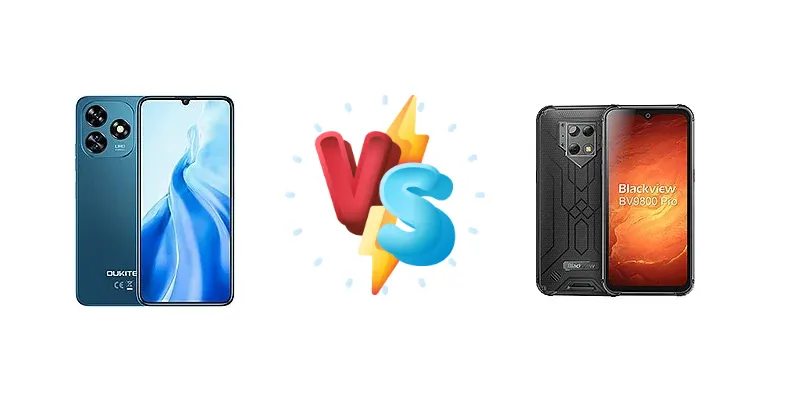
Oukitel C51 vs Blackview BV9800 Pro: A Detailed Comparison for Budget Buyers
| Phones Images | |||||
|---|---|---|---|---|---|
|
🏆 Quick Verdict
For the average user prioritizing everyday tasks and affordability, the Blackview BV9800 Pro emerges as the better choice. Its Helio P70 chipset offers a noticeable performance advantage over the Unisoc T606 in the Oukitel C51, translating to smoother multitasking and a more responsive user experience, despite the C51's lower price.
| PHONES | ||
|---|---|---|
| Phone Names | Oukitel C51 | Blackview BV9800 Pro |
| Network | ||
|---|---|---|
| 2G bands | GSM 850 / 900 / 1800 / 1900 | GSM 850 / 900 / 1800 / 1900 |
| 3G bands | HSDPA 900 / 2100 | HSDPA 800 / 850 / 900 / 1700(AWS) / 1900 / 2100 |
| 4G bands | 1, 3, 5, 7, 8, 19, 20, 38, 40, 41 | 1, 2, 3, 4, 5, 6, 7, 8, 12, 13, 17, 18, 19, 20, 25, 26, 28, 34, 38, 39, 40, 41, 66 |
| Speed | HSPA, LTE | HSPA, LTE |
| Technology | GSM / HSPA / LTE | GSM / CDMA / HSPA / CDMA2000 / LTE |
| Launch | ||
|---|---|---|
| Announced | 2024, May | 2019, October 28. Released 2019, November |
| Status | Available. Released 2024, June | Discontinued |
| Body | ||
|---|---|---|
| Dimensions | 168.1 x 78.2 x 9.4 mm (6.62 x 3.08 x 0.37 in) | 168.5 x 81 x 14.8 mm (6.63 x 3.19 x 0.58 in) |
| SIM | Nano-SIM | Nano-SIM + Nano-SIM |
| Weight | 205 g (7.23 oz) | 322 g (11.36 oz) |
| Display | ||
|---|---|---|
| Protection | Corning Gorilla Glass 5 | - |
| Resolution | 720 x 1600 pixels, 20:9 ratio (~258 ppi density) | 1080 x 2340 pixels, 19.5:9 ratio (~409 ppi density) |
| Size | 6.8 inches, 111.6 cm2 (~84.9% screen-to-body ratio) | 6.3 inches, 97.4 cm2 (~71.4% screen-to-body ratio) |
| Type | IPS LCD, 450 nits | IPS LCD |
| Platform | ||
|---|---|---|
| CPU | Octa-core (2x1.6 GHz Cortex-A75 & 6x1.6 GHz Cortex-A55) | Octa-core (4x2.1 GHz Cortex-A73 & 4x2.0 GHz Cortex-A53) |
| Chipset | Unisoc T606 (12 nm) | Mediatek MT6771V/CT Helio P70 (12 nm) |
| GPU | Mali-G57 MP1 | Mali-G72 MP3 |
| OS | Android 13 | Android 9.0 (Pie) |
| Memory | ||
|---|---|---|
| Card slot | microSDXC (dedicated slot) | microSDXC |
| Internal | 128GB 6GB RAM | 128GB 6GB RAM |
| Main Camera | ||
|---|---|---|
| Features | LED flash, panorama | Thermal imaging, LED flash |
| Single | 13 MP, f/2.2, (wide), 1/3.06", AF | - |
| Triple | - | 48 MP, (wide), PDAF 5 MP, thermal assisted camera FLIR thermal camera (Lepton module) |
| Video | 1080p@30fps | 1080p@30fps |
| Selfie camera | ||
|---|---|---|
| Single | 5 MP, f/2.2, (wide), 1/5" | 16 MP, f/2.0, (wide) |
| Video | Yes | 1080p@30fps |
| Sound | ||
|---|---|---|
| 35mm jack | Yes | Yes |
| Loudspeaker | Yes | Yes |
| Comms | ||
|---|---|---|
| Bluetooth | 5.0, A2DP, LE | 4.1, A2DP |
| NFC | No | Yes |
| Positioning | GPS, GALILEO, GLONASS, BDS | GPS, GLONASS, GALILEO |
| Radio | FM radio | FM radio |
| USB | USB Type-C 2.0, OTG | USB Type-C 2.0, OTG |
| WLAN | Wi-Fi 802.11 a/b/g/n/ac, dual-band | Wi-Fi 802.11 a/b/g/n/ac |
| Features | ||
|---|---|---|
| Sensors | Fingerprint (side-mounted), accelerometer, proximity | Fingerprint (side-mounted), accelerometer, gyro, proximity, compass, barometer |
| Battery | ||
|---|---|---|
| Charging | 10W wired | 18W wired |
| Type | Li-Po 5150 mAh | 6580 mAh |
| Misc | ||
|---|---|---|
| Colors | Gray, Blue, Purple | Black, Orange |
| Price | - | About 340 EUR |
Oukitel C51
- Significantly lower price point
- Modern Android experience
- Adequate for basic tasks
- Unisoc T606 chipset is underpowered
- Slow 10W charging
- Likely lower build quality
Blackview BV9800 Pro
- More powerful Helio P70 chipset
- Faster 18W charging
- Ruggedized design for enhanced durability
- Higher price compared to Oukitel C51
- Potentially bulkier due to ruggedized build
- Camera performance likely similar to C51
Display Comparison
Neither device boasts a standout display. Both utilize 12nm chipsets, suggesting a focus on cost optimization over display technology. While specific display specs are unavailable, the BV9800 Pro’s positioning suggests a potentially higher quality panel, though likely still IPS LCD. The absence of high refresh rates or advanced features like LTPO on either device indicates a focus on maximizing battery life rather than visual fidelity.
Camera Comparison
Camera performance is likely to be similar, with both devices likely relying on software processing to enhance image quality. Without specific sensor details, it’s difficult to make a definitive judgment. However, the BV9800 Pro’s slightly higher price point *could* indicate a marginally better primary sensor. It’s safe to assume both phones will include a 2MP macro camera, which offers limited practical benefit due to its low resolution and fixed focus. Focusing on real-world image samples is crucial when evaluating these devices.
Performance
The core difference lies in the chipsets. The Blackview BV9800 Pro’s MediaTek Helio P70, with its 4x2.1 GHz Cortex-A73 cores, provides a significant architectural advantage over the Oukitel C51’s Unisoc T606. The Cortex-A73 cores in the P70 are demonstrably more powerful than the Cortex-A75 cores in the T606, resulting in faster app loading times and smoother performance in demanding applications. While both are 12nm chips, the P70’s core configuration and higher clock speeds translate to a more responsive user experience. The T606 is adequate for basic tasks, but will struggle with heavier multitasking or graphically intensive games.
Battery Life
The Blackview BV9800 Pro’s 18W wired charging is a clear advantage over the Oukitel C51’s 10W charging. While battery capacity isn’t specified, the faster charging speed will significantly reduce the time spent tethered to a power outlet. This is particularly important for a rugged phone, as users are more likely to be away from power sources for extended periods. The 18W charging will allow for a quicker top-up, ensuring the BV9800 Pro remains usable throughout the day, even with heavy use.
Buying Guide
Buy the Oukitel C51 if you need a secondary device for basic communication, light social media use, and are on an extremely tight budget. Its primary strength is its price. Buy the Blackview BV9800 Pro if you work in a demanding environment, enjoy outdoor activities, or simply prefer a phone that can survive drops and exposure to the elements. The BV9800 Pro’s ruggedized design and superior processing power justify the price premium for those prioritizing durability and performance.