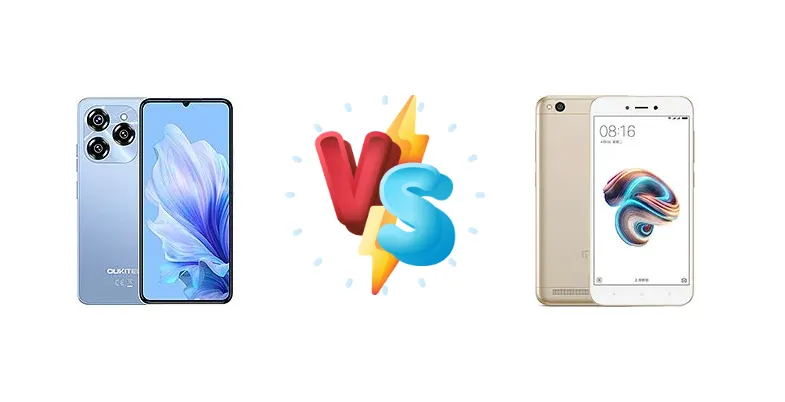
The Xiaomi Redmi 5A was a staple in the budget smartphone market for years, offering a reliable experience at an incredibly low price. However, technology moves quickly. The Oukitel C50 arrives with a significantly more modern chipset, promising a substantial performance boost. This comparison dissects the key differences between these two devices, determining if the C50 justifies an upgrade or if the Redmi 5A still holds value for basic users.
🏆 Quick Verdict
For the vast majority of users, the Oukitel C50 is the clear winner. Its Mediatek Dimensity 6100+ chipset delivers a dramatically faster and more responsive experience than the aging Snapdragon 425 in the Redmi 5A. While charging is slower, the performance gains are too significant to ignore for anyone beyond the most basic smartphone tasks.
| Network |
|---|
| 2G bands | GSM 850 / 900 / 1800 / 1900 | GSM 850 / 900 / 1800 / 1900 - SIM 1 & SIM 2 |
| 3G bands | HSDPA 850 / 900 / 1700(AWS) / 1900 / 2100 | HSDPA 850 / 900 / 1900 / 2100 |
| 4G bands | 1, 3, 5, 7, 8, 19, 20, 28, 38, 39, 40, 41 | 1, 3, 5, 7, 8, 34, 38, 39, 40, 41 |
| 5G bands | 1, 3, 28, 38, 41, 77, 78 SA/NSA | - |
| Speed | HSPA, LTE, 5G | HSPA, LTE |
| Technology | GSM / HSPA / LTE / 5G | GSM / CDMA / HSPA / LTE |
| | - | CDMA 800 & TD-SCDMA |
| Launch |
|---|
| Announced | 2024, June 17 | 2017, November. Released 2017, December |
| Status | Available. Released 2024, June | Discontinued |
| Body |
|---|
| Build | - | Glass front, aluminum back, aluminum frame |
| Dimensions | 167.5 x 77.7 x 9.2 mm (6.59 x 3.06 x 0.36 in) | 140.4 x 70.1 x 8.4 mm (5.53 x 2.76 x 0.33 in) |
| SIM | Nano-SIM | Nano-SIM + Nano-SIM |
| Weight | 208 g (7.34 oz) | 137 g (4.83 oz) |
| Display |
|---|
| Protection | Corning Gorilla Glass 5 | - |
| Resolution | 720 x 1600 pixels, 20:9 ratio (~258 ppi density) | 720 x 1280 pixels, 16:9 ratio (~296 ppi density) |
| Size | 6.8 inches, 111.6 cm2 (~85.8% screen-to-body ratio) | 5.0 inches, 68.0 cm2 (~69.1% screen-to-body ratio) |
| Type | IPS LCD, 400 nits | IPS LCD |
| Platform |
|---|
| CPU | Octa-core (2x2.2 GHz Cortex-A76 & 6x2.0 GHz Cortex-A55) | Quad-core 1.4 GHz Cortex-A53 |
| Chipset | Mediatek Dimensity 6100+ (6 nm) | Qualcomm MSM8917 Snapdragon 425 (28 nm) |
| GPU | Mali-G57 MC2 | Adreno 308 |
| OS | Android 14 | Android 7.1.2 (Nougat), upgradable to Android 8.1, MIUI 12 |
| Memory |
|---|
| Card slot | microSDXC | microSDXC (dedicated slot) |
| Internal | 128GB 8GB RAM | 16GB 2GB RAM, 32GB 3GB RAM |
| | - | eMMC 5.1 |
| Main Camera |
|---|
| Features | LED flash, HDR, panorama | LED flash, HDR, panorama |
| Single | - | 13 MP, f/2.2, 22mm (wide), 1/3.1", 1.12µm, PDAF |
| Triple | 50 MP, f/1.8, (wide), 1/2.76", AF
other unspecified cameras | - |
| Video | 1080p@30fps | 1080p@30fps |
| Selfie camera |
|---|
| Single | 5 MP, f/2.2, (wide), 1/5" | 5 MP, f/2.0, 26mm (wide), 1/5.0", 1.12µm |
| Video | 720p@30fps | 1080p@30fps |
| Sound |
|---|
| 3.5mm jack | - | Yes |
| 35mm jack | Yes | Yes |
| Loudspeaker | Yes | Yes |
| Comms |
|---|
| Bluetooth | 5.2, A2DP, LE | 4.1, A2DP, LE |
| Infrared port | - | Yes |
| NFC | No | No |
| Positioning | GPS, GALILEO, GLONASS, BDS | GPS, GLONASS, BDS |
| Radio | FM radio | FM radio |
| USB | USB Type-C 2.0, OTG | microUSB 2.0 |
| WLAN | Wi-Fi 802.11 a/b/g/n/ac, dual-band | Wi-Fi 802.11 b/g/n, Wi-Fi Direct |
| Features |
|---|
| Sensors | Fingerprint (side-mounted), accelerometer, proximity | Accelerometer, proximity |
| Battery |
|---|
| Charging | 10W wired | - |
| Type | Li-Po 5150 mAh | Li-Ion 3000 mAh, non-removable |
| Misc |
|---|
| Colors | Grey, Green, Blue | Gold, Dark Gray, Rose Gold, Blue |
| Models | - | MCG3B, MCI3B |
| Price | About 160 EUR | About 100 EUR |
| SAR | - | 0.53 W/kg (head) 1.23 W/kg (body) |
Oukitel C50
- Significantly faster processor for smooth performance
- More power-efficient chipset for longer battery life
- Likely a more modern and vibrant display
- Slower 10W charging
- Potentially higher price point
Xiaomi Redmi 5A
- Extremely affordable price
- Simple and easy-to-use interface
- Reliable for basic tasks
- Outdated and slow processor
- Poor performance with modern apps
- Limited multitasking capabilities
Display Comparison
Neither device's display specifications are provided, so a direct comparison is limited. However, given the Redmi 5A's age, it likely utilizes an older LCD panel with lower brightness and color accuracy compared to what's typically found in modern budget phones like the Oukitel C50. The C50, benefiting from newer manufacturing processes, likely offers a more vibrant and visually appealing display, even if resolution remains similar. Bezels are also expected to be slimmer on the C50, contributing to a more modern aesthetic.
Camera Comparison
Without detailed camera specifications, a precise comparison is difficult. However, it's reasonable to assume the Oukitel C50 benefits from more advanced image processing capabilities due to its newer chipset. While both phones likely feature basic camera setups, the Dimensity 6100+'s ISP (Image Signal Processor) will likely deliver better dynamic range, noise reduction, and overall image quality. The Redmi 5A's older ISP will likely produce images with less detail and more noise, particularly in low-light conditions. We can expect the C50 to handle video recording with greater stability and clarity.
Performance
The performance gap is the most significant differentiator. The Oukitel C50's Mediatek Dimensity 6100+ (6nm) is a modern octa-core processor featuring two high-performance Cortex-A76 cores clocked at 2.2 GHz and six efficiency cores at 2.0 GHz. This architecture is a world apart from the Xiaomi Redmi 5A's Qualcomm Snapdragon 425 (28nm) which utilizes a quad-core Cortex-A53 configuration at 1.4 GHz. The 6nm process node of the Dimensity 6100+ offers superior power efficiency and thermal management, allowing for sustained performance. The A76 cores provide a substantial uplift in single-core performance, crucial for app launch speeds and responsiveness, while the octa-core configuration excels in multitasking. The Redmi 5A will struggle with demanding apps and even moderate multitasking.
Battery Life
Battery capacity isn't specified for either device, but the Oukitel C50's 10W charging is significantly slower than what's commonly found in modern smartphones. The Redmi 5A likely has similar or slightly slower charging speeds. However, the Dimensity 6100+'s superior power efficiency means the C50 will likely achieve comparable or even better battery life despite the slower charging, as it consumes less power during typical usage. The 28nm Snapdragon 425 is inherently less efficient, requiring more power for the same tasks.
Buying Guide
Buy the Oukitel C50 if you need a phone capable of handling modern apps, multitasking, and even light gaming without significant lag. It's ideal for users who stream video, browse social media extensively, or require a smoother overall experience. Buy the Xiaomi Redmi 5A if you prioritize extreme affordability and only need a phone for basic calling, texting, and very light app usage. It's a suitable option for first-time smartphone users or as a temporary device.
Frequently Asked Questions
❓ Will the Oukitel C50 be able to run popular games like PUBG Mobile or Call of Duty?
While the Dimensity 6100+ is a capable chipset, demanding games like PUBG Mobile and Call of Duty will likely require reduced graphics settings for a smooth experience. The Redmi 5A would struggle significantly with these titles, likely exhibiting severe lag and frame rate drops.
❓ Is the Oukitel C50 a good choice for someone upgrading from a very old smartphone?
Yes, the Oukitel C50 represents a substantial upgrade for anyone coming from a smartphone several years old. The performance difference will be immediately noticeable, making everyday tasks like browsing, social media, and video streaming much more enjoyable.
❓ Does the Xiaomi Redmi 5A still receive software updates?
It is highly unlikely that the Xiaomi Redmi 5A is still receiving official software updates. Security patches and new features are no longer being provided, making it potentially vulnerable to security risks.
❓ What type of user would benefit most from the Redmi 5A in 2024?
The Redmi 5A is best suited for users who primarily need a phone for basic communication – calls and texts – and very light app usage. It's a good option for those on an extremely tight budget or as a temporary device.