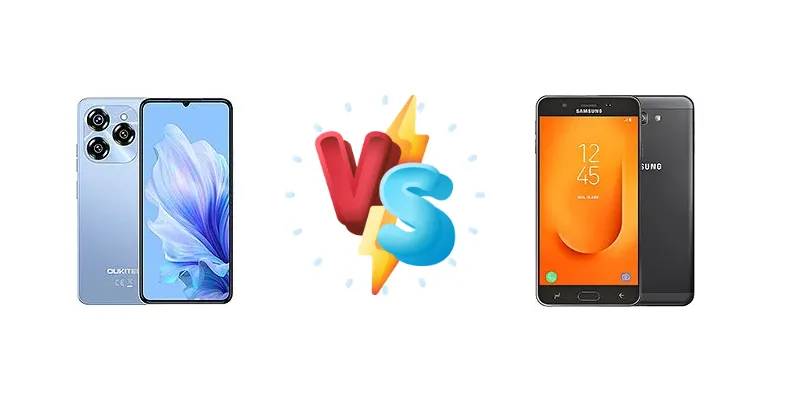
The Oukitel C50 and Samsung Galaxy J7 Prime 2 represent different approaches to the budget smartphone market. The J7 Prime 2, released in 2017, aimed for a balance of features and affordability, while the newer Oukitel C50 leverages a more modern chipset to deliver a performance boost. This comparison dissects their key differences to determine which device offers the best experience in 2024.
🏆 Quick Verdict
For the average user prioritizing performance and future-proofing, the Oukitel C50 is the clear winner. Its Mediatek Dimensity 6100+ chipset provides a substantial upgrade in processing power compared to the Samsung Galaxy J7 Prime 2’s aging Exynos 7870. However, the J7 Prime 2’s potentially more refined software experience and wider availability might appeal to some.
| Network |
|---|
| 2G bands | GSM 850 / 900 / 1800 / 1900 | GSM 850 / 900 / 1800 / 1900 |
| 3G bands | HSDPA 850 / 900 / 1700(AWS) / 1900 / 2100 | HSDPA 850 / 900 / 1900 / 2100 |
| 4G bands | 1, 3, 5, 7, 8, 19, 20, 28, 38, 39, 40, 41 | 1, 3, 5, 7, 8, 20, 38, 40 |
| 5G bands | 1, 3, 28, 38, 41, 77, 78 SA/NSA | - |
| Speed | HSPA, LTE, 5G | HSPA 42.2/5.76 Mbps, LTE Cat4 150/50 Mbps |
| Technology | GSM / HSPA / LTE / 5G | GSM / HSPA / LTE |
| Launch |
|---|
| Announced | 2024, June 17 | 2018, March. Released 2018, April |
| Status | Available. Released 2024, June | Discontinued |
| Body |
|---|
| Build | - | Glass front (Gorilla Glass), aluminum/plastic back, aluminum frame |
| Dimensions | 167.5 x 77.7 x 9.2 mm (6.59 x 3.06 x 0.36 in) | 151.7 x 75 x 8 mm (5.97 x 2.95 x 0.31 in) |
| SIM | Nano-SIM | · Nano-SIM· Nano-SIM + Nano-SIM |
| Weight | 208 g (7.34 oz) | 170 g (6.00 oz) |
| Display |
|---|
| Protection | Corning Gorilla Glass 5 | Corning Gorilla Glass (market dependent) |
| Resolution | 720 x 1600 pixels, 20:9 ratio (~258 ppi density) | 1080 x 1920 pixels, 16:9 ratio (~401 ppi density) |
| Size | 6.8 inches, 111.6 cm2 (~85.8% screen-to-body ratio) | 5.5 inches, 83.4 cm2 (~73.3% screen-to-body ratio) |
| Type | IPS LCD, 400 nits | PLS LCD |
| Platform |
|---|
| CPU | Octa-core (2x2.2 GHz Cortex-A76 & 6x2.0 GHz Cortex-A55) | Octa-core 1.6 GHz Cortex-A53 |
| Chipset | Mediatek Dimensity 6100+ (6 nm) | Exynos 7870 Octa (14 nm) |
| GPU | Mali-G57 MC2 | Mali-T830 MP1 |
| OS | Android 14 | Android 7.0 (Nougat), upgradable to Android 9.0 (Pie) |
| Memory |
|---|
| Card slot | microSDXC | microSDXC (dedicated slot) |
| Internal | 128GB 8GB RAM | 32GB 3GB RAM |
| | - | eMMC 5.1 |
| Main Camera |
|---|
| Features | LED flash, HDR, panorama | LED flash, panorama, HDR |
| Single | - | 13 MP, f/1.9, 28mm (wide), AF |
| Triple | 50 MP, f/1.8, (wide), 1/2.76", AF
other unspecified cameras | - |
| Video | 1080p@30fps | 1080p@30fps |
| Selfie camera |
|---|
| Single | 5 MP, f/2.2, (wide), 1/5" | 13 MP, f/1.9, 1/3.1", 1.12µm |
| Video | 720p@30fps | 1080p@30fps |
| Sound |
|---|
| 3.5mm jack | - | Yes |
| 35mm jack | Yes | Yes |
| Loudspeaker | Yes | Yes |
| Comms |
|---|
| Bluetooth | 5.2, A2DP, LE | 4.1, A2DP, LE |
| NFC | No | No |
| Positioning | GPS, GALILEO, GLONASS, BDS | GPS, GLONASS, BDS |
| Radio | FM radio | FM radio |
| USB | USB Type-C 2.0, OTG | microUSB 2.0, OTG |
| WLAN | Wi-Fi 802.11 a/b/g/n/ac, dual-band | Wi-Fi 802.11 b/g/n, Wi-Fi Direct |
| Features |
|---|
| Sensors | Fingerprint (side-mounted), accelerometer, proximity | Fingerprint (front-mounted), accelerometer, proximity |
| | - | ANT+ |
| Battery |
|---|
| Charging | 10W wired | - |
| Music play | - | Up to 84 h |
| Talk time | - | Up to 21 h (3G) |
| Type | Li-Po 5150 mAh | Li-Ion 3300 mAh, non-removable |
| Misc |
|---|
| Colors | Grey, Green, Blue | Black, Gold, Rose Gold |
| Models | - | SM-G611F, SM-G611FF, SM-G611M, SM-G611MT, SM-G611K |
| Price | About 160 EUR | About 170 EUR |
| SAR | - | 0.61 W/kg (head) |
| SAR EU | - | 0.37 W/kg (head) 1.63 W/kg (body) |
Oukitel C50
- Significantly faster processor with the Dimensity 6100+
- More efficient 6nm manufacturing process
- Likely better camera image processing
- Potential for longer software support
- Slow 10W charging
- Limited brand recognition compared to Samsung
Samsung Galaxy J7 Prime 2
- Established brand reputation (Samsung)
- Potentially more refined software experience
- Wider availability of accessories
- Potentially more compact form factor
- Outdated Exynos 7870 chipset
- Slower performance for modern apps
- Limited software updates
- Less efficient 14nm process
Display Comparison
Neither device's display specifications are provided, so a direct comparison is limited. However, given the J7 Prime 2's release date, it likely features a TFT LCD panel. The Oukitel C50, being a more recent device, may utilize an IPS LCD, offering wider viewing angles and better color reproduction. The J7 Prime 2's 5.5-inch display size is likely smaller than the C50's, but without specific details, it's difficult to assess the overall viewing experience. The absence of information regarding refresh rates suggests both devices operate at the standard 60Hz.
Camera Comparison
Without detailed camera specifications, a comprehensive comparison is challenging. However, the J7 Prime 2 was marketed with a 13MP main camera, which was respectable for its time. The Oukitel C50 likely features a higher resolution sensor, but megapixel count isn't everything. Image processing algorithms play a crucial role, and the newer chipset in the C50 likely allows for more sophisticated image enhancement. The presence of a 2MP macro camera on the J7 Prime 2 is largely a marketing gimmick, offering limited practical benefit. The C50's image quality will likely be superior due to its more modern processing capabilities.
Performance
The core difference lies in the chipsets. The Oukitel C50’s Mediatek Dimensity 6100+ (6nm) is a significant leap forward from the Samsung Galaxy J7 Prime 2’s Exynos 7870 (14nm). The Dimensity 6100+ utilizes newer Cortex-A76 and A55 cores, resulting in substantially improved CPU performance – the 2x2.2 GHz Cortex-A76 cores will handle demanding tasks far more efficiently than the J7 Prime 2’s 1.6 GHz Cortex-A53 cores. The 6nm process node also contributes to better power efficiency and thermal management. While both are octa-core CPUs, the architectural advancements in the Dimensity 6100+ translate to a noticeably snappier user experience, especially for multitasking and gaming.
Battery Life
Battery capacity isn't specified for either device. However, the Oukitel C50’s 10W wired charging is significantly slower than what the J7 Prime 2 likely offered (though specific charging speeds for the J7 Prime 2 are unavailable). The Dimensity 6100+'s 6nm process should contribute to better battery life despite the slower charging, but a larger battery in the J7 Prime 2 could offset this advantage. Expect a longer full charge time with the Oukitel C50.
Buying Guide
Buy the Oukitel C50 if you need a phone capable of handling modern apps and light gaming without significant lag. Its newer chipset ensures smoother multitasking and a longer software support lifespan. Buy the Samsung Galaxy J7 Prime 2 if you prioritize a potentially more polished user experience from a well-established brand, and are willing to accept significantly slower performance and limited software updates. It's a good option for basic communication and light tasks.
Frequently Asked Questions
❓ Does the Exynos 7870 in the Samsung Galaxy J7 Prime 2 overheat during prolonged use, like gaming?
The Exynos 7870 is known to throttle under sustained load, meaning performance will decrease to prevent overheating. While it won't become dangerously hot, expect noticeable lag and frame drops during extended gaming sessions. The Oukitel C50's Dimensity 6100+ and 6nm process are much more efficient and will handle gaming for longer periods without significant throttling.
❓ Is the 10W charging on the Oukitel C50 a significant drawback compared to potentially faster charging on the J7 Prime 2?
Yes, 10W charging is quite slow by modern standards. A full charge will take considerably longer than with the J7 Prime 2, assuming the J7 Prime 2 supports faster charging (specifics are unavailable). This means you'll need to charge the Oukitel C50 overnight or plan charging sessions accordingly.
❓ Will the Oukitel C50 receive regular software updates and security patches?
Oukitel's software update track record is less consistent than Samsung's. While the Dimensity 6100+ is a modern chipset, long-term software support from Oukitel is not guaranteed. The Samsung Galaxy J7 Prime 2 is likely no longer receiving updates.