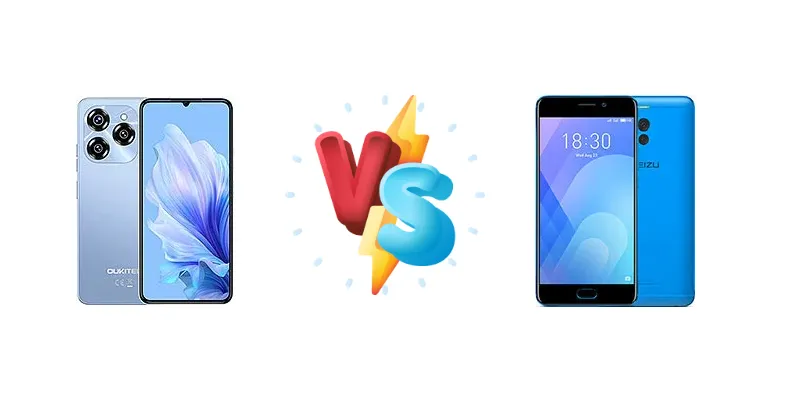
The Oukitel C50 and Meizu M6 Note represent different approaches to the budget smartphone market. The C50, leveraging a newer Mediatek Dimensity 6100+ chipset, aims for modern performance. Conversely, the M6 Note, with its Snapdragon 625, focuses on a proven platform and faster charging capabilities. This comparison dissects their strengths and weaknesses to determine which device offers the best value.
🏆 Quick Verdict
For the average user prioritizing future-proofing and overall processing power, the Oukitel C50 is the better choice. Its Dimensity 6100+ offers a significant performance leap over the Snapdragon 625. However, users who frequently need quick top-ups and value fast charging will find the Meizu M6 Note more convenient.
| Network |
|---|
| 2G bands | GSM 850 / 900 / 1800 / 1900 | GSM 850 / 900 / 1800 / 1900 - SIM 1 & SIM 2 |
| 3G bands | HSDPA 850 / 900 / 1700(AWS) / 1900 / 2100 | HSDPA 850 / 900 / 1900 / 2100 |
| 4G bands | 1, 3, 5, 7, 8, 19, 20, 28, 38, 39, 40, 41 | 1, 3, 5, 7, 8, 20, 38, 40 |
| 5G bands | 1, 3, 28, 38, 41, 77, 78 SA/NSA | - |
| Speed | HSPA, LTE, 5G | HSPA, LTE |
| Technology | GSM / HSPA / LTE / 5G | GSM / CDMA / HSPA / LTE |
| | - | CDMA 800 |
| Launch |
|---|
| Announced | 2024, June 17 | 2017, August. Released 2017, September |
| Status | Available. Released 2024, June | Discontinued |
| Body |
|---|
| Build | - | Glass front, aluminum back, aluminum frame |
| Dimensions | 167.5 x 77.7 x 9.2 mm (6.59 x 3.06 x 0.36 in) | 154.6 x 75.2 x 8.4 mm (6.09 x 2.96 x 0.33 in) |
| SIM | Nano-SIM | Nano-SIM + Nano-SIM |
| Weight | 208 g (7.34 oz) | 173 g (6.10 oz) |
| Display |
|---|
| Protection | Corning Gorilla Glass 5 | - |
| Resolution | 720 x 1600 pixels, 20:9 ratio (~258 ppi density) | 1080 x 1920 pixels, 16:9 ratio (~403 ppi density) |
| Size | 6.8 inches, 111.6 cm2 (~85.8% screen-to-body ratio) | 5.5 inches, 82.6 cm2 (~71.0% screen-to-body ratio) |
| Type | IPS LCD, 400 nits | IPS LCD |
| Platform |
|---|
| CPU | Octa-core (2x2.2 GHz Cortex-A76 & 6x2.0 GHz Cortex-A55) | Octa-core 2.0 GHz Cortex-A53 |
| Chipset | Mediatek Dimensity 6100+ (6 nm) | Qualcomm MSM8953 Snapdragon 625 (14 nm) |
| GPU | Mali-G57 MC2 | Adreno 506 |
| OS | Android 14 | Android 7.1.2 (Nougat), Flyme 7.3 |
| Memory |
|---|
| Card slot | microSDXC | microSDXC |
| Internal | 128GB 8GB RAM | 16GB 4GB RAM, 32GB 3GB RAM, 64GB 4GB RAM |
| | - | eMMC 5.1 |
| Main Camera |
|---|
| Dual | - | 12 MP, f/1.9, 1/2.55", 1.4µm, dual pixel PDAF
5 MP, f/2.0, AF |
| Features | LED flash, HDR, panorama | quad-LED dual-tone flash, HDR, panorama |
| Triple | 50 MP, f/1.8, (wide), 1/2.76", AF
other unspecified cameras | - |
| Video | 1080p@30fps | 1080p@30fps |
| Selfie camera |
|---|
| Single | 5 MP, f/2.2, (wide), 1/5" | 16 MP, f/2.0, 26mm (wide), 1/3.06", 1.0µm |
| Video | 720p@30fps | 1080p@30fps |
| Sound |
|---|
| 3.5mm jack | - | Yes |
| 35mm jack | Yes | Yes |
| Loudspeaker | Yes | Yes |
| Comms |
|---|
| Bluetooth | 5.2, A2DP, LE | 4.2, A2DP, LE |
| NFC | No | No |
| Positioning | GPS, GALILEO, GLONASS, BDS | GPS, GLONASS |
| Radio | FM radio | No |
| USB | USB Type-C 2.0, OTG | microUSB 2.0 |
| WLAN | Wi-Fi 802.11 a/b/g/n/ac, dual-band | Wi-Fi 802.11 a/b/g/n, dual-band |
| Features |
|---|
| Sensors | Fingerprint (side-mounted), accelerometer, proximity | Fingerprint (front-mounted), accelerometer, gyro, proximity, compass |
| Battery |
|---|
| Charging | 10W wired | 24W wired |
| Type | Li-Po 5150 mAh | Li-Ion 4000 mAh, non-removable |
| Misc |
|---|
| Colors | Grey, Green, Blue | Black, Blue, Gold |
| Models | - | M6 Note, MZ-M6 Note |
| Price | About 160 EUR | About 170 EUR |
Oukitel C50
- Significantly more powerful processor (Dimensity 6100+)
- More modern architecture for improved efficiency
- Potential for better future software support
- Slow 10W charging
- Display specifications unknown, potentially lower quality
Meizu M6 Note
- Fast 24W wired charging
- Proven and stable Snapdragon 625 chipset
- Potentially more refined image processing
- Older chipset with limited performance headroom
- Less efficient 14nm process node
Display Comparison
Neither device's display specifications are provided, so a direct comparison is limited. However, given the M6 Note's age, it likely utilizes an IPS LCD panel. The Oukitel C50, being a more recent device, *may* incorporate a higher-quality panel with improved color accuracy and brightness. The absence of information regarding refresh rates suggests both likely operate at a standard 60Hz. Bezels are expected to be larger on the M6 Note due to its older design.
Camera Comparison
Without specific camera sensor details, a definitive comparison is difficult. However, the market segment suggests the M6 Note likely features a more mature image processing pipeline. The Oukitel C50, while potentially having a higher megapixel count, may rely on software optimization to compensate for a potentially smaller sensor. The absence of OIS information for both devices suggests limited low-light performance. The focus should be on real-world image samples to assess the quality of each device.
Performance
The Oukitel C50’s Mediatek Dimensity 6100+ (6nm) represents a substantial architectural upgrade over the Meizu M6 Note’s Qualcomm Snapdragon 625 (14nm). The Dimensity 6100+ features a modern CPU configuration with 2x2.2 GHz Cortex-A76 cores and 6x2.0 GHz Cortex-A55 cores, offering significantly improved single-core and multi-core performance compared to the Snapdragon 625’s all-Cortex-A53 setup. The 6nm process node also contributes to better power efficiency and thermal management. While the Snapdragon 625 was known for its efficiency, the Dimensity 6100+ delivers a more responsive experience for demanding tasks and gaming.
Battery Life
The Oukitel C50’s 10W charging is a significant drawback compared to the Meizu M6 Note’s 24W wired charging. While battery capacity isn’t specified, the faster charging of the M6 Note translates to considerably quicker top-up times. A full charge on the M6 Note will likely take less than 90 minutes, while the C50 could require over two hours. This difference is crucial for users who rely on frequent charging throughout the day. The Dimensity 6100+'s 6nm process *may* partially offset the slower charging with improved power efficiency, but the M6 Note still holds a clear advantage in charging convenience.
Buying Guide
Buy the Oukitel C50 if you need a phone capable of handling demanding apps and multitasking, and are willing to trade off charging speed for a more modern processor. Buy the Meizu M6 Note if you prioritize quick charging and a stable, well-established chipset, even if it means sacrificing some raw processing power. The M6 Note is ideal for users who don't heavily game or run resource-intensive applications.
Frequently Asked Questions
❓ Will the Oukitel C50 struggle with graphically demanding games like PUBG or Genshin Impact?
While the Dimensity 6100+ is a capable chipset, demanding games may require reduced graphics settings for a smooth experience. The Snapdragon 625 in the M6 Note would likely struggle even more, requiring significant compromises in visual fidelity. The C50 offers a better chance of playable performance, but it's not a dedicated gaming phone.
❓ How much faster is the charging on the Meizu M6 Note in real-world use?
The 24W charging on the M6 Note can realistically add around 50% charge in approximately 30-45 minutes, while the Oukitel C50’s 10W charging would take over 90 minutes to achieve the same level. This difference is particularly noticeable for users who need a quick boost before leaving the house.
❓ Is the Snapdragon 625 still a viable chipset in 2024 for everyday tasks?
The Snapdragon 625 remains functional for basic tasks like browsing, social media, and calling. However, it will exhibit noticeable slowdowns when multitasking or running more demanding applications. The Dimensity 6100+ in the Oukitel C50 provides a much smoother and more responsive experience for these scenarios.