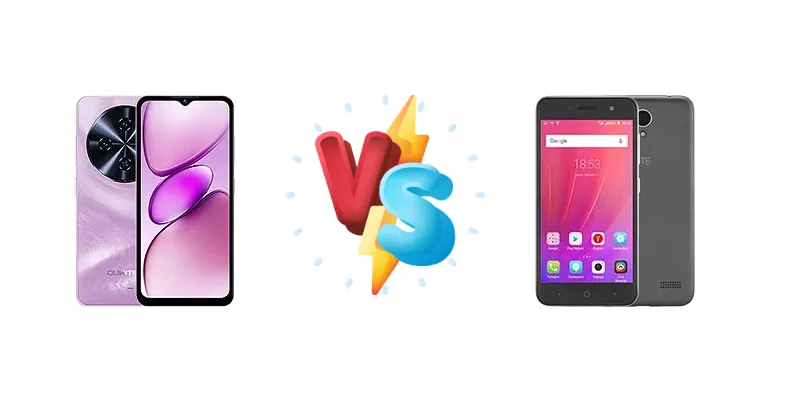
The budget smartphone market is fiercely competitive, and the Oukitel C5 and ZTE Blade A520 represent two distinct approaches to delivering value. The C5, a newer entrant, boasts a more modern Unisoc T310 chipset, while the A520 relies on the older, but well-known, Mediatek MT6737. This comparison will dissect their strengths and weaknesses to determine which phone offers the best experience for the price-conscious consumer.
🏆 Quick Verdict
For the average user prioritizing responsiveness and future-proofing, the Oukitel C5 emerges as the winner. Its Unisoc T310 chipset, built on a 12nm process, provides a significant performance advantage over the ZTE Blade A520’s aging Mediatek MT6737, despite the A520’s potentially lower initial cost.
| Network |
|---|
| 2G bands | GSM 850 / 900 / 1800 / 1900 | GSM 850 / 900 / 1800 / 1900 - SIM 1 & SIM 2 |
| 3G bands | HSDPA 850 / 900 / 1700(AWS) / 1900 / 2100 | HSDPA 900 / 1900 / 2100 |
| 4G bands | 1, 2, 3, 4, 5, 7, 8, 12, 17, 19, 20, 25, 26, 28, 66 | 1, 3, 5, 7, 8, 20 |
| Speed | HSPA, LTE | HSPA 42.2/5.76 Mbps, LTE Cat4 150/50 Mbps |
| Technology | GSM / HSPA / LTE | GSM / HSPA / LTE |
| | - | HSDPA 850 / 900 / 2100 |
| Launch |
|---|
| Announced | 2025, June | 2017, March. Released 2017, May |
| Status | Available. Released 2025, July | Discontinued |
| Body |
|---|
| Dimensions | 163.6 x 75.9 x 9.3 mm (6.44 x 2.99 x 0.37 in) | 144 x 71 x 8.4 mm (5.67 x 2.80 x 0.33 in) |
| SIM | Nano-SIM + Nano-SIM | Nano-SIM + Nano-SIM |
| Weight | 198 g (6.98 oz) | 130 g (4.59 oz) |
| Display |
|---|
| Protection | Sharp glass, Mohs level 5 | - |
| Resolution | 540 x 1200 pixels, 20:9 ratio (~202 ppi density) | 720 x 1280 pixels, 16:9 ratio (~294 ppi density) |
| Size | 6.52 inches, 102.6 cm2 (~82.7% screen-to-body ratio) | 5.0 inches, 68.9 cm2 (~67.4% screen-to-body ratio) |
| Type | IPS LCD, 450 nits | IPS LCD |
| Platform |
|---|
| CPU | Quad-core (1x2.0 GHz Cortex-A75 & 3x1.8 GHz Cortex-A55) | Quad-core 1.25 GHz Cortex-A53 |
| Chipset | Unisoc T310 (12 nm) | Mediatek MT6737 (28 nm) |
| GPU | PowerVR GE8300 | Mali-T720MP2 |
| OS | Android 14 | Android 7.0 (Nougat) |
| Memory |
|---|
| Card slot | microSDXC (uses shared SIM slot) | microSDXC (uses shared SIM slot) |
| Internal | 64GB 4GB RAM, 128GB 4GB RAM, 256GB 4GB RAM | 8GB 1GB RAM, 16GB 2GB RAM |
| | - | eMMC 5.0 |
| Main Camera |
|---|
| Features | LED flash, HDR, panorama | LED flash, HDR, panorama |
| Single | 13 MP, f/2.2 (wide), AF | 8 MP, AF |
| Video | 1080p@30fps | 1080p@30fps |
| Selfie camera |
|---|
| Single | 5 MP, f/2.2, (wide) | 8 MP or 2 MP |
| Video | 720p@30fps | - |
| Sound |
|---|
| 3.5mm jack | - | Yes |
| 35mm jack | Yes | Yes |
| Loudspeaker | Yes | Yes |
| Comms |
|---|
| Bluetooth | 5.0, A2DP, LE | 4.1, A2DP, LE |
| NFC | No | No |
| Positioning | GPS, GALILEO, GLONASS, BDS | GPS |
| Radio | FM radio | FM radio |
| USB | USB Type-C | microUSB 2.0 |
| WLAN | Wi-Fi 802.11 a/b/g/n/ac, dual-band | Wi-Fi 802.11 b/g/n, Wi-Fi Direct |
| Features |
|---|
| Sensors | Accelerometer | Accelerometer |
| Battery |
|---|
| Charging | 10W wired | - |
| Type | Li-Po 5000 mAh | Li-Ion 2400 mAh, removable |
| Misc |
|---|
| Colors | Gold, Purple, Blue, Black | Gray |
| Models | - | BLADE A520, BA520 |
| Price | - | About 80 EUR |
| EU LABEL |
|---|
| Battery | 55:37h endurance, 1000 cycles | - |
| Energy | Class A | - |
| Free fall | Class A (270 falls) | - |
| Repairability | Class B | - |
Oukitel C5
- Significantly better performance with the Unisoc T310 chipset.
- Superior battery endurance (55:37h).
- More modern processor architecture (Cortex-A75).
- Potentially better thermal management due to 12nm process.
- Slow 10W charging.
- Display specifications are unknown.
ZTE Blade A520
- Potentially lower initial purchase price.
- Established platform with known software support (though likely outdated).
- Functional for basic communication tasks.
- May be readily available in some markets.
- Outdated and inefficient Mediatek MT6737 chipset.
- Poor performance compared to the Oukitel C5.
- Likely shorter battery life.
- Older design with potentially wider bezels.
Display Comparison
Neither device provides display specifications, so a direct comparison is limited. However, given the price points, both likely utilize LCD panels with 720p resolutions. The A520, being an older model, may exhibit wider bezels. The C5’s newer design *potentially* benefits from slightly improved color accuracy, but this is speculative. Display quality is unlikely to be a deciding factor for either phone.
Camera Comparison
Without detailed camera specifications, a meaningful comparison is difficult. Both phones likely feature basic camera setups geared towards casual photography. It’s reasonable to assume the ZTE Blade A520’s camera system is older and potentially less refined in image processing. The Oukitel C5, being a newer device, *may* benefit from improved software algorithms, but the sensor quality is unknown for both. The presence of a 2MP macro lens on either device is largely a marketing gimmick and should not influence purchasing decisions.
Performance
The core difference lies in the chipsets. The Oukitel C5’s Unisoc T310, fabricated on a 12nm process, features a Cortex-A75 performance core alongside three Cortex-A55 efficiency cores. This architecture is significantly more advanced than the ZTE Blade A520’s Mediatek MT6737, which uses four Cortex-A53 cores built on a less efficient 28nm process. The A75 core in the C5 delivers substantially higher single-core performance, translating to snappier app launches and smoother multitasking. The 12nm process also contributes to better thermal management, reducing the likelihood of throttling under sustained load. The A520 will struggle with demanding apps and multitasking.
Battery Life
The Oukitel C5 boasts an impressive 55:37h endurance rating, indicating exceptional battery life. While the ZTE Blade A520’s battery capacity is unknown, its less efficient Mediatek MT6737 chipset will undoubtedly result in shorter runtimes. The C5’s 10W charging is slow by modern standards, but the long endurance mitigates this drawback. Users prioritizing all-day (or multi-day) battery life will strongly favor the Oukitel C5.
Buying Guide
Buy the Oukitel C5 if you need a phone that feels responsive for everyday tasks, benefits from a more efficient processor for longer battery life, and offers a glimpse into more modern mobile technology. Buy the ZTE Blade A520 if you prioritize absolute lowest cost and are willing to compromise on performance and long-term software support; it's a functional device for basic communication but won't excel in demanding applications.
Frequently Asked Questions
❓ Will the Unisoc T310 in the Oukitel C5 struggle with popular apps like TikTok or Facebook?
While not a flagship processor, the Unisoc T310’s Cortex-A75 core provides enough power for smooth operation of social media apps like TikTok and Facebook. The performance difference compared to the ZTE Blade A520’s MT6737 will be noticeable, resulting in faster loading times and less lag.
❓ Is the 10W charging on the Oukitel C5 a significant drawback, considering its long battery life?
The 10W charging is indeed slow, taking several hours for a full charge. However, the Oukitel C5’s exceptional 55:37h battery endurance means you won’t need to charge it as frequently. Overnight charging is perfectly viable, mitigating the slow charging speed.
❓ Can I expect any software updates for the ZTE Blade A520?
Given the ZTE Blade A520 is an older device, the likelihood of receiving significant software updates is low. Security patches may be infrequent or nonexistent, which is a potential security risk. The Oukitel C5, being newer, *may* receive more frequent updates, though this is not guaranteed.
❓ How does the 28nm process of the MT6737 affect the ZTE Blade A520's battery life?
The 28nm process is less efficient than the 12nm process used in the Unisoc T310. This means the MT6737 consumes more power for the same tasks, resulting in shorter battery life for the ZTE Blade A520. The larger process node generates more heat, further impacting efficiency.