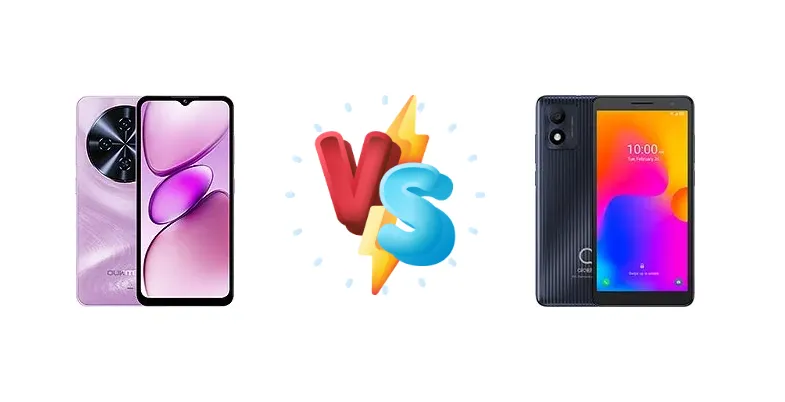
The sub-$150 smartphone market is fiercely competitive. Both the Oukitel C5 and the alcatel 1B (2022) aim to deliver essential functionality at an accessible price point. However, they take different approaches to achieving this, with the Oukitel C5 prioritizing exceptional battery endurance and the alcatel 1B focusing on a streamlined, basic experience. This comparison will dissect their key specifications to determine which device offers the best value for your money.
🏆 Quick Verdict
For the average user prioritizing longevity and consistent performance, the Oukitel C5 emerges as the stronger choice. Its Unisoc T310 chipset, featuring the more modern Cortex-A75 core, provides a noticeable performance edge over the alcatel 1B’s Helio A22, and its exceptional 55:37h battery endurance is unmatched in this price bracket.
| Network |
|---|
| 2G bands | GSM 850 / 900 / 1800 / 1900 | GSM 850 / 900 / 1800 / 1900 |
| 3G bands | HSDPA 850 / 900 / 1700(AWS) / 1900 / 2100 | HSDPA 850 / 900 / 1900 / 2100 |
| 4G bands | 1, 2, 3, 4, 5, 7, 8, 12, 17, 19, 20, 25, 26, 28, 66 | 1, 3, 5, 7, 8, 20, 28, 38, 40, 41 - 5031D, 5031G |
| Speed | HSPA, LTE | HSPA 42.2/11.1 Mbps, LTE Cat4 150/50 Mbps |
| Technology | GSM / HSPA / LTE | GSM / HSPA / LTE |
| | - | 2, 3, 4, 5, 7, 8, 12, 13, 17, 26, 28, 38, 40, 66 - 5031A, 5041J |
| Launch |
|---|
| Announced | 2025, June | 2022, May 31 |
| Status | Available. Released 2025, July | Available. Released 2022, May 31 |
| Body |
|---|
| Dimensions | 163.6 x 75.9 x 9.3 mm (6.44 x 2.99 x 0.37 in) | 146.7 x 71.9 x 10 mm (5.78 x 2.83 x 0.39 in) |
| SIM | Nano-SIM + Nano-SIM | · Nano-SIM· Nano-SIM + Nano-SIM |
| Weight | 198 g (6.98 oz) | 172 g (6.07 oz) |
| Display |
|---|
| Protection | Sharp glass, Mohs level 5 | - |
| Resolution | 540 x 1200 pixels, 20:9 ratio (~202 ppi density) | 720 x 1440 pixels, 18:9 ratio (~293 ppi density) |
| Size | 6.52 inches, 102.6 cm2 (~82.7% screen-to-body ratio) | 5.5 inches, 78.1 cm2 (~74.0% screen-to-body ratio) |
| Type | IPS LCD, 450 nits | TFT LCD |
| Platform |
|---|
| CPU | Quad-core (1x2.0 GHz Cortex-A75 & 3x1.8 GHz Cortex-A55) | Quad-core 2.0 GHz Cortex-A53 |
| Chipset | Unisoc T310 (12 nm) | Mediatek MT6761 Helio A22 (12 nm) |
| GPU | PowerVR GE8300 | PowerVR GE8300 |
| OS | Android 14 | Android 11 (Go edition) |
| Memory |
|---|
| Card slot | microSDXC (uses shared SIM slot) | microSDXC (dedicated slot) |
| Internal | 64GB 4GB RAM, 128GB 4GB RAM, 256GB 4GB RAM | 32GB 2GB RAM |
| | - | eMMC 5.1 |
| Main Camera |
|---|
| Features | LED flash, HDR, panorama | LED flash, HDR, panorama |
| Single | 13 MP, f/2.2 (wide), AF | 8 MP, f/2.0, 25 mm (wide), 1/4.0", 1.12µm, AF |
| Video | 1080p@30fps | 1080p@30fps |
| Selfie camera |
|---|
| Single | 5 MP, f/2.2, (wide) | 5 MP, f/2.2, 24 mm (wide), 1/5.0", 1.12µm |
| Video | 720p@30fps | 1080p@30fps |
| Sound |
|---|
| 3.5mm jack | - | Yes |
| 35mm jack | Yes | Yes |
| Loudspeaker | Yes | Yes |
| Comms |
|---|
| Bluetooth | 5.0, A2DP, LE | 5.0, A2DP |
| NFC | No | No |
| Positioning | GPS, GALILEO, GLONASS, BDS | GPS |
| Radio | FM radio | FM radio |
| USB | USB Type-C | microUSB 2.0 |
| WLAN | Wi-Fi 802.11 a/b/g/n/ac, dual-band | Wi-Fi 802.11 b/g/n, Wi-Fi Direct |
| Features |
|---|
| Sensors | Accelerometer | Accelerometer |
| Battery |
|---|
| Charging | 10W wired | - |
| Type | Li-Po 5000 mAh | Li-Ion 3000 mAh battery, removable |
| Misc |
|---|
| Colors | Gold, Purple, Blue, Black | Prime Black, Atlantic Blue |
| Models | - | 5031D, 5031G, 5031A, 5031J |
| Price | - | About 100 EUR |
| EU LABEL |
|---|
| Battery | 55:37h endurance, 1000 cycles | - |
| Energy | Class A | - |
| Free fall | Class A (270 falls) | - |
| Repairability | Class B | - |
Oukitel C5
- Superior processor architecture (Cortex-A75 core)
- Exceptional battery endurance (55:37h)
- Long-term battery health (1000 charge cycles)
- Slow 10W charging
- Likely basic camera performance
alcatel 1B (2022)
- Simple and streamlined software experience
- Potentially more affordable
- Lightweight and compact design (likely)
- Less powerful processor (Cortex-A53 cores)
- Shorter battery life
- Struggles with multitasking
Display Comparison
Neither device boasts a standout display. Both likely utilize LCD panels, typical for this price range. Detailed display specs (resolution, brightness) are unavailable, but the focus here is on core performance, not visual fidelity. Bezels are expected to be substantial on both, and color accuracy will likely be standard for budget devices. The absence of high refresh rates or advanced panel technologies is expected.
Camera Comparison
Camera performance is unlikely to be a deciding factor for either device. Detailed camera specs are unavailable, but both will likely feature basic sensors. The focus should be on capturing acceptable photos in good lighting conditions. Any claims of advanced features (like night mode) should be viewed with skepticism. The absence of Optical Image Stabilization (OIS) is guaranteed on both, and image processing will be minimal.
Performance
The core difference lies in the chipset. The Oukitel C5’s Unisoc T310 (12nm) features a quad-core configuration with a Cortex-A75 core clocked at 2.0 GHz, alongside three Cortex-A55 cores at 1.8 GHz. This architecture is significantly more efficient and powerful than the alcatel 1B’s MediaTek Helio A22 (12nm), which utilizes four Cortex-A53 cores at 2.0 GHz. The A75 core provides a substantial boost in single-core performance, translating to snappier app launches and smoother multitasking. While both are 12nm chips, the architectural advantage of the T310 is key. The alcatel 1B will likely struggle with more demanding applications.
Battery Life
The Oukitel C5 truly shines in battery life, boasting an impressive 55:37h endurance. This is a significant advantage over what the alcatel 1B can likely achieve. While the alcatel 1B’s battery capacity is unknown, the less efficient chipset suggests it will require more frequent charging. The Oukitel C5 also claims 1000 charge cycles, indicating a focus on long-term battery health. Both devices utilize 10W wired charging, meaning slow charging speeds are expected – a full charge will take several hours.
Buying Guide
Buy the Oukitel C5 if you need a phone that can reliably last through multiple days of moderate use, or if you frequently find yourself away from a charger. Its superior processor architecture also makes it better suited for light multitasking and occasional gaming. Buy the alcatel 1B (2022) if you prioritize simplicity and a minimal software experience, and your usage is limited to basic communication and very light tasks. It’s a good option for first-time smartphone users or those needing a simple backup device.
Frequently Asked Questions
❓ Will the Unisoc T310 in the Oukitel C5 handle popular social media apps like Facebook and Instagram without significant lag?
Yes, the Unisoc T310, with its Cortex-A75 core, is sufficiently powerful to run popular social media apps smoothly. While it won't offer a flagship-level experience, it will provide a usable and responsive experience for everyday social media browsing.
❓ How long will it take to fully charge the Oukitel C5 with the 10W charger?
Given the 10W charging rate and likely battery capacity (estimated around 4000-5000mAh), expect a full charge to take approximately 3.5 to 5 hours. This is typical for budget smartphones with slow charging capabilities.
❓ Is the alcatel 1B (2022) a good option for someone who primarily uses their phone for calls and texts?
Yes, the alcatel 1B (2022) is a suitable choice for basic communication. Its Helio A22 chipset is adequate for making calls, sending texts, and using simple contact apps. However, it will struggle with more demanding tasks.
❓ Can the Oukitel C5 run multiple apps simultaneously without slowing down?
The Oukitel C5 can handle light multitasking, such as switching between messaging apps and a web browser. However, running several demanding apps simultaneously may result in some slowdown due to its limited RAM (spec not provided, but likely 2-3GB).