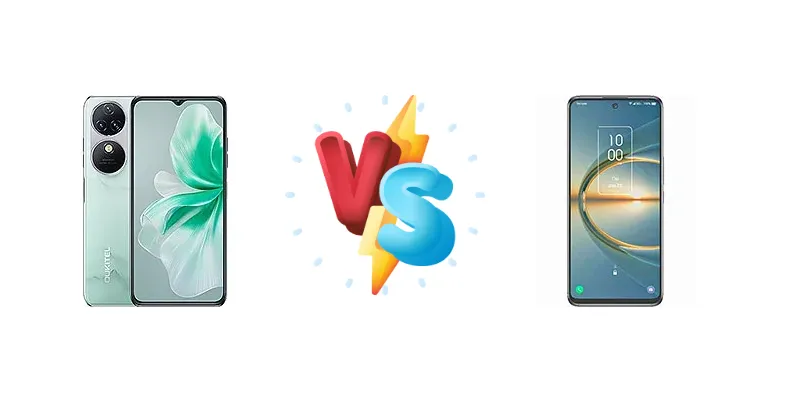
The Oukitel C38 and TCL 30 V 5G represent compelling options in the increasingly competitive sub-$200 5G smartphone market. While both aim to deliver affordable connectivity, they take distinctly different approaches under the hood, relying on chipsets from Mediatek and Qualcomm respectively. This comparison dissects those differences to determine which device offers the best value for your money.
🏆 Quick Verdict
For the average user prioritizing consistent performance and future-proofing, the TCL 30 V 5G emerges as the better choice. Its Qualcomm Snapdragon 480, built on a more efficient 8nm process, provides a noticeable advantage in application responsiveness and sustained performance compared to the Oukitel C38’s Mediatek MT8788.
| Network |
|---|
| 2G bands | GSM 850 / 900 / 1800 / 1900 | GSM 850 / 900 / 1800 / 1900 |
| 3G bands | HSDPA 850 / 900 / 1700(AWS) / 1900 / 2100 | HSDPA 850 / 900 / 1700(AWS) / 1900 / 2100 |
| 4G bands | 1, 2, 3, 4, 5, 7, 8, 12, 17, 18, 19, 20, 25, 26, 28, 38, 39, 40, 41, 66 | 2, 4, 5, 12, 13, 46, 48, 66 |
| 5G bands | - | 2, 5, 48, 66, 77, 260, 261 SA/NSA/Sub6/mmWave |
| Speed | HSPA, LTE | HSPA, LTE, 5G |
| Technology | GSM / HSPA / LTE | GSM / HSPA / LTE / 5G |
| Launch |
|---|
| Announced | 2024, May | 2022, January 04 |
| Status | Available. Released 2024, June | Available. Released 2022, January 28 |
| Body |
|---|
| Build | - | Glass front, plastic frame, plastic back |
| Dimensions | 164.3 x 75.5 x 8.8 mm (6.47 x 2.97 x 0.35 in) | 165.9 x 76 x 9.1 mm (6.53 x 2.99 x 0.36 in) |
| SIM | Nano-SIM + Nano-SIM | Nano-SIM |
| Weight | 200 g (7.05 oz) | 200.4 g (7.09 oz) |
| Display |
|---|
| Protection | Corning Gorilla Glass 5 | Corning Gorilla Glass 3 |
| Resolution | 1080 x 2408 pixels, 20:9 ratio (~400 ppi density) | 1080 x 2400 pixels, 20:9 ratio (~395 ppi density) |
| Size | 6.6 inches, 104.9 cm2 (~84.6% screen-to-body ratio) | 6.67 inches, 107.4 cm2 (~85.2% screen-to-body ratio) |
| Type | IPS LCD, 480 nits | IPS LCD |
| Platform |
|---|
| CPU | Octa-core (4x2.0 GHz Cortex-A73 & 4x2.0 GHz Cortex-A53) | Octa-core (2x2.0 GHz Kryo 460 & 6x1.8 GHz Kryo 460) |
| Chipset | Mediatek MT8788 (12 nm) | Qualcomm SM4350 Snapdragon 480 5G (8 nm) |
| GPU | Mali-G72 MP3 | Adreno 619 |
| OS | Android 13 | Android 11, TCL UI |
| Memory |
|---|
| Card slot | microSDXC (uses shared SIM slot) | microSDXC (dedicated slot) |
| Internal | 256GB 6GB RAM | 128GB 4GB RAM |
| Main Camera |
|---|
| Features | LED flash, HDR, panorama | LED flash, HDR, panorama |
| Triple | 48 MP, f/1.8, (wide), 1/2.0", PDAF
2 MP (macro)
Auxiliary lens | 50 MP, (wide), PDAF
5 MP, (ultrawide)
2 MP (macro) |
| Video | 1080p@30fps | 1080p@30fps |
| Selfie camera |
|---|
| Single | 32 MP, f/2.3, (wide), 1/2.8" | 16 MP, (wide) |
| Video | 1080p@30fps | 1080p@30fps |
| Sound |
|---|
| 35mm jack | No | Yes |
| Loudspeaker | Yes | Yes, with dual speakers |
| Comms |
|---|
| Bluetooth | 5.0, A2DP, LE | 5.1, A2DP, LE |
| NFC | No | No |
| Positioning | GPS, GALILEO, GLONASS | GPS |
| Radio | FM radio | No |
| USB | USB Type-C 2.0, OTG | USB Type-C 3.0, OTG |
| WLAN | Wi-Fi 802.11 a/b/g/n/ac, dual-band | Wi-Fi 802.11 a/b/g/n/ac, dual-band, Wi-Fi Direct |
| Features |
|---|
| Sensors | Fingerprint (side-mounted), accelerometer | Fingerprint (rear-mounted), accelerometer, proximity, compass, gyro, barometer |
| Battery |
|---|
| Charging | 18W wired | 18W wired |
| Type | Li-Po 5150 mAh | Li-Po 4500 mAh |
| Misc |
|---|
| Colors | Black, White, Green | Midnight Gray |
| Price | About 140 EUR | About 270 EUR |
Oukitel C38
- Potentially lower price point
- May offer slightly larger battery capacity (unconfirmed)
- Functional for basic smartphone tasks
- Less efficient Mediatek MT8788 chipset
- Slower application loading times
- Potential for noticeable lag during multitasking
TCL 30 V 5G
- More efficient Qualcomm Snapdragon 480 chipset
- Smoother multitasking and app performance
- Better long-term performance and software support
- May be slightly more expensive
- Potentially smaller battery capacity (unconfirmed)
- Still a budget device with inherent limitations
Display Comparison
Neither device boasts a standout display. Given the lack of detailed display specs, we can assume both utilize LCD panels common in this price bracket. However, the chipset differences indirectly impact the display experience; a smoother processor like the Snapdragon 480 in the TCL 30 V 5G will translate to more fluid scrolling and animations, making the display *feel* more responsive. Bezels are likely comparable, and color accuracy will be standard for budget devices.
Camera Comparison
Without detailed camera specifications, a direct comparison is difficult. However, it’s safe to assume both phones feature basic camera setups geared towards casual photography. The image signal processor (ISP) within the Snapdragon 480 generally offers superior image processing capabilities, potentially resulting in better dynamic range and noise reduction in the TCL 30 V 5G. The presence of a more advanced ISP is more impactful than megapixel count in this price range. We can expect both phones to struggle in low-light conditions.
Performance
The core difference lies in the chipsets. The TCL 30 V 5G’s Qualcomm Snapdragon 480 (8nm) offers a significant architectural advantage over the Oukitel C38’s Mediatek MT8788 (12nm). The smaller fabrication node of the Snapdragon 480 translates to improved power efficiency and thermal management. While both CPUs feature octa-core configurations, the Snapdragon’s Kryo 460 cores, particularly the 2x2.0 GHz performance cores, are architecturally more advanced than the Cortex-A73 cores in the MT8788. This means the TCL 30 V 5G will handle demanding apps and multitasking with greater ease. The MT8788, while capable, will likely exhibit more noticeable slowdowns under sustained load.
Battery Life
Both devices feature 18W wired charging, suggesting similar charging speeds. Battery capacity isn’t specified, but the Snapdragon 480’s superior power efficiency gives the TCL 30 V 5G an edge in real-world battery life. The 8nm process allows it to accomplish the same tasks using less power, resulting in longer usage times between charges. While the Oukitel C38 might have a slightly larger battery, the less efficient chipset will likely negate any capacity advantage.
Buying Guide
Buy the Oukitel C38 if you primarily need a phone for basic tasks like calls, texts, and light social media, and are comfortable with potentially slower app loading times. Buy the TCL 30 V 5G if you value smoother multitasking, occasional gaming, and a more responsive user experience, even if it means spending slightly more.
Frequently Asked Questions
❓ Will the Mediatek MT8788 in the Oukitel C38 struggle with graphically intensive games like PUBG Mobile?
Yes, the Mediatek MT8788 is likely to struggle with demanding games like PUBG Mobile, even at lower settings. The GPU within the MT8788 is less powerful than the Adreno 610 in the Snapdragon 480, resulting in lower frame rates and potential stuttering. The TCL 30 V 5G will provide a significantly smoother gaming experience.
❓ Does the Snapdragon 480 in the TCL 30 V 5G support carrier aggregation for faster 5G speeds?
Yes, the Snapdragon 480 supports carrier aggregation, allowing it to combine multiple 5G channels for faster download and upload speeds, provided your carrier supports it. This is a key advantage over some other budget 5G chipsets and will result in a more consistent and reliable 5G experience.
❓ How will the difference in fabrication process (12nm vs 8nm) affect the long-term performance of these phones?
The 8nm fabrication process of the Snapdragon 480 is more efficient, generating less heat for the same level of performance. This means the TCL 30 V 5G is less likely to experience thermal throttling – a reduction in performance to prevent overheating – during prolonged use, ensuring more consistent performance over time. The Oukitel C38, with its 12nm chip, is more susceptible to throttling.