
Oukitel C36 vs. Ulefone Power Armor 13: A Detailed Comparison of Budget Rugged Phones
| Phones Images | |||||
|---|---|---|---|---|---|
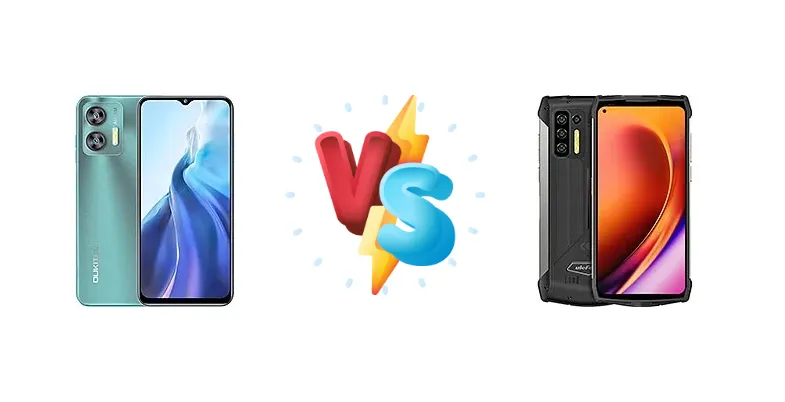
|
🏆 Quick Verdict
For the average user prioritizing affordability and basic functionality, the Oukitel C36 is a viable option. However, the Ulefone Power Armor 13 emerges as the clear winner, offering significantly faster charging (33W vs 10W) and a more powerful Mediatek Helio G95 chipset, making it better suited for demanding tasks and longer-term usability.
| PHONES | ||
|---|---|---|
| Phone Names | Oukitel C36 | Ulefone Power Armor 13 |
| Network | ||
|---|---|---|
| 2G bands | GSM 850 / 900 / 1800 / 1900 | GSM 850 / 900 / 1800 / 1900 |
| 3G bands | HSDPA 850 / 1700(AWS) / 1900 / 2100 | HSDPA 850 / 900 / 1700(AWS) / 1900 / 2100 |
| 4G bands | 1, 2, 3, 4, 5, 7, 8, 12, 17, 19, 20, 25, 26, 28, 66 | 1, 2, 3, 4, 5, 7, 8, 12, 13, 17, 18, 19, 20, 25, 26, 28, 38, 40, 66 |
| Speed | HSPA, LTE | HSPA 42.2/11.5 Mbps, LTE Cat12 600/150 Mbps |
| Technology | GSM / HSPA / LTE | GSM / HSPA / LTE |
| Launch | ||
|---|---|---|
| Announced | 2023, September | 2021, July 22 |
| Status | Available. Released 2023, September | Available. Released 2021, July 26 |
| Body | ||
|---|---|---|
| Dimensions | 163.8 x 75.4 x 9.2 mm (6.45 x 2.97 x 0.36 in) | 183.7 x 85.4 x 20.8 mm (7.23 x 3.36 x 0.82 in) |
| SIM | Nano-SIM + Nano-SIM | Nano-SIM + Nano-SIM |
| Weight | 199 g (7.02 oz) | 492 g (1.08 lb) |
| - | IP68 dust/water resistant (up to 1.5m for 30 min) Drop-to-concrete resistance from up to 1.2m MIL-STD-810G compliant | |
| Display | ||
|---|---|---|
| Protection | - | Corning Gorilla Glass 3 |
| Resolution | 720 x 1612 pixels, 20:9 ratio (~269 ppi density) | 1080 x 2400 pixels, 20:9 ratio (~386 ppi density) |
| Size | 6.56 inches, 103.4 cm2 (~83.7% screen-to-body ratio) | 6.81 inches, 112.0 cm2 (~71.4% screen-to-body ratio) |
| Type | IPS LCD, 400 nits | IPS LCD |
| Platform | ||
|---|---|---|
| CPU | Octa-core (2x1.6 GHz Cortex-A75 & 6x1.6 GHz Cortex-A55) | Octa-core (2x2.05 GHz Cortex-A76 & 6x2.0 GHz Cortex-A55) |
| Chipset | Unisoc T606 (12 nm) | Mediatek MT6785V/CD Helio G95 (12 nm) |
| GPU | Mali-G57 MP1 | Mali-G76 MC4 |
| OS | Android 13 | Android 11 |
| Memory | ||
|---|---|---|
| Card slot | microSDXC (dedicated slot) | microSDXC (uses shared SIM slot) |
| Internal | 128GB 4GB RAM | 256GB 8GB RAM |
| Main Camera | ||
|---|---|---|
| Dual | 13 MP, f/2.2, (wide), 1/3.0", AF Secondary unspecified camera | - |
| Features | Dual-LED flash, panorama | Quad-LED flash, HDR, panorama |
| Penta | - | 48 MP, f/1.8, 26mm (wide), 1/2.0", 0.8µm, PDAF 8 MP, f/2.2, (ultrawide) 2 MP (macro) Auxiliary lens |
| Video | 1080p@30fps | 4K@30fps, 1080p@30fps |
| Selfie camera | ||
|---|---|---|
| Features | - | HDR, panorama |
| Single | 5 MP, f/2.2, (wide), 1/5.0" | 16 MP, f/2.2 |
| Video | 720p@30fps | 1080p@30fps |
| Sound | ||
|---|---|---|
| 3.5mm jack | - | Yes |
| 35mm jack | Yes | Yes |
| Loudspeaker | Yes | Yes |
| Comms | ||
|---|---|---|
| Bluetooth | 5.1, A2DP, LE | 5.0, A2DP, LE |
| NFC | No | Yes |
| Positioning | GPS, GLONASS, GALILEO, BDS | GPS, GLONASS, GALILEO, BDS |
| Radio | Unspecified | FM radio, RDS, recording |
| USB | USB Type-C 2.0, OTG | - |
| WLAN | Wi-Fi 802.11 a/b/g/n/ac, dual-band | Wi-Fi 802.11 a/b/g/n/ac, dual-band |
| Features | ||
|---|---|---|
| Sensors | Fingerprint (side-mounted), accelerometer, proximity | Fingerprint (side-mounted), accelerometer, gyro, proximity, compass, baroceptor, coulombmeter |
| - | Infrared distance measure (error range: 1~20m, ±10mm; 20~40m, ±25mm) | |
| Battery | ||
|---|---|---|
| Charging | 10W wired | 33W wired 15W wireless 5W reverse wireless |
| Type | Li-Po 5150 mAh | Li-Po 13200 mAh |
| Misc | ||
|---|---|---|
| Colors | Black, Green, Light Blue | Black |
| Price | About 110 EUR | About 300 EUR |
| Tests | ||
|---|---|---|
| Battery life | - | Endurance rating 296h |
| Camera | - | Photo / Video |
| Display | - | Contrast ratio: 1306:1 (nominal) |
| Loudspeaker | - | -28.3 LUFS (Average) |
| Performance | - | AnTuTu: 294194 (v8), 351678 (v9) GeekBench: 1610 (v5.1) GFXBench: 18fps (ES 3.1 onscreen) |
Oukitel C36
- Extremely affordable price point
- Ruggedized design for basic protection
- Acceptable for light daily tasks
- Slow 10W charging
- Unisoc T606 chipset limits performance
- Likely subpar camera quality
Ulefone Power Armor 13
- Faster and more capable Mediatek Helio G95 chipset
- Significantly faster 33W wired and 15W wireless charging
- Brighter display for outdoor visibility
- Higher price compared to the Oukitel C36
- Rugged design adds bulk
- Camera performance likely still limited by sensor quality
Display Comparison
Both devices share a contrast ratio of 1306:1, suggesting similar visual depth. However, the Ulefone Power Armor 13 boasts a measured peak brightness of 401 nits, which will provide a noticeably more visible display outdoors compared to the Oukitel C36, which lacks published brightness data. While both are likely IPS LCD panels, the higher brightness of the Ulefone gives it an edge in usability in bright sunlight. Bezels are expected to be substantial on both, given their ruggedized nature.
Camera Comparison
Both phones list 'Photo / Video' capabilities, but lack specific details. Given the price points, image quality is unlikely to be a primary strength for either. The absence of detailed sensor information suggests both likely employ budget sensors. Focusing on the chipset, the G95 in the Ulefone Power Armor 13 includes an ISP (Image Signal Processor) capable of handling more complex image processing, potentially resulting in better dynamic range and noise reduction compared to the Unisoc T606. Any 2MP macro lenses on either device should be considered marketing filler.
Performance
The Ulefone Power Armor 13’s Mediatek Helio G95 chipset represents a substantial performance leap over the Oukitel C36’s Unisoc T606. The G95 utilizes Cortex-A76 cores clocked at 2.05 GHz, compared to the C36’s Cortex-A75 cores at 1.6 GHz. This translates to faster app loading times, smoother multitasking, and improved gaming performance. The G95’s more efficient architecture also suggests better thermal management under sustained load. While both are 12nm chips, the architectural improvements in the G95 are significant. The C36 is adequate for basic tasks, but the Power Armor 13 is demonstrably more capable.
Battery Life
Both devices share an endurance rating of 296 hours, suggesting similar battery life under identical usage conditions. However, the Ulefone Power Armor 13’s charging capabilities are vastly superior. Its 33W wired charging, 15W wireless charging, and 5W reverse wireless charging provide significantly more flexibility and convenience than the Oukitel C36’s limited 10W wired charging. While the capacity isn't specified, the faster charging speeds mean less downtime and quicker top-ups, making the Power Armor 13 more practical for users on the go.
Buying Guide
Buy the Oukitel C36 if you need a very affordable, basic rugged phone for light use – think occasional calls, texts, and simple apps. It’s ideal for those who prioritize minimal cost over performance. Buy the Ulefone Power Armor 13 if you prefer a phone that can handle more demanding applications, benefits from significantly faster charging, and offers a more robust overall experience, even if it comes at a higher price point. This is the choice for users who need a reliable workhorse.