
Oukitel C36 vs Cubot KingKong 7: A Detailed Comparison for Budget Buyers
| Phones Images | |||||
|---|---|---|---|---|---|
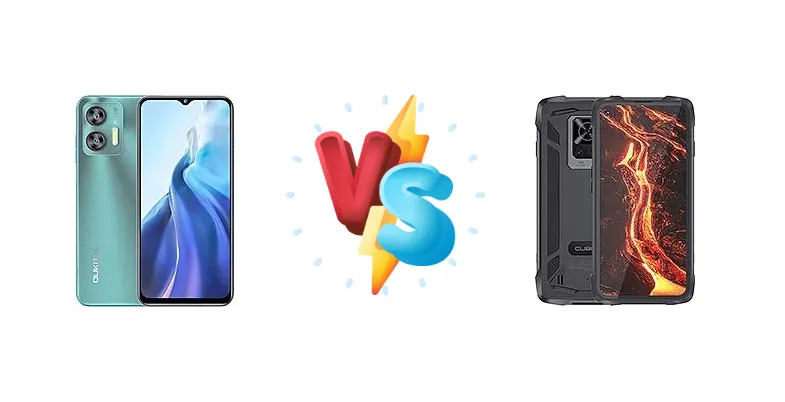
|
🏆 Quick Verdict
For the average user prioritizing a slightly more modern chipset and potentially better long-term software support, the Oukitel C36 is the better choice. However, the Cubot KingKong 7’s Helio P60 offers a performance edge in CPU-intensive tasks, making it suitable for users who occasionally push their phone harder.
| PHONES | ||
|---|---|---|
| Phone Names | Oukitel C36 | Cubot KingKong 7 |
| Network | ||
|---|---|---|
| 2G bands | GSM 850 / 900 / 1800 / 1900 | GSM 850 / 900 / 1800 / 1900 |
| 3G bands | HSDPA 850 / 1700(AWS) / 1900 / 2100 | HSDPA 850 / 900 / 1700(AWS) / 1900 / 2100 |
| 4G bands | 1, 2, 3, 4, 5, 7, 8, 12, 17, 19, 20, 25, 26, 28, 66 | 1, 2, 3, 4, 5, 7, 8, 12, 13, 17, 18, 19, 20, 25, 26, 28, 38, 40, 41, 66 |
| Speed | HSPA, LTE | HSPA, LTE |
| Technology | GSM / HSPA / LTE | GSM / CDMA / HSPA / LTE |
| Launch | ||
|---|---|---|
| Announced | 2023, September | 2022 |
| Status | Available. Released 2023, September | Available. Released 2022 |
| Body | ||
|---|---|---|
| Dimensions | 163.8 x 75.4 x 9.2 mm (6.45 x 2.97 x 0.36 in) | 166.8 x 83.5 x 14 mm (6.57 x 3.29 x 0.55 in) |
| SIM | Nano-SIM + Nano-SIM | Nano-SIM + Nano-SIM |
| Weight | 199 g (7.02 oz) | 267 g (9.42 oz) |
| Display | ||
|---|---|---|
| Resolution | 720 x 1612 pixels, 20:9 ratio (~269 ppi density) | 1080 x 2300 pixels (~400 ppi density) |
| Size | 6.56 inches, 103.4 cm2 (~83.7% screen-to-body ratio) | 6.36 inches, 100.4 cm2 (~72.1% screen-to-body ratio) |
| Type | IPS LCD, 400 nits | IPS LCD |
| Platform | ||
|---|---|---|
| CPU | Octa-core (2x1.6 GHz Cortex-A75 & 6x1.6 GHz Cortex-A55) | Octa-core (4x2.0 GHz Cortex-A73 & 4x2.0 GHz Cortex-A53) |
| Chipset | Unisoc T606 (12 nm) | Mediatek MT6771V/CA Helio P60 (12 nm) |
| GPU | Mali-G57 MP1 | Mali-G72 MP3 |
| OS | Android 13 | Android 11 |
| Memory | ||
|---|---|---|
| Card slot | microSDXC (dedicated slot) | microSDXC (uses shared SIM slot) |
| Internal | 128GB 4GB RAM | 128GB 8GB RAM |
| Main Camera | ||
|---|---|---|
| Dual | 13 MP, f/2.2, (wide), 1/3.0", AF Secondary unspecified camera | - |
| Features | Dual-LED flash, panorama | LED flash |
| Triple | - | 64 MP, (wide), AF 16 MP, (ultrawide) 5 MP (macro) |
| Video | 1080p@30fps | Yes |
| Selfie camera | ||
|---|---|---|
| Single | 5 MP, f/2.2, (wide), 1/5.0" | 32 MP |
| Video | 720p@30fps | Yes |
| Sound | ||
|---|---|---|
| 35mm jack | Yes | Unspecified |
| Loudspeaker | Yes | Yes |
| Comms | ||
|---|---|---|
| Bluetooth | 5.1, A2DP, LE | 4.2, A2DP |
| NFC | No | Yes |
| Positioning | GPS, GLONASS, GALILEO, BDS | GPS, GLONASS, BDS |
| Radio | Unspecified | Unspecified |
| USB | USB Type-C 2.0, OTG | USB Type-C, OTG |
| WLAN | Wi-Fi 802.11 a/b/g/n/ac, dual-band | Wi-Fi 802.11 a/b/g/n |
| Features | ||
|---|---|---|
| Sensors | Fingerprint (side-mounted), accelerometer, proximity | Fingerprint (rear-mounted), accelerometer, gyro, proximity, compass |
| Battery | ||
|---|---|---|
| Charging | 10W wired | - |
| Type | Li-Po 5150 mAh | 5000 mAh |
| Misc | ||
|---|---|---|
| Colors | Black, Green, Light Blue | Black |
| Price | About 110 EUR | - |
Oukitel C36
- Newer Unisoc T606 chipset offers potential for future software updates.
- Potentially better power efficiency with the T606.
- 10W charging is adequate for overnight charging.
- Slower CPU performance compared to the Helio P60.
- Significantly slower 10W charging.
- Limited detailed specifications available.
Cubot KingKong 7
- Stronger CPU performance with the MediaTek Helio P60.
- More mature ISP for potentially better image processing.
- Potentially supports faster charging standards.
- Older chipset may receive fewer software updates.
- Helio P60 may throttle more under sustained load.
- Less power efficient than the Unisoc T606.
Display Comparison
Neither Oukitel nor Cubot provide detailed display specifications beyond resolution. Given the price point, both likely utilize IPS LCD panels. The focus here is on the chipset's ability to drive the display efficiently. The Unisoc T606's integrated GPU may offer slightly better power efficiency for basic display tasks, but the difference will be minimal. Bezels are expected to be substantial on both devices, reflecting their budget nature. Color accuracy is unlikely to be a strong point on either.
Camera Comparison
Detailed camera specs are absent, making a direct comparison difficult. Both phones likely feature a primary camera and potentially a depth or macro sensor. Given the price bracket, image quality will be heavily reliant on software processing. The Helio P60’s ISP (Image Signal Processor) is more mature and potentially capable of better noise reduction and dynamic range compared to the T606’s ISP. However, the quality of the sensor itself will be the dominant factor. Expect both phones to struggle in low-light conditions. Any 2MP macro sensors included should be considered marketing features rather than genuinely useful cameras.
Performance
The core difference lies in the chipsets. The Cubot KingKong 7’s MediaTek Helio P60 (MT6771V/CA) features four Cortex-A73 cores clocked at 2.0 GHz, paired with four Cortex-A53 cores. This architecture, while older (12nm), provides a stronger peak CPU performance than the Oukitel C36’s Unisoc T606. The T606 uses two Cortex-A75 cores at 1.6 GHz and six Cortex-A55 cores, also on a 12nm process. The A73 cores in the Helio P60 are generally more powerful than the A75 cores in the T606, resulting in faster app loading and smoother multitasking. However, the T606’s newer architecture may offer better sustained performance due to improved thermal management, though both phones will likely throttle under prolonged heavy load. The GPU performance is also likely to favor the Helio P60.
Battery Life
Battery capacity isn't specified for either device, but both likely fall in the 4000-5000 mAh range, typical for this price point. The Oukitel C36’s 10W charging is significantly slower than what the KingKong 7 *could* support (MediaTek Helio P60 often supports faster charging standards). This means the C36 will take considerably longer to fully charge. While the T606 is potentially more power-efficient, the slower charging speed of the C36 could negate this advantage for users who frequently need to top up their battery.
Buying Guide
Buy the Oukitel C36 if you need a phone for everyday tasks like calling, texting, social media, and light web browsing, and value a newer chipset for potential future updates. Buy the Cubot KingKong 7 if you prioritize slightly better CPU performance for occasional gaming or demanding applications, and don't mind an older chipset.