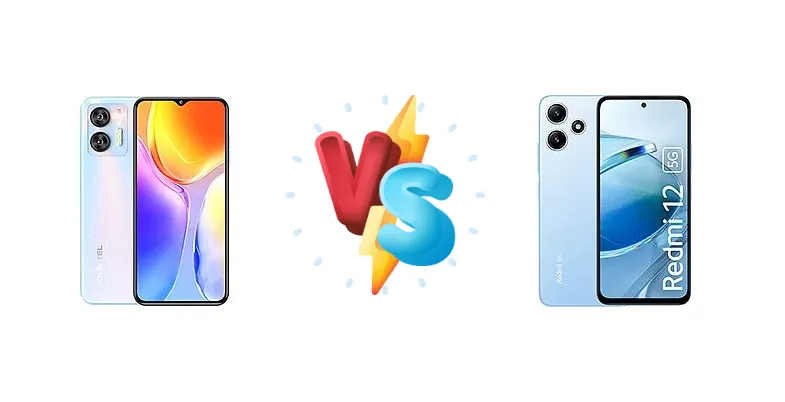
The sub-$200 5G smartphone market is heating up. The Oukitel C35 and Xiaomi Redmi 12 5G represent compelling options for users seeking affordable connectivity. However, they take distinctly different approaches to achieving this, primarily through their chipset choices. This comparison dissects those choices and their implications for everyday use.
🏆 Quick Verdict
For most users, the Xiaomi Redmi 12 5G is the better choice. Its Snapdragon 4 Gen 2, built on a more efficient 4nm process, delivers noticeably improved performance and thermal management compared to the Oukitel C35’s Unisoc Tiger T616. While the Oukitel offers a slightly lower entry price, the Redmi 12 5G’s superior efficiency and faster charging justify the small premium.
| Network |
|---|
| 2G bands | GSM 850 / 900 / 1800 / 1900 | GSM 850 / 900 / 1800 / 1900 |
| 3G bands | HSDPA 850 / 1700(AWS) / 1900 / 2100 | HSDPA 850 / 900 / 2100 |
| 4G bands | 1, 2, 3, 4, 5, 7, 8, 12, 17, 19, 20, 25, 26, 28, 66 | 1, 3, 5, 8, 40, 41 |
| 5G bands | - | 1, 3, 5, 8, 28, 40, 78 SA/NSA |
| Speed | HSPA, LTE | HSPA, LTE, 5G |
| Technology | GSM / HSPA / LTE | GSM / HSPA / LTE / 5G |
| Launch |
|---|
| Announced | 2023, August | 2023, August 01 |
| Status | Available. Released 2023, August | Available. Released 2023, August 04 |
| Body |
|---|
| Build | - | Glass front (Gorilla Glass), plastic frame, glass back (Gorilla Glass) |
| Dimensions | 163.8 x 75.4 x 9.2 mm (6.45 x 2.97 x 0.36 in) | 168.6 x 76.3 x 8.2 mm (6.64 x 3.00 x 0.32 in) |
| SIM | Nano-SIM + Nano-SIM | Nano-SIM + Nano-SIM |
| Weight | 199 g (7.02 oz) | 199 g (7.02 oz) |
| Display |
|---|
| Protection | - | Corning Gorilla Glass |
| Resolution | 720 x 1600 pixels, 20:9 ratio (~267 ppi density) | 1080 x 2460 pixels (~396 ppi density) |
| Size | 6.56 inches, 103.9 cm2 (~84.1% screen-to-body ratio) | 6.79 inches, 109.5 cm2 (~85.1% screen-to-body ratio) |
| Type | IPS LCD, 400 nits | IPS LCD, 90Hz, 550 nits |
| Platform |
|---|
| CPU | Octa-core (2x2.0 GHz Cortex-A75 & 6x1.8 GHz Cortex-A55) | Octa-core (2x2.2 GHz Cortex-A78 & 6x1.95 GHz Cortex-A55) |
| Chipset | Unisoc Tiger T616 (12 nm) | Qualcomm SM4450 Snapdragon 4 Gen 2 (4 nm) |
| GPU | Mali-G57 MP1 | Adreno 613 |
| OS | Android 13 | Android 13, upgradable to Android 15, HyperOS 2 |
| Memory |
|---|
| Card slot | microSDXC (dedicated slot) | microSDXC (uses shared SIM slot) |
| Internal | 256GB 12GB RAM | 128GB 4GB RAM, 128GB 6GB RAM, 128GB 8GB RAM, 256GB 8GB RAM |
| Main Camera |
|---|
| Dual | 50 MP, (wide), AF
Secondary unspecified camera | 50 MP, f/1.8, (wide), PDAF
Auxiliary lens |
| Features | Dual-LED flash, panorama | LED flash, HDR |
| Video | 1080p@30fps | 1080p@30fps |
| Selfie camera |
|---|
| Features | - | HDR |
| Single | 8 MP | 8 MP, f/2.0, (wide), 1.12µm |
| Video | Yes | 1080p@30fps |
| Sound |
|---|
| 35mm jack | Yes | Yes |
| Loudspeaker | Yes | Yes |
| Comms |
|---|
| Bluetooth | 5.1, A2DP, LE | 5.3, A2DP, LE |
| Infrared port | - | Yes |
| NFC | No | Unspecified |
| Positioning | GPS, GLONASS, GALILEO, BDS | GPS, GLONASS, GALILEO, BDS |
| Radio | Unspecified | No |
| USB | USB Type-C 2.0, OTG | USB Type-C |
| WLAN | Wi-Fi 802.11 a/b/g/n/ac, dual-band | Wi-Fi 802.11 a/b/g/n/ac, dual-band |
| Features |
|---|
| Sensors | Fingerprint (side-mounted), accelerometer, proximity | Fingerprint (side-mounted), accelerometer, compass |
| Battery |
|---|
| Charging | 10W wired | 18W wired, PD |
| Type | Li-Po 5150 mAh | Li-Po 5000 mAh |
| Misc |
|---|
| Colors | Black, Green, Light Blue | Jade Black, Pastel Blue, Moonstone Silver |
| Models | - | 23076RN4BI, 23076RN8DY, 2AFZZRN8DY |
| Price | About 190 EUR | € 104.09 / ₹ 15,999 |
| SAR | - | 1.09 W/kg (head) 0.88 W/kg (body) |
| SAR EU | - | 0.98 W/kg (head) 1.00 W/kg (body) |
Oukitel C35
- Potentially lower initial cost
- Likely similar battery capacity to Redmi 12 5G
- Functional for basic smartphone tasks
- Less powerful Unisoc Tiger T616 chipset
- Slower 10W charging
- Inferior thermal management
Xiaomi Redmi 12 5G
- More efficient Snapdragon 4 Gen 2 chipset
- Faster 18W charging with PD
- Better overall performance and multitasking
- Slightly higher price point
- May not offer significantly better camera performance in ideal conditions
- Potentially similar display quality to Oukitel C35
Display Comparison
Neither device is expected to deliver a flagship-level display experience. Specifics like panel type (IPS vs AMOLED) and resolution are not provided, but both likely target a 720p+ resolution. The key difference lies in processing power impacting UI smoothness. The Redmi 12 5G’s more powerful chipset will contribute to a more responsive experience when scrolling and navigating the interface, even if the panel itself is similar. Bezels are likely comparable given the price point.
Camera Comparison
Without detailed camera specs, a direct comparison is difficult. However, given the price bracket, both phones likely feature a primary sensor around 13-50MP. The Redmi 12 5G benefits from Qualcomm’s image signal processor (ISP), which generally provides better image processing capabilities, particularly in low-light conditions. The Oukitel C35 will rely on Unisoc’s ISP, which is less refined. Expect the Redmi 12 5G to produce more consistently good photos and videos. The inclusion of a 2MP macro lens on either device is largely a marketing gimmick and shouldn't heavily influence purchasing decisions.
Performance
The core of the difference lies in the chipsets. The Xiaomi Redmi 12 5G’s Qualcomm Snapdragon 4 Gen 2 (4nm) is a significant upgrade over the Oukitel C35’s Unisoc Tiger T616 (12nm). The 4nm process node is far more efficient, translating to lower heat generation and sustained performance. While both are octa-core CPUs, the Redmi 12 5G utilizes Cortex-A78 cores (2x2.2 GHz) which are architecturally superior to the C35’s Cortex-A75 cores (2x2.0 GHz). This means the Redmi 12 5G will handle demanding apps and multitasking with greater ease. The Redmi 12 5G will also benefit from Qualcomm’s optimizations for gaming.
Battery Life
Battery capacity is not specified for either device, but both likely fall in the 5000mAh range. The Redmi 12 5G’s 18W charging with Power Delivery (PD) is a clear advantage over the Oukitel C35’s 10W charging. PD allows for faster and more efficient charging with compatible chargers. This translates to significantly reduced charging times – expect the Redmi 12 5G to reach 100% much faster than the C35. The Snapdragon 4 Gen 2’s superior efficiency will also contribute to longer battery life in real-world usage.
Buying Guide
Buy the Oukitel C35 if your absolute priority is minimizing upfront cost and you primarily need a phone for basic tasks like calls, texts, and light social media. Buy the Xiaomi Redmi 12 5G if you value smoother multitasking, better gaming performance, and faster charging, even if it means spending a little more. The Redmi 12 5G is the better all-rounder for most users.
Frequently Asked Questions
❓ Will the Unisoc Tiger T616 in the Oukitel C35 struggle with demanding games like PUBG Mobile?
Yes, the Unisoc Tiger T616 is likely to struggle with PUBG Mobile at higher settings. You'll likely need to reduce graphics settings significantly to achieve playable frame rates, and even then, expect some stuttering. The Snapdragon 4 Gen 2 in the Redmi 12 5G will provide a much smoother gaming experience.
❓ How much faster is the 18W charging on the Redmi 12 5G compared to the 10W charging on the Oukitel C35?
The 18W charging with Power Delivery on the Redmi 12 5G will charge the phone considerably faster. While exact times depend on the charger and battery capacity, expect the Redmi 12 5G to reach a full charge in approximately 2-2.5 hours, while the Oukitel C35 could take 3.5-4 hours or longer.
❓ Does the Snapdragon 4 Gen 2 in the Redmi 12 5G offer noticeable improvements in app loading times compared to the Oukitel C35?
Yes, the Snapdragon 4 Gen 2’s faster CPU and GPU, combined with its more efficient architecture, will result in noticeably quicker app loading times. You’ll experience a snappier and more responsive user experience overall.