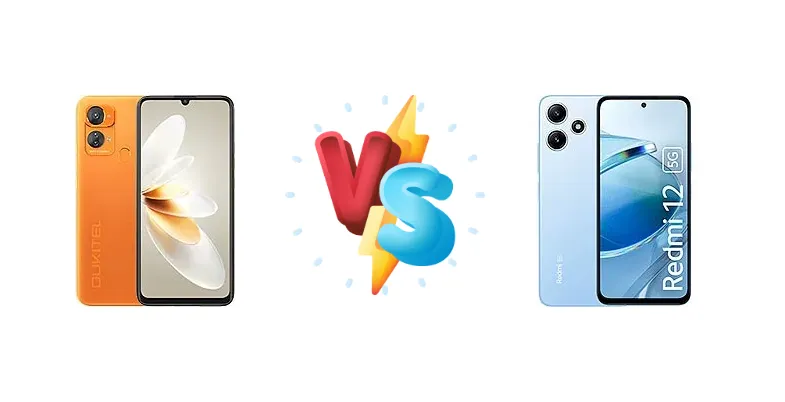
The sub-$200 smartphone market is fiercely competitive. The Oukitel C33 aims to deliver affordability, while the Xiaomi Redmi 12 5G brings 5G connectivity and a more modern chipset to the table. This comparison dissects the core differences between these two devices, focusing on where each excels and who will benefit most from their respective strengths.
🏆 Quick Verdict
For the average user prioritizing performance and future-proofing, the Xiaomi Redmi 12 5G is the clear winner. Its Snapdragon 4 Gen 2, built on a 4nm process, offers significantly better efficiency and processing power than the Oukitel C33’s Unisoc T606, despite both being octa-core CPUs.
| Network |
|---|
| 2G bands | GSM 850 / 900 / 1800 / 1900 | GSM 850 / 900 / 1800 / 1900 |
| 3G bands | HSDPA 850 / 900 / 2100 | HSDPA 850 / 900 / 2100 |
| 4G bands | LTE | 1, 3, 5, 8, 40, 41 |
| 5G bands | - | 1, 3, 5, 8, 28, 40, 78 SA/NSA |
| Speed | HSPA, LTE | HSPA, LTE, 5G |
| Technology | GSM / HSPA / LTE | GSM / HSPA / LTE / 5G |
| Launch |
|---|
| Announced | 2023, May | 2023, August 01 |
| Status | Available. Released 2023, May | Available. Released 2023, August 04 |
| Body |
|---|
| Build | - | Glass front (Gorilla Glass), plastic frame, glass back (Gorilla Glass) |
| Dimensions | 9.8 mm thickness | 168.6 x 76.3 x 8.2 mm (6.64 x 3.00 x 0.32 in) |
| SIM | Nano-SIM + Nano-SIM | Nano-SIM + Nano-SIM |
| Weight | 210 g (7.41 oz) | 199 g (7.02 oz) |
| Display |
|---|
| Protection | - | Corning Gorilla Glass |
| Resolution | 720 x 1600 pixels, 20:9 ratio (~258 ppi density) | 1080 x 2460 pixels (~396 ppi density) |
| Size | 6.8 inches, 111.6 cm2 | 6.79 inches, 109.5 cm2 (~85.1% screen-to-body ratio) |
| Type | IPS LCD, 450 nits | IPS LCD, 90Hz, 550 nits |
| Platform |
|---|
| CPU | Octa-core (2x1.6 GHz Cortex-A75 & 6x1.6 GHz Cortex-A55) | Octa-core (2x2.2 GHz Cortex-A78 & 6x1.95 GHz Cortex-A55) |
| Chipset | Unisoc T606 (12 nm) | Qualcomm SM4450 Snapdragon 4 Gen 2 (4 nm) |
| GPU | Mali-G57 MP1 | Adreno 613 |
| OS | Android 13 | Android 13, upgradable to Android 15, HyperOS 2 |
| Memory |
|---|
| Card slot | microSDXC (dedicated slot) | microSDXC (uses shared SIM slot) |
| Internal | 256GB 8GB RAM | 128GB 4GB RAM, 128GB 6GB RAM, 128GB 8GB RAM, 256GB 8GB RAM |
| Main Camera |
|---|
| Dual | - | 50 MP, f/1.8, (wide), PDAF
Auxiliary lens |
| Features | LED flash, panorama | LED flash, HDR |
| Triple | 50 MP, (wide), AF
Other unspecified cameras | - |
| Video | 1080p@30fps | 1080p@30fps |
| Selfie camera |
|---|
| Features | - | HDR |
| Single | 5 MP | 8 MP, f/2.0, (wide), 1.12µm |
| Video | Yes | 1080p@30fps |
| Sound |
|---|
| 35mm jack | Yes | Yes |
| Loudspeaker | Yes | Yes |
| Comms |
|---|
| Bluetooth | 5.0, A2DP, LE | 5.3, A2DP, LE |
| Infrared port | - | Yes |
| NFC | No | Unspecified |
| Positioning | GPS, GLONASS, GALILEO, BDS | GPS, GLONASS, GALILEO, BDS |
| Radio | Unspecified | No |
| USB | USB Type-C 2.0 | USB Type-C |
| WLAN | Yes | Wi-Fi 802.11 a/b/g/n/ac, dual-band |
| Features |
|---|
| Sensors | Fingerprint (rear-mounted); unspecified sensors | Fingerprint (side-mounted), accelerometer, compass |
| Battery |
|---|
| Charging | - | 18W wired, PD |
| Type | Li-Po 5150 mAh | Li-Po 5000 mAh |
| Misc |
|---|
| Colors | Gray, Blue, Orange | Jade Black, Pastel Blue, Moonstone Silver |
| Models | - | 23076RN4BI, 23076RN8DY, 2AFZZRN8DY |
| Price | About 160 EUR | € 104.09 / ₹ 15,999 |
| SAR | - | 1.09 W/kg (head) 0.88 W/kg (body) |
| SAR EU | - | 0.98 W/kg (head) 1.00 W/kg (body) |
Oukitel C33
- Potentially lower price point
- Functional for basic smartphone tasks
- May offer larger storage options (depending on configuration)
- Significantly less powerful processor
- Less efficient chipset leading to shorter battery life
- Likely slower software experience
Xiaomi Redmi 12 5G
- More powerful and efficient Snapdragon 4 Gen 2 processor
- 5G connectivity for faster data speeds
- 18W charging with PD for faster and versatile charging
- Slightly higher price point
- May have limited storage options in base configurations
- LCD display isn't premium
Display Comparison
Neither device boasts a standout display. While specific display specs (resolution, brightness) are missing for the Oukitel C33, its market positioning suggests a basic LCD panel. The Redmi 12 5G, similarly, is expected to feature a standard LCD. The key difference lies in the underlying processing power impacting UI smoothness. A more powerful chipset, like the Snapdragon 4 Gen 2, will translate to a more responsive experience when navigating the interface, even on a similar panel.
Camera Comparison
Without detailed camera specifications for the Oukitel C33, a direct comparison is limited. However, both phones likely feature budget-oriented camera systems. The Redmi 12 5G, given Xiaomi’s camera expertise, is expected to offer more refined image processing and potentially better low-light performance. The focus should be on the main sensor quality; the presence of 2MP macro or depth sensors on either device adds minimal value. The Snapdragon’s ISP (Image Signal Processor) will also contribute to faster image capture and processing speeds.
Performance
The performance gap is the most significant differentiator. The Xiaomi Redmi 12 5G’s Qualcomm SM4450 Snapdragon 4 Gen 2 (4nm) is a substantial upgrade over the Oukitel C33’s Unisoc T606 (12nm). The 4nm fabrication process delivers superior power efficiency, meaning less heat generation and sustained performance under load. Furthermore, the Redmi 12 5G utilizes Cortex-A78 cores in its CPU, a more advanced architecture than the Cortex-A75 cores found in the Oukitel C33. This translates to approximately 20% faster single-core performance, noticeable in app launch times and general responsiveness. The Redmi 12 5G also benefits from the Snapdragon's optimized GPU, providing a better gaming experience.
Battery Life
The Oukitel C33’s battery capacity is unknown, but given its price point, it’s likely comparable to the Redmi 12 5G’s. However, the Redmi 12 5G’s 18W charging with PD (Power Delivery) offers a more versatile and potentially faster charging experience. More importantly, the Snapdragon 4 Gen 2’s superior power efficiency means the Redmi 12 5G will likely achieve similar or better battery life despite potentially having a similar capacity, due to reduced power draw during everyday use.
Buying Guide
Buy the Oukitel C33 if you need a basic, functional smartphone for essential tasks like calls, texts, and light social media, and are prioritizing the absolute lowest price point. Buy the Xiaomi Redmi 12 5G if you prefer a smoother user experience, faster app loading times, 5G connectivity, and a more efficient processor that will hold up better over time, even if it means spending a bit more upfront.
Frequently Asked Questions
❓ Will the Unisoc T606 in the Oukitel C33 struggle with multitasking?
Yes, the Unisoc T606 is a budget-oriented processor. While it can handle basic multitasking, running multiple demanding apps simultaneously will likely result in noticeable slowdowns and lag. The Redmi 12 5G’s Snapdragon 4 Gen 2 is significantly better equipped for multitasking due to its more powerful CPU cores and efficient architecture.
❓ Does the Redmi 12 5G support carrier aggregation for improved 5G speeds?
While specific carrier aggregation support varies by region and carrier, Qualcomm Snapdragon chipsets generally offer robust carrier aggregation capabilities. This means the Redmi 12 5G is more likely to achieve faster and more stable 5G speeds compared to a device with a Unisoc chipset, assuming your carrier supports it.
❓ Is the 18W charging on the Redmi 12 5G significantly faster than what the Oukitel C33 likely offers?
Yes, 18W charging with Power Delivery (PD) is a noticeable improvement over the charging speeds typically found on phones in the Oukitel C33’s price range. PD allows for faster and more efficient charging with compatible chargers, and the Redmi 12 5G’s chipset is optimized for this charging standard.