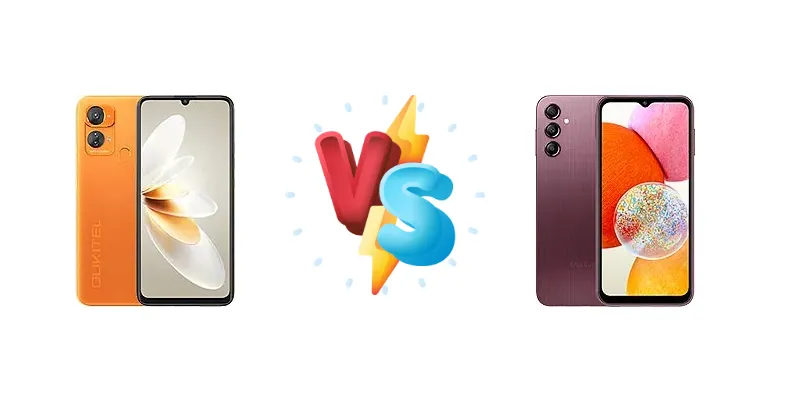
The sub-$200 smartphone market is fiercely competitive. The Oukitel C33 and Samsung Galaxy A14 both aim to deliver essential smartphone functionality at an accessible price point, but they take different approaches. The C33 relies on the Unisoc T606, while the A14 offers a choice between the Mediatek Helio G80 and the Exynos 850, creating a significant performance disparity.
🏆 Quick Verdict
For the average user, the Samsung Galaxy A14 (especially the Exynos 850 variant) is the better choice. While the Oukitel C33 offers a compelling price, the A14’s more powerful chipset options and Samsung’s software support provide a smoother, more future-proof experience.
| Network |
|---|
| 2G bands | GSM 850 / 900 / 1800 / 1900 | GSM 850 / 900 / 1800 / 1900 |
| 3G bands | HSDPA 850 / 900 / 2100 | HSDPA 850 / 900 / 2100 |
| 4G bands | LTE | 1, 3, 5, 7, 8, 20, 28, 38, 40, 41 |
| Speed | HSPA, LTE | HSPA, LTE |
| Technology | GSM / HSPA / LTE | GSM / HSPA / LTE |
| Launch |
|---|
| Announced | 2023, May | 2023, February 28 |
| Status | Available. Released 2023, May | Available. Released 2023, March 27 |
| Body |
|---|
| Build | - | Glass front, plastic back, plastic frame |
| Dimensions | 9.8 mm thickness | 167.7 x 78 x 9.1 mm (6.60 x 3.07 x 0.36 in) |
| SIM | Nano-SIM + Nano-SIM | · Nano-SIM· Nano-SIM + Nano-SIM |
| Weight | 210 g (7.41 oz) | 201 g (7.09 oz) |
| Display |
|---|
| Resolution | 720 x 1600 pixels, 20:9 ratio (~258 ppi density) | 1080 x 2408 pixels, 20:9 ratio (~400 ppi density) |
| Size | 6.8 inches, 111.6 cm2 | 6.6 inches, 104.9 cm2 (~80.2% screen-to-body ratio) |
| Type | IPS LCD, 450 nits | PLS LCD |
| Platform |
|---|
| CPU | Octa-core (2x1.6 GHz Cortex-A75 & 6x1.6 GHz Cortex-A55) | Octa-core (2x2.0 GHz Cortex-A75 & 6x1.8 GHz Cortex-A55) - Version AOcta-core (4x2.0 GHz Cortex-A55 & 4x2.0 GHz Cortex-A55) - Version B |
| Chipset | Unisoc T606 (12 nm) | Mediatek MT6769 Helio G80 (12 nm) - Version AExynos 850 (8 nm) - Version B |
| GPU | Mali-G57 MP1 | Mali-G52 MC2 |
| OS | Android 13 | Android 13, upgradable to Android 15, One UI 7 |
| Memory |
|---|
| Card slot | microSDXC (dedicated slot) | microSDXC (dedicated slot) |
| Internal | 256GB 8GB RAM | 64GB 4GB RAM, 128GB 4GB RAM, 128GB 6GB RAM |
| Main Camera |
|---|
| Features | LED flash, panorama | LED flash, panorama, HDR |
| Single | - | 13 MP, f/2.0, (wide) |
| Triple | 50 MP, (wide), AF
Other unspecified cameras | 50 MP, f/1.8, 26mm (wide), 1/2.75", 0.64µm, PDAF
5 MP, f/2.2, 17mm (ultrawide), 1/5.0", 1.12µm
2 MP (macro) |
| Video | 1080p@30fps | 1080p@30fps |
| Selfie camera |
|---|
| Single | 5 MP | 13 MP, f/2.0, 26mm (wide), 1/3.1", 1.12µm |
| Video | Yes | 1080p@30fps |
| Sound |
|---|
| 3.5mm jack | - | Yes |
| 35mm jack | Yes | Yes |
| Loudspeaker | Yes | Yes |
| Comms |
|---|
| Bluetooth | 5.0, A2DP, LE | 5.1 or 5.3, A2DP, LE |
| NFC | No | Yes (market/region dependent) |
| Positioning | GPS, GLONASS, GALILEO, BDS | GPS, GALILEO, GLONASS, BDS, QZSS |
| Radio | Unspecified | Unspecified |
| USB | USB Type-C 2.0 | USB Type-C 2.0 |
| WLAN | Yes | Wi-Fi 802.11 a/b/g/n/ac, dual-band, Wi-Fi Direct |
| Features |
|---|
| Sensors | Fingerprint (rear-mounted); unspecified sensors | Fingerprint (side-mounted), accelerometer, proximity, compass |
| Battery |
|---|
| Charging | - | 15W wired |
| Type | Li-Po 5150 mAh | Li-Po 5000 mAh |
| Misc |
|---|
| Colors | Gray, Blue, Orange | Black, Dark Red, Silver, Green |
| Models | - | SM-A145F, SM-A145F/DSN, SM-A145M, SM-A145M/DS, SM-A145P, SM-A145R |
| Price | About 160 EUR | € 85.76 / $ 147.60 / £ 79.95 |
| SAR EU | - | 0.46 W/kg (head) 1.37 W/kg (body) |
Oukitel C33
- Lowest possible price point
- Potentially longer battery life under light use
- Functional for basic smartphone tasks
- Less powerful chipset
- Limited software support
- Inferior performance for gaming and multitasking
Samsung Galaxy A14
- More powerful chipset options (Helio G80/Exynos 850)
- Samsung’s software ecosystem and updates
- Better performance for demanding apps and games
- Higher price than Oukitel C33
- 15W charging is relatively slow
- May still exhibit some performance limitations with demanding games
Display Comparison
Neither device boasts a standout display. Both are likely to utilize LCD panels, common in this price bracket. Specifics like resolution and refresh rate are missing, but the focus here is on processing power, not visual fidelity. Bezels are expected to be noticeable on both. Color accuracy will likely be standard for the segment, prioritizing power efficiency over color calibration.
Camera Comparison
Camera performance is likely to be similar in real-world usage, with both phones relying on software processing to enhance image quality. Details on sensor sizes are unavailable, but both will likely feature a primary sensor paired with auxiliary lenses of limited utility (like a 2MP macro). The A14’s image processing, benefiting from Samsung’s experience, is likely to produce more consistent results. The Oukitel C33’s camera system is likely to be more basic, focusing on capturing snapshots rather than detailed photography.
Performance
This is where the biggest difference lies. The Samsung Galaxy A14 offers two chipset options: the Mediatek Helio G80 and the Exynos 850. The Helio G80, built on a 12nm process, features a CPU clocked up to 2.0 GHz, utilizing two Cortex-A75 cores for performance and six Cortex-A55 cores for efficiency. The Oukitel C33’s Unisoc T606, also 12nm, has a similar core configuration (2x1.6 GHz Cortex-A75 & 6x1.6 GHz Cortex-A55) but with slightly lower clock speeds. The Exynos 850, built on an 8nm process, represents a significant leap in efficiency and performance, offering a more responsive experience. The 8nm node allows for better thermal management, reducing throttling during sustained tasks. The A14, particularly with the Exynos 850, will handle multitasking and demanding apps more effectively.
Battery Life
Both devices likely feature batteries in the 5000mAh range, typical for this price point. The Oukitel C33’s less powerful chipset may translate to slightly better battery life under light usage. However, the Samsung Galaxy A14’s more efficient Exynos 850 (if equipped) will offer a better balance of performance and endurance. The A14 supports 15W wired charging, while charging speed for the C33 is unknown, but likely similar or slower.
Buying Guide
Buy the Oukitel C33 if you prioritize absolute lowest cost and basic functionality – it’s a suitable option for first-time smartphone users or as a secondary device. Buy the Samsung Galaxy A14 if you value performance for social media, streaming, and light gaming, alongside the reliability and software updates associated with the Samsung brand. The Exynos 850 version is preferable if available.
Frequently Asked Questions
❓ Does the Exynos 850 chip in the Samsung Galaxy A14 overheat during prolonged gaming sessions?
The Exynos 850, built on an 8nm process, is significantly more thermally efficient than the Unisoc T606. While it may get warm during extended gaming, it’s less prone to significant throttling, providing a more consistent frame rate compared to the C33.
❓ Is the 2MP macro camera on either phone actually useful for taking detailed close-up photos?
Generally, 2MP macro cameras on budget phones offer limited detail and image quality. They are often included for marketing purposes but rarely deliver impressive results. Expect soft, noisy images with limited clarity.
❓ Can the Samsung Galaxy A14 (Helio G80 version) reliably run PUBG Mobile at 60fps?
The Helio G80 can run PUBG Mobile, but achieving a consistent 60fps will likely require lowering graphics settings to medium or low. The Exynos 850 version will offer a smoother experience at higher settings.
❓ How long will software updates be supported on the Oukitel C33 compared to the Samsung Galaxy A14?
Samsung typically provides longer software support for its devices than smaller brands like Oukitel. Expect the Galaxy A14 to receive more frequent security updates and potentially one or two major Android version upgrades, while the C33’s support is likely to be limited.