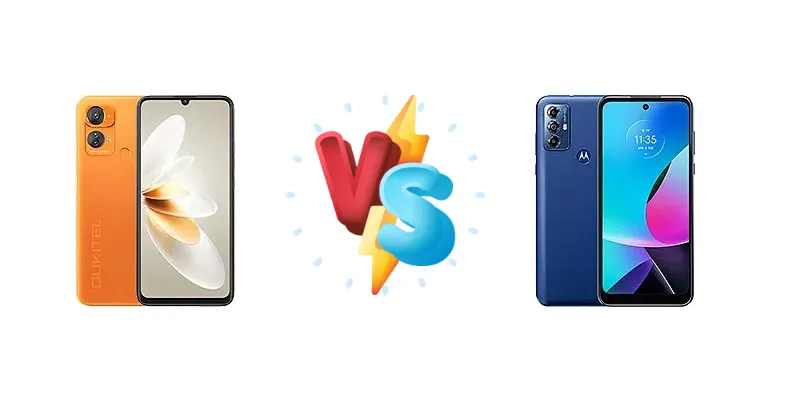
The sub-$150 smartphone market is fiercely competitive. Both the Oukitel C33 and the Motorola Moto G Play (2023) aim to deliver essential smartphone functionality at an accessible price. However, they take different approaches to achieving this, primarily through their chipset choices. This comparison dissects those differences and determines which device offers the best value for your money.
🏆 Quick Verdict
For the average user prioritizing responsiveness and overall performance, the Oukitel C33 emerges as the better choice. Its Unisoc T606, with its Cortex-A75 cores, provides a noticeable performance edge over the Moto G Play’s Helio G37, despite the latter’s higher clock speeds on its less efficient Cortex-A53 cores. While the Moto G Play benefits from Motorola’s clean software, the C33’s chipset advantage is more impactful for daily tasks.
| Network |
|---|
| 2G bands | GSM 850 / 900 / 1800 / 1900 | GSM 850 / 900 / 1800 / 1900 |
| 3G bands | HSDPA 850 / 900 / 2100 | HSDPA 850 / 900 / 1700(AWS) / 1900 / 2100 |
| 4G bands | LTE | 1, 2, 3, 4, 5, 7, 8, 12, 13, 14, 17, 18, 19, 20, 25, 26, 29, 30, 38, 39, 40, 41, 66, 71 |
| Speed | HSPA, LTE | HSPA, LTE |
| Technology | GSM / HSPA / LTE | GSM / CDMA / HSPA / LTE |
| | - | CDMA 800 / 1900 |
| Launch |
|---|
| Announced | 2023, May | 2022, December 08 |
| Status | Available. Released 2023, May | Available. Released 2022, December 12 |
| Body |
|---|
| Build | - | Plastic frame, plastic back |
| Dimensions | 9.8 mm thickness | 167.2 x 76.5 x 9.4 mm (6.58 x 3.01 x 0.37 in) |
| SIM | Nano-SIM + Nano-SIM | Nano-SIM |
| Weight | 210 g (7.41 oz) | 203 g (7.20 oz) |
| | - | Water-repellent coating |
| Display |
|---|
| Resolution | 720 x 1600 pixels, 20:9 ratio (~258 ppi density) | 720 x 1600 pixels, 20:9 ratio (~270 ppi density) |
| Size | 6.8 inches, 111.6 cm2 | 6.5 inches, 102.0 cm2 (~79.7% screen-to-body ratio) |
| Type | IPS LCD, 450 nits | IPS LCD, 90Hz |
| Platform |
|---|
| CPU | Octa-core (2x1.6 GHz Cortex-A75 & 6x1.6 GHz Cortex-A55) | Octa-core (4x2.3 GHz Cortex-A53 & 4x1.8 GHz Cortex-A53) |
| Chipset | Unisoc T606 (12 nm) | Mediatek MT6765 Helio G37 (12 nm) |
| GPU | Mali-G57 MP1 | PowerVR GE8320 |
| OS | Android 13 | Android 12 |
| Memory |
|---|
| Card slot | microSDXC (dedicated slot) | microSDXC (dedicated slot) |
| Internal | 256GB 8GB RAM | 32GB 3GB RAM |
| | - | eMMC 5.1 |
| Main Camera |
|---|
| Features | LED flash, panorama | LED flash, HDR, panorama |
| Triple | 50 MP, (wide), AF
Other unspecified cameras | 16 MP, f/2.2, (wide), 1.12µm, PDAF
2 MP (macro)
Auxiliary lens |
| Video | 1080p@30fps | 1080p@30/60fps |
| Selfie camera |
|---|
| Features | - | HDR |
| Single | 5 MP | 5 MP, f/2.4, (wide), 1.12µm |
| Video | Yes | 1080p@30fps |
| Sound |
|---|
| 3.5mm jack | - | Yes |
| 35mm jack | Yes | Yes |
| Loudspeaker | Yes | Yes |
| Comms |
|---|
| Bluetooth | 5.0, A2DP, LE | 5.0, A2DP, LE |
| NFC | No | No |
| Positioning | GPS, GLONASS, GALILEO, BDS | GPS, GLONASS |
| Radio | Unspecified | No |
| USB | USB Type-C 2.0 | USB Type-C 2.0 |
| WLAN | Yes | Wi-Fi 802.11 a/b/g/n/ac, dual-band |
| Features |
|---|
| Sensors | Fingerprint (rear-mounted); unspecified sensors | Fingerprint (rear-mounted), accelerometer, proximity, barometer |
| Battery |
|---|
| Charging | - | 10W wired |
| Type | Li-Po 5150 mAh | Li-Po 5000 mAh |
| Misc |
|---|
| Colors | Gray, Blue, Orange | Deep Indigo |
| Models | - | XT2271-1, XT2271-3, XT2271-5, XT2271-4 |
| Price | About 160 EUR | $ 54.00 / C$ 129.00 |
Oukitel C33
- More responsive chipset with Cortex-A75 cores
- Potentially faster charging (spec not confirmed)
- Better overall performance for multitasking
- Software experience may not be as refined as Motorola
- Display specs are unknown and likely basic
Motorola Moto G Play (2023)
- Clean, near-stock Android experience
- Motorola’s reputation for software updates (though limited)
- Reliable battery life with 5000mAh capacity
- Less powerful chipset with older Cortex-A53 architecture
- Slow 10W charging
- Performance may struggle with demanding apps
Display Comparison
Neither device boasts a standout display. Both utilize panels likely around 6.5-6.6 inches, typical for this price bracket. However, detailed specs like resolution and brightness are missing. Given the market segment, expect 720p+ resolutions. The focus here isn't on visual fidelity, but on basic usability. Bezels are likely to be substantial on both, and color accuracy will be standard for budget displays. Without further data, a clear winner is impossible to declare.
Camera Comparison
Camera performance is likely to be similar on both devices, leaning towards basic functionality. Both will likely feature a primary camera around 13MP, and potentially a secondary depth or macro sensor (often 2MP, and largely irrelevant). Image processing will be the differentiating factor, and Motorola generally offers more refined software algorithms. However, without detailed sensor size or aperture information, it’s difficult to assess the low-light performance. Expect acceptable results in good lighting conditions, but struggles in challenging environments. The G37's ISP may offer slightly better noise reduction, but the C33's chipset could compensate with software enhancements.
Performance
This is where the key difference lies. The Oukitel C33’s Unisoc T606 features two Cortex-A75 cores clocked at 1.6 GHz alongside six Cortex-A55 cores. This architecture provides a significant advantage in single-core performance compared to the Motorola Moto G Play (2023)’s MediaTek Helio G37, which relies on four Cortex-A53 cores clocked at 2.3 GHz and another four at 1.8 GHz. While the G37’s higher clock speeds *seem* better, the A53 architecture is less efficient and less capable than the A75. The A75 cores in the C33 will handle demanding tasks more effectively. The 12nm process node is shared, so thermal management should be comparable, but the C33 will likely complete tasks faster. The G37's GPU is adequate for basic gaming, but the T606 will offer a smoother experience overall.
Battery Life
Both devices likely house batteries around 5000mAh, standard for this price point. However, the Motorola Moto G Play (2023) is limited to 10W wired charging. The Oukitel C33’s charging speed is unspecified, but even a modest 15W charger would provide a significant advantage in topping up the battery. While 5000mAh provides all-day battery life for moderate users on both devices, the slower charging on the Moto G Play will be a drawback for those who need quick top-ups.
Buying Guide
Buy the Oukitel C33 if you need a phone that feels more responsive for everyday tasks like browsing, social media, and light multitasking. Its chipset architecture provides a smoother experience. Buy the Motorola Moto G Play (2023) if you prioritize a clean, near-stock Android experience and are willing to trade some performance for that software simplicity, and if 10W charging is sufficient for your needs.
Frequently Asked Questions
❓ Will the Unisoc T606 in the Oukitel C33 handle popular games like PUBG Mobile?
The Unisoc T606 can run PUBG Mobile, but you'll likely need to lower the graphics settings to medium or low for a smooth experience. The Helio G37 in the Moto G Play will struggle more with consistent frame rates, even at lower settings. The T606's architecture provides a better foundation for gaming.
❓ How much of a difference will the 10W charging on the Moto G Play make in daily use?
The 10W charging on the Moto G Play is a significant drawback. Expect a 0-100% charge to take over 3 hours. If you frequently need to top up your phone throughout the day, this will be frustrating. The Oukitel C33, if it supports even 15W charging, will be considerably faster.
❓ Does the Motorola Moto G Play (2023) receive regular software updates?
Motorola provides a relatively clean Android experience and typically offers at least one major OS update and a few security patches. However, update support for budget devices like the Moto G Play is often limited compared to higher-end models. Don't expect the same level of long-term support as a flagship phone.