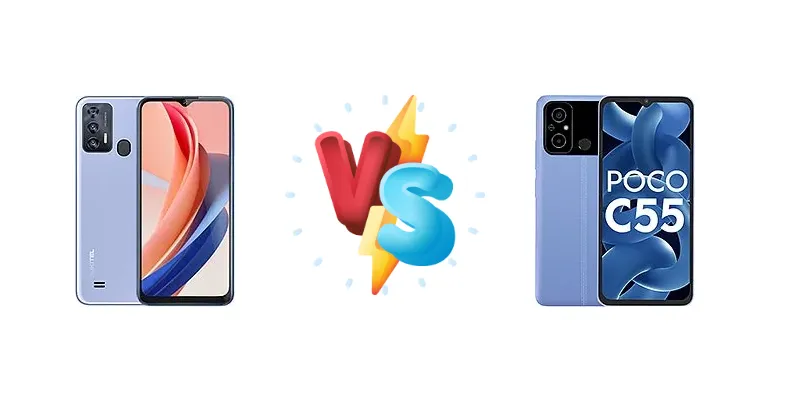
The sub-$150 smartphone market is fiercely competitive. Both the Oukitel C31 Pro and the Xiaomi Poco C55 aim to deliver essential smartphone functionality at an accessible price. However, they take different approaches to achieving this, with the Poco C55 boasting a more modern chipset while the Oukitel C31 Pro focuses on a more basic, streamlined experience. This comparison will dissect their key differences to determine which device offers the best value.
🏆 Quick Verdict
For most users, the Xiaomi Poco C55 is the superior choice. Its Helio G85 chipset provides a noticeable performance uplift over the Oukitel C31 Pro’s Helio P22, translating to smoother multitasking and a more responsive user experience. While the C31 Pro may appeal to those prioritizing simplicity, the C55’s extra processing power justifies the slight price difference.
| Network |
|---|
| 2G bands | GSM 850 / 900 / 1800 / 1900 | GSM 850 / 900 / 1800 / 1900 |
| 3G bands | HSDPA 850 / 900 / 2100 | HSDPA 850 / 900 / 2100 |
| 4G bands | LTE | 1, 3, 5, 8, 40, 41 |
| Speed | HSPA, LTE | HSPA, LTE |
| Technology | GSM / HSPA / LTE | GSM / HSPA / LTE |
| Launch |
|---|
| Announced | 2022, December | 2023, February 21 |
| Status | Available. Released 2022, December | Available. Released 2023, February 28 |
| Body |
|---|
| Build | - | Glass front (Panda Glass), eco leather back |
| Dimensions | 9.5 mm thickness | 168.8 x 76.4 x 8.8 mm (6.65 x 3.01 x 0.35 in) |
| SIM | Nano-SIM + Nano-SIM | Nano-SIM + Nano-SIM |
| Weight | 212 g (7.48 oz) | 192 g (6.77 oz) |
| | - | Dust and splash resistant |
| Display |
|---|
| Protection | - | Panda Glass |
| Resolution | 720 x 1600 pixels, 20:9 ratio (~269 ppi density) | 720 x 1650 pixels (~268 ppi density) |
| Size | 6.52 inches, 102.6 cm2 | 6.71 inches, 106.5 cm2 (~82.6% screen-to-body ratio) |
| Type | IPS LCD, 400 nits | IPS LCD |
| Platform |
|---|
| CPU | Octa-core 2.0 GHz Cortex-A53 | Octa-core (2x2.0 GHz Cortex-A75 & 6x1.8 GHz Cortex-A55) |
| Chipset | Mediatek MT6762 Helio P22 (12 nm) | Mediatek MT6769Z Helio G85 (12 nm) |
| GPU | PowerVR GE8320 | Mali-G52 MC2 |
| OS | Android 12 | Android 12, MIUI 13 for POCO |
| Memory |
|---|
| Card slot | microSDXC (dedicated slot) | microSDXC (dedicated slot) |
| Internal | 64GB 4GB RAM | 64GB 4GB RAM, 128GB 6GB RAM |
| | - | eMMC 5.1 |
| Main Camera |
|---|
| Dual | - | 50 MP, f/1.8, (wide), PDAF
0.08 MP (depth) |
| Features | LED flash | LED flash, HDR |
| Single | - | 50 MP, f/1.8, (wide), PDAF
Auxiliary lens |
| Triple | 13 MP, (wide), AF
Other unspecified cameras | - |
| Video | 1080p@30fps | 1080p@30fps |
| Selfie camera |
|---|
| Features | - | HDR |
| Single | 5 MP | 5 MP |
| Video | Yes | 1080p@30fps |
| Sound |
|---|
| 3.5mm jack | - | Yes |
| 35mm jack | Yes | Yes |
| Loudspeaker | Yes | Yes |
| Comms |
|---|
| Bluetooth | Yes | 5.0, A2DP, LE |
| NFC | No | No |
| Positioning | GPS, GLONASS, GALILEO, BDS | GPS, GLONASS, GALILEO, BDS, QZSS |
| Radio | Unspecified | FM radio, recording |
| USB | USB Type-C 2.0 | microUSB 2.0, OTG |
| WLAN | Yes | Wi-Fi 802.11 a/b/g/n/ac, dual-band |
| Features |
|---|
| Sensors | Fingerprint (rear-mounted); unspecified sensors | Fingerprint (rear-mounted), accelerometer |
| | - | Virtual proximity sensing |
| Battery |
|---|
| Charging | - | 10W wired |
| Type | Li-Po 5150 mAh | Li-Po 5000 mAh |
| Misc |
|---|
| Colors | Blue, Purple, Black | Cool Blue, Power Black, Forest Green |
| Models | - | 22127PC95I |
| Price | About 110 EUR | About 110 EUR |
| SAR | - | 0.87 W/kg (head) 0.77 W/kg (body) |
Oukitel C31 Pro
- Potentially lower price point
- Simpler software experience
- May offer slightly longer battery life under light use
- Significantly weaker performance
- Outdated chipset
- Likely limited software updates
Xiaomi Poco C55
- Superior performance with Helio G85
- More responsive user experience
- Better multitasking capabilities
- Xiaomi’s established software support
- Slower 10W charging
- Potentially higher price
- May have more pre-installed bloatware
Display Comparison
Neither device boasts a standout display. Both utilize 12nm chipsets, suggesting similar power constraints impacting display capabilities. While specific display specs (resolution, brightness) are missing for the Oukitel C31 Pro, it's reasonable to assume a similar LCD panel to the Poco C55. The Poco C55’s display is adequate for everyday use, but lacks features like high refresh rates or HDR support. The focus here is clearly on cost reduction, meaning neither phone will impress display enthusiasts.
Camera Comparison
Camera performance is likely to be similar, given both phones target the budget segment. Without detailed sensor information for the Oukitel C31 Pro, it’s safe to assume a similar reliance on software processing to enhance image quality. The Poco C55’s camera setup is likely to be more refined due to Xiaomi’s established image processing algorithms. Both phones will likely struggle in low-light conditions, and the inclusion of 2MP macro lenses on both devices is largely for marketing purposes, offering limited practical benefit. Expect acceptable results in good lighting conditions, but don't anticipate flagship-level image quality.
Performance
The core difference lies in the chipsets. The Xiaomi Poco C55’s Mediatek Helio G85 is a significant upgrade over the Oukitel C31 Pro’s Helio P22. The G85 features a combination of two Cortex-A75 cores (2.0 GHz) and six Cortex-A55 cores (1.8 GHz), offering a more balanced and powerful architecture compared to the P22’s eight Cortex-A53 cores (2.0 GHz). The A75 cores provide a substantial boost in single-core performance, crucial for app launch times and responsiveness. While both are 12nm chips, the G85’s architecture delivers superior multi-core performance, benefiting multitasking and light gaming. The Poco C55 will handle demanding apps and games with noticeably less lag.
Battery Life
Battery life will depend heavily on usage patterns. While specific battery capacities are not provided, the Poco C55’s 10W charging is a notable drawback. The Helio G85 is more power-hungry than the Helio P22, potentially offsetting any gains from a larger battery (if present). The Oukitel C31 Pro, with its less demanding chipset, may offer slightly longer battery life under light usage. However, the slower charging speed on both devices means topping up the battery will take a considerable amount of time.
Buying Guide
Buy the Oukitel C31 Pro if you need a truly basic smartphone for calls, texts, and light app usage, and prioritize a simple, uncluttered software experience. You're willing to sacrifice performance for a potentially lower price point. Buy the Xiaomi Poco C55 if you prefer a phone capable of handling moderate multitasking, occasional gaming, and benefit from a more powerful processor for future-proofing and a smoother overall experience.
Frequently Asked Questions
❓ Will the Poco C55 struggle with popular games like PUBG Mobile?
The Helio G85 in the Poco C55 can handle PUBG Mobile, but you'll likely need to lower the graphics settings to medium or low to achieve a consistently smooth frame rate. The Oukitel C31 Pro’s Helio P22 would likely struggle significantly, even on the lowest settings.
❓ How much bloatware comes pre-installed on the Poco C55?
Xiaomi phones are known to include some pre-installed apps (bloatware). While the amount varies, you can typically uninstall or disable most of these apps to free up storage space and improve performance. The Oukitel C31 Pro may have less bloatware, but its software support is likely to be less frequent.
❓ Is the 10W charging on the Poco C55 a major drawback?
Yes, 10W charging is relatively slow by today's standards. Expect it to take several hours to fully charge the device from 0%. This is a compromise to keep the price down, but it requires planning your charging schedule.
❓ Does the Oukitel C31 Pro receive regular software updates?
Oukitel typically provides limited software updates for its budget devices. Don't expect frequent security patches or major Android version upgrades. The Poco C55, being a Xiaomi device, is more likely to receive at least some level of software support.