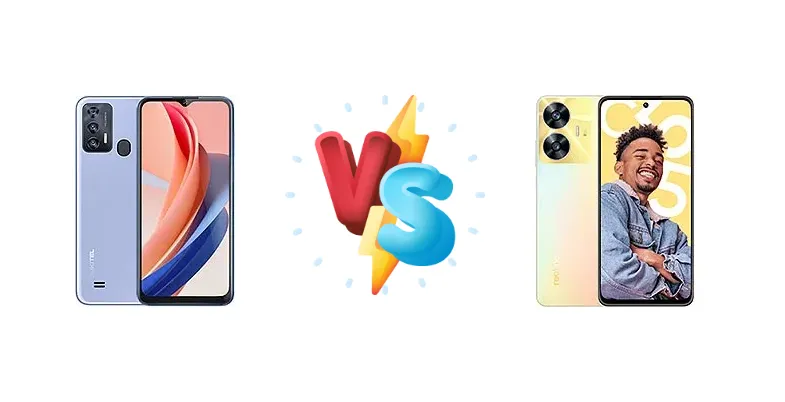
The sub-$200 smartphone market is fiercely competitive. Both the Oukitel C31 Pro and the Realme C55 aim to deliver essential smartphone functionality at an accessible price point. However, they take different approaches to achieving this, with the Realme C55 prioritizing performance and charging speed, while the Oukitel C31 Pro appears to focus on a more basic, cost-optimized experience. This comparison will dissect their key differences to help you determine which device best suits your needs.
🏆 Quick Verdict
For the vast majority of users, the Realme C55 is the superior choice. Its Helio G88 chipset provides a noticeable performance uplift over the Oukitel C31 Pro’s Helio P22, and the 33W charging significantly reduces downtime. While both phones share similar battery endurance ratings, the Realme C55’s faster charging makes that endurance more practical.
| Network |
|---|
| 2G bands | GSM 850 / 900 / 1800 / 1900 | GSM 850 / 900 / 1800 / 1900 |
| 3G bands | HSDPA 850 / 900 / 2100 | HSDPA 850 / 900 / 2100 |
| 4G bands | LTE | 1, 3, 5, 8, 38, 40, 41 |
| Speed | HSPA, LTE | HSPA, LTE |
| Technology | GSM / HSPA / LTE | GSM / HSPA / LTE |
| Launch |
|---|
| Announced | 2022, December | 2023, March 07 |
| Status | Available. Released 2022, December | Available. Released 2023, March 08 |
| Body |
|---|
| Build | - | Glass front, plastic frame, plastic back |
| Dimensions | 9.5 mm thickness | 165.6 x 75.9 x 7.9 mm (6.52 x 2.99 x 0.31 in) |
| SIM | Nano-SIM + Nano-SIM | Nano-SIM + Nano-SIM |
| Weight | 212 g (7.48 oz) | 189.5 g (6.70 oz) |
| Display |
|---|
| Resolution | 720 x 1600 pixels, 20:9 ratio (~269 ppi density) | 1080 x 2400 pixels, 20:9 ratio (~392 ppi density) |
| Size | 6.52 inches, 102.6 cm2 | 6.72 inches, 109.0 cm2 (~86.7% screen-to-body ratio) |
| Type | IPS LCD, 400 nits | IPS LCD, 90Hz, 680 nits (peak) |
| Platform |
|---|
| CPU | Octa-core 2.0 GHz Cortex-A53 | Octa-core (2x2.0 GHz Cortex-A75 & 6x1.8 GHz Cortex-A55) |
| Chipset | Mediatek MT6762 Helio P22 (12 nm) | Mediatek MT6769H Helio G88 (12 nm) |
| GPU | PowerVR GE8320 | Mali-G52 MC2 |
| OS | Android 12 | Android 13, Realme UI 4.0 |
| Memory |
|---|
| Card slot | microSDXC (dedicated slot) | microSDXC (dedicated slot) |
| Internal | 64GB 4GB RAM | 64GB 4GB RAM, 64GB 6GB RAM, 128GB 4GB RAM, 128GB 6GB RAM, 128GB 8GB RAM, 256GB 8GB RAM |
| Main Camera |
|---|
| Dual | - | 64 MP, (wide), 1/2.0", PDAF
Auxiliary lens |
| Features | LED flash | LED flash, HDR, panorama |
| Single | - | 8 MP, (wide) |
| Triple | 13 MP, (wide), AF
Other unspecified cameras | - |
| Video | 1080p@30fps | 1080p@30/60fps |
| Selfie camera |
|---|
| Features | - | HDR, panorama |
| Single | 5 MP | 8 MP, (wide) |
| Video | Yes | 1080p@30fps |
| Sound |
|---|
| 3.5mm jack | - | Yes |
| 35mm jack | Yes | Yes |
| Loudspeaker | Yes | Yes |
| Comms |
|---|
| Bluetooth | Yes | 5.2, A2DP, LE |
| NFC | No | Yes, 360˚ (market/region dependent) |
| Positioning | GPS, GLONASS, GALILEO, BDS | GPS, GLONASS, GALILEO, BDS |
| Radio | Unspecified | No |
| USB | USB Type-C 2.0 | USB Type-C 2.0 |
| WLAN | Yes | Wi-Fi 802.11 a/b/g/n/ac, dual-band |
| Features |
|---|
| Sensors | Fingerprint (rear-mounted); unspecified sensors | Fingerprint (side-mounted), accelerometer, proximity, compass |
| Battery |
|---|
| Charging | - | 33W wired, 50% in 29 min |
| Type | Li-Po 5150 mAh | 5000 mAh |
| Misc |
|---|
| Colors | Blue, Purple, Black | Sun Shower, Rainy Night, Rainforest |
| Models | - | RMX3710 |
| Price | About 110 EUR | ₹ 8,399 |
| Tests |
|---|
| Battery life | - |
Endurance rating 123h
|
| Camera | - |
Photo / Video |
| Display | - |
Contrast ratio: 1264:1 (nominal) |
| Loudspeaker | - |
-31.8 LUFS (Below average)
|
| Performance | - |
AnTuTu: 257263 (v9)
GeekBench: 1452 (v5.1), 1413 (v6)
GFXBench: 9fps (ES 3.1 onscreen) |
Oukitel C31 Pro
- Potentially lower price point
- Acceptable battery endurance
- Functional for basic smartphone tasks
- Outdated Helio P22 chipset
- Likely slower charging speeds
- Inferior performance for gaming and multitasking
Realme C55
- Faster Helio G88 chipset for improved performance
- 33W fast charging for quick top-ups
- Brighter display for better outdoor visibility
- More refined software experience (likely)
- Slightly higher price compared to Oukitel C31 Pro
- Still a budget device with inherent limitations
Display Comparison
Both the Oukitel C31 Pro and Realme C55 feature displays with a 1264:1 contrast ratio, suggesting similar visual pop. However, the Realme C55 boasts a measured peak brightness of 659 nits, a significant advantage over what we can infer is a lower brightness on the Oukitel C31 Pro. This higher brightness translates to better visibility outdoors under direct sunlight. While both likely utilize IPS LCD panels (given the price point), the Realme C55’s superior brightness makes it the more usable display in a wider range of conditions.
Camera Comparison
Both devices list 'Photo / Video' capabilities, but lack specific details. Given the price bracket, we can expect similar image quality. However, the Realme C55’s brand reputation suggests a more refined image processing pipeline. Without sensor size or aperture information, it’s difficult to make a definitive judgment. It’s likely both phones rely heavily on software processing to enhance image quality, and the Realme C55 likely has the edge in this area. The presence of a 2MP macro camera on either device is largely inconsequential; its utility is limited by the low resolution and lack of optical image stabilization.
Performance
The Realme C55’s Mediatek Helio G88 chipset represents a substantial upgrade over the Oukitel C31 Pro’s Helio P22. The G88 utilizes a combination of two Cortex-A75 cores clocked at 2.0 GHz and six Cortex-A55 cores at 1.8 GHz, offering a more powerful architecture than the P22’s all-Cortex-A53 configuration. This difference in CPU architecture directly impacts multitasking and app responsiveness. The G88’s GPU also provides a more capable graphics experience, making the Realme C55 a better choice for casual gaming. The Oukitel C31 Pro’s P22 is adequate for basic tasks, but will struggle with demanding applications.
Battery Life
Both the Oukitel C31 Pro and Realme C55 achieve an endurance rating of 123 hours, indicating comparable battery life under similar usage patterns. However, the Realme C55’s 33W wired charging capability is a game-changer. It can reach 50% charge in just 29 minutes, significantly reducing downtime compared to the likely slower charging speeds of the Oukitel C31 Pro. This faster charging effectively mitigates any potential battery life differences, making the Realme C55 the more convenient option for users who need to quickly top up their device.
Buying Guide
Buy the Oukitel C31 Pro if you absolutely need to minimize upfront cost and are primarily using the phone for very basic tasks like calls, texts, and light social media. Buy the Realme C55 if you value a smoother user experience, faster app loading times, and the convenience of rapid charging, even if it means spending a bit more.
Frequently Asked Questions
❓ Is the Realme C55’s Helio G88 chipset capable of running popular games like PUBG Mobile?
Yes, the Helio G88 is capable of running PUBG Mobile at medium settings with acceptable frame rates. While it won’t deliver a flagship gaming experience, it provides a significantly smoother experience than the Oukitel C31 Pro’s Helio P22, which would likely struggle even at the lowest settings.
❓ How long does it realistically take to fully charge the Realme C55 from 0%?
While the Realme C55 charges to 50% in 29 minutes, a full charge from 0% typically takes around 65-75 minutes with the included 33W charger. This is considerably faster than the Oukitel C31 Pro, which likely takes over 2 hours to fully charge.
❓ Does the Realme C55 support software updates and security patches?
Realme generally provides regular software updates and security patches for its devices, including the C55. While the frequency and duration of support may not match flagship models, users can expect a reasonable level of ongoing software maintenance.
❓ Is the Oukitel C31 Pro a good choice for elderly users who primarily need a phone for calls and texts?
Yes, the Oukitel C31 Pro could be a suitable option for elderly users with basic needs. Its simplicity and lower price point may be appealing, but the slower performance could be frustrating for even simple tasks if the phone becomes cluttered with apps.