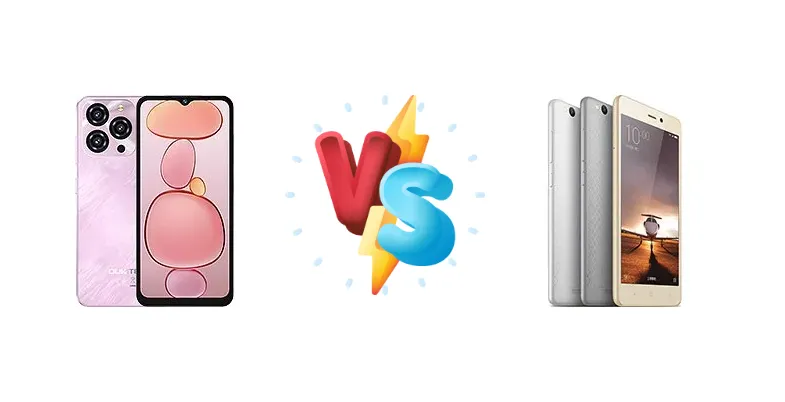
The Oukitel C3 and Xiaomi Redmi 3 represent two approaches to the ultra-budget smartphone market. The Redmi 3, released in 2016, established a benchmark for battery life in its class. The C3, a more recent entrant, aims to surpass it with a newer chipset and a focus on extended endurance. This comparison dissects their strengths and weaknesses to determine which device delivers the best value in 2024.
🏆 Quick Verdict
For users prioritizing maximum battery life and longevity, the Oukitel C3 is the clear winner. Its Unisoc T310 chipset, coupled with a reported 50:32h endurance, significantly outlasts the Redmi 3’s 107h rating. While the Redmi 3 offers a familiar Qualcomm platform, the C3’s superior efficiency makes it the better choice for power users and those frequently away from a charger.
| Network |
|---|
| 2G bands | GSM 850 / 900 / 1800 / 1900 | GSM 900 / 1800 / 1900 - SIM 1 & SIM 2 |
| 3G bands | HSDPA 850 / 900 / 1700(AWS) / 1900 / 2100 | HSDPA 850 / 900 / 1900 / 2100 |
| 4G bands | 1, 2, 3, 4, 5, 7, 8, 12, 17, 19, 20, 25, 26, 28, 66 | 1, 3, 7, 38, 39, 40, 41 |
| 5G bands | - | 1, 28, 41, 77, 78 SA/NSA |
| Speed | HSPA, LTE | HSPA, LTE, EV-DO Rev.A 3.1 Mbps |
| Technology | GSM / HSPA / LTE | GSM / CDMA / HSPA / EVDO / LTE |
| | - | CDMA2000 1xEV-DO |
| Launch |
|---|
| Announced | 2025, June | 2016, January. Released 2016, January |
| Status | Available. Released 2025, July | Discontinued |
| Body |
|---|
| Build | - | Glass front, aluminum back, aluminum frame |
| Dimensions | 163.6 x 75.9 x 9.3 mm (6.44 x 2.99 x 0.37 in) | 139.3 x 69.6 x 8.5 mm (5.48 x 2.74 x 0.33 in) |
| SIM | Nano-SIM + Nano-SIM | Nano-SIM + Micro-SIM |
| Weight | 198 g (6.98 oz) | 144 g (5.08 oz) |
| Display |
|---|
| Protection | Sharp glass, Mohs level 5 | - |
| Resolution | 540 x 1200 pixels, 20:9 ratio (~202 ppi density) | 720 x 1280 pixels, 16:9 ratio (~294 ppi density) |
| Size | 6.52 inches, 102.6 cm2 (~82.7% screen-to-body ratio) | 5.0 inches, 68.9 cm2 (~71.1% screen-to-body ratio) |
| Type | IPS LCD, 450 nits | IPS LCD |
| Platform |
|---|
| CPU | Quad-core (1x2.0 GHz Cortex-A75 & 3x1.8 GHz Cortex-A55) | Octa-core (4x1.5 GHz Cortex-A53 & 4x1.2 GHz Cortex-A53) |
| Chipset | Unisoc T310 (12 nm) | Qualcomm MSM8939v2 Snapdragon 616 (28 nm) |
| GPU | PowerVR GE8300 | Adreno 405 |
| OS | Android 14 | Android 5.1 (Lollipop), MIUI 7 |
| Memory |
|---|
| Card slot | microSDXC (uses shared SIM slot) | microSDXC (uses shared SIM slot) |
| Internal | 64GB 4GB RAM, 128GB 4GB RAM, 256GB 4GB RAM | 16GB 2GB RAM, 32GB 3GB RAM |
| | - | eMMC 4.5 |
| Main Camera |
|---|
| Dual | - | 48 MP, f/1.8, 25mm (wide), 1/2.0", 0.8µm, PDAF
2 MP, f/2.4, (depth) |
| Features | LED flash, HDR, panorama | LED flash, HDR, panorama |
| Single | 13 MP, f/2.2 (wide), AF | 13 MP, f/2.0, PDAF |
| Video | 1080p@30fps | 1080p@30fps |
| Selfie camera |
|---|
| Features | - | HDR |
| Single | 5 MP, f/2.2, (wide) | 5 MP, f/2.2 |
| Video | 720p@30fps | 1080p@30fps |
| Sound |
|---|
| 3.5mm jack | - | Yes |
| 35mm jack | Yes | Yes |
| Loudspeaker | Yes | Yes |
| Comms |
|---|
| Bluetooth | 5.0, A2DP, LE | 4.1, A2DP |
| Infrared port | - | Yes |
| NFC | No | No |
| Positioning | GPS, GALILEO, GLONASS, BDS | GPS, GLONASS, BDS |
| Radio | FM radio | FM radio |
| USB | USB Type-C | microUSB 2.0 |
| WLAN | Wi-Fi 802.11 a/b/g/n/ac, dual-band | Wi-Fi 802.11 b/g/n, Wi-Fi Direct, hotspot |
| Features |
|---|
| Sensors | Accelerometer | Accelerometer, gyro, proximity, compass |
| Battery |
|---|
| Charging | 10W wired | 10W wired |
| Type | Li-Po 5000 mAh | Li-Ion 4100 mAh, non-removable |
| Misc |
|---|
| Colors | Gold, Purple, Blue, Black | Gold, Dark Gray, Silver, Classic Gold |
| Models | - | 2015816 |
| Price | - | About 160 EUR |
| SAR | - | 0.90 W/kg (head) 0.56 W/kg (body) |
| SAR EU | - | 1.33 W/kg (head) |
| Tests |
|---|
| Battery life | - |
Endurance rating 107h
|
| Camera | - |
Photo / Video |
| EU LABEL |
|---|
| Battery | 50:32h endurance, 1000 cycles | - |
| Energy | Class A | - |
| Free fall | Class A (270 falls) | - |
| Repairability | Class B | - |
Oukitel C3
- Exceptional battery life (50:32h endurance)
- Modern Unisoc T310 chipset for improved performance
- 1000-cycle battery lifespan for long-term reliability
- Limited camera information available
- 10W charging is relatively slow
Xiaomi Redmi 3
- Qualcomm Snapdragon 616 chipset with established support
- Decent battery life (107h endurance)
- Familiar Android experience (likely)
- Older 28nm chipset is less efficient
- Significantly shorter battery life compared to Oukitel C3
Display Comparison
Neither device boasts a standout display. Both are likely to feature LCD panels typical of their price points. The Redmi 3’s display specifications are not provided, but given its release date, it likely features a 720p resolution. The Oukitel C3’s display details are also absent, but its focus on battery life suggests a power-efficient panel. The absence of information on refresh rates or brightness levels indicates neither phone is geared towards media consumption.
Camera Comparison
Both devices offer photo and video capabilities, but detailed camera specifications are lacking. The Redmi 3 likely features a primary sensor around 13MP, common for its era. The Oukitel C3’s camera details are unavailable. Without sensor size, aperture, or image processing information, a meaningful comparison is impossible. It’s safe to assume both cameras are adequate for basic photography in good lighting conditions, but will struggle in low-light scenarios.
Performance
The core difference lies in the chipsets. The Oukitel C3’s Unisoc T310 (12nm) utilizes a more modern architecture – a Cortex-A75 paired with three Cortex-A55 cores – compared to the Xiaomi Redmi 3’s older Qualcomm Snapdragon 616 (28nm). While the Snapdragon 616 has eight Cortex-A53 cores, the newer architecture of the T310, despite having fewer cores, offers superior per-core performance. The 12nm process node of the T310 is also more efficient than the 28nm node of the Snapdragon 616, contributing to the C3’s extended battery life. This translates to snappier app loading and smoother multitasking on the Oukitel C3.
Battery Life
This is where the Oukitel C3 truly shines. Its reported 50:32h endurance rating dwarfs the Xiaomi Redmi 3’s 107h rating. While the Redmi 3’s rating is still respectable, the C3’s significantly longer endurance is a game-changer. Both phones support 10W wired charging, meaning charge times will be similar. However, the C3’s 1000-cycle battery life suggests a greater long-term reliability and reduced battery degradation over time.
Buying Guide
Buy the Oukitel C3 if you need a phone that can reliably last through multiple days of moderate use, or if you frequently travel and have limited access to power outlets. Its focus on endurance and 1000-cycle battery life makes it ideal for users who prioritize longevity. Buy the Xiaomi Redmi 3 if you prefer a device with a well-established Qualcomm chipset and a wider community support base, but understand you'll be sacrificing significant battery life in comparison.
Frequently Asked Questions
❓ How does the Unisoc T310 in the Oukitel C3 compare to the Snapdragon 616 in real-world app performance?
While the Snapdragon 616 has more cores, the Unisoc T310’s newer Cortex-A75 architecture delivers superior single-core performance, resulting in faster app loading times and smoother multitasking. The T310 is also more power-efficient, contributing to the C3’s longer battery life.
❓ Is the 10W charging speed on the Oukitel C3 a significant drawback, considering its large battery?
Yes, 10W charging is relatively slow by today’s standards. However, the Oukitel C3’s exceptional battery life means you won’t need to charge it as frequently. The focus is on maximizing usage time between charges, rather than rapid replenishment.
❓ Given the Redmi 3's age, is software support still available?
Software support for the Xiaomi Redmi 3 is likely limited or non-existent at this point. Security updates and new Android versions are unlikely to be released, potentially posing a security risk. The Oukitel C3, being a newer device, will likely receive at least some level of software support.