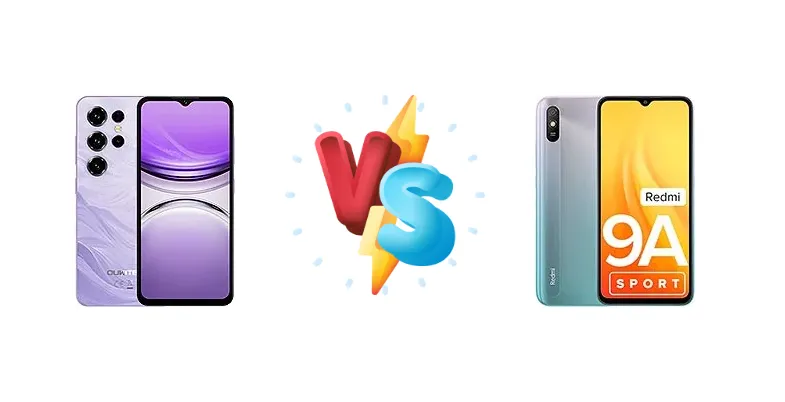
The sub-$150 smartphone market is fiercely competitive, demanding a careful balance of features and price. The Oukitel C2 and Xiaomi Redmi 9A Sport represent two distinct approaches: the C2 prioritizing exceptional battery endurance, while the Redmi 9A Sport aims for a more balanced everyday experience. This comparison dissects their core components to reveal which device best suits your needs.
🏆 Quick Verdict
For users prioritizing longevity above all else, the Oukitel C2 is the clear winner. Its impressive 55:29h endurance and 1000 charge cycles significantly outperform the Redmi 9A Sport. However, the Redmi 9A Sport offers a more modern CPU architecture, potentially providing a smoother experience for multitasking and light gaming.
| Network |
|---|
| 2G bands | GSM 850 / 900 / 1800 / 1900 | GSM 850 / 900 / 1800 / 1900 |
| 3G bands | HSDPA 850 / 900 / 1700(AWS) / 1900 / 2100 | HSDPA 850 / 900 / 2100 |
| 4G bands | 1, 2, 3, 4, 5, 7, 8, 12, 17, 19, 20, 25, 26, 28, 66 | 1, 3, 5, 8, 40, 41 |
| Speed | HSPA, LTE | HSPA, LTE |
| Technology | GSM / HSPA / LTE | GSM / HSPA / LTE |
| Launch |
|---|
| Announced | 2025, July | 2021, September 28 |
| Status | Available. Released 2025, August | Available. Released 2021, September 28 |
| Body |
|---|
| Dimensions | 163.6 x 75.9 x 9.3 mm (6.44 x 2.99 x 0.37 in) | 164.9 x 77.1 x 9 mm (6.49 x 3.04 x 0.35 in) |
| SIM | Nano-SIM + Nano-SIM | Nano-SIM + Nano-SIM |
| Weight | 198 g (6.98 oz) | 194 g (6.84 oz) |
| | - | Water-repellent coating |
| Display |
|---|
| Protection | Sharp glass, Mohs level 5 | - |
| Resolution | 540 x 1200 pixels, 20:9 ratio (~202 ppi density) | 720 x 1600 pixels, 20:9 ratio (~269 ppi density) |
| Size | 6.52 inches, 102.6 cm2 (~82.7% screen-to-body ratio) | 6.53 inches, 102.9 cm2 (~81.0% screen-to-body ratio) |
| Type | IPS LCD, 450 nits | IPS LCD, 400 nits (typ) |
| Platform |
|---|
| CPU | Quad-core (1x2.0 GHz Cortex-A75 & 3x1.8 GHz Cortex-A55) | Octa-core (4x2.0 GHz Cortex-A53 & 4x1.5 GHz Cortex-A53) |
| Chipset | Unisoc T310 (12 nm) | Mediatek MT6762G Helio G25 (12 nm) |
| GPU | PowerVR GE8300 | PowerVR GE8320 |
| OS | Android 14 | Android 10, MIUI 12 |
| Memory |
|---|
| Card slot | microSDXC (uses shared SIM slot) | microSDXC (dedicated slot) |
| Internal | 64GB 4GB RAM, 128GB 4GB RAM, 256GB 4GB RAM | 32GB 2GB RAM, 32GB 3GB RAM |
| | - | eMMC 5.1 |
| Main Camera |
|---|
| Features | LED flash, HDR, panorama | LED flash, HDR |
| Single | 13 MP, f/2.2 (wide), AF | 13 MP, f/2.2, 28mm (wide), 1.0µm, PDAF |
| Video | 1080p@30fps | 1080p@30/60fps |
| Selfie camera |
|---|
| Features | - | HDR |
| Single | 5 MP, f/2.2, (wide) | 5 MP, f/2.2, (wide), 1.12µm |
| Video | 720p@30fps | 1080p@30fps |
| Sound |
|---|
| 3.5mm jack | - | Yes |
| 35mm jack | Yes | Yes |
| Loudspeaker | Yes | Yes |
| Comms |
|---|
| Bluetooth | 5.0, A2DP, LE | 5.0, A2DP, LE |
| NFC | No | No |
| Positioning | GPS, GALILEO, GLONASS, BDS | GPS, GLONASS, BDS |
| Radio | FM radio | FM radio |
| USB | USB Type-C | microUSB 2.0, OTG |
| WLAN | Wi-Fi 802.11 a/b/g/n/ac, dual-band | Wi-Fi 802.11 a/b/g/n, Wi-Fi Direct |
| Features |
|---|
| Sensors | Accelerometer | Accelerometer, proximity |
| Battery |
|---|
| Charging | 10W wired | 10W wired |
| Type | Li-Po 5000 mAh | Li-Po 5000 mAh |
| Misc |
|---|
| Colors | Gold, Purple, Blue, Black | Carbon Black, Coral Green, Metallic Blue |
| Price | - | About 100 EUR |
| EU LABEL |
|---|
| Battery | 55:29h endurance, 1000 cycles | - |
| Energy | Class A | - |
| Free fall | Class A (270 falls) | - |
| Repairability | Class B | - |
Oukitel C2
- Exceptional battery life (55:29h endurance)
- High charge cycle count (1000 cycles)
- More efficient Cortex-A75 core for demanding tasks
- Quad-core CPU may struggle with heavy multitasking
- Likely basic camera performance
Xiaomi Redmi 9A Sport
- Octa-core CPU for potentially smoother multitasking
- Integrated GPU may offer a slight gaming advantage
- Wider availability and brand recognition
- Significantly lower battery life
- Less efficient Cortex-A53 cores
- 2MP macro camera is likely of limited utility
Display Comparison
Neither device boasts a standout display. Both likely utilize LCD panels, common in this price bracket. Detailed display specs (resolution, brightness) are unavailable, but the focus here is on core performance. The absence of high refresh rates or advanced panel technologies is expected, making display quality a secondary consideration.
Camera Comparison
Camera performance is likely to be similar, with both phones targeting the entry-level segment. Without detailed sensor information, it's safe to assume both rely on basic image processing. The presence of a 2MP macro lens on the Redmi 9A Sport is a common, but often underwhelming, feature in this price range. Real-world image quality will depend heavily on software optimization, but neither phone is expected to compete with mid-range or flagship devices.
Performance
The CPU architecture is where these phones diverge significantly. The Oukitel C2 features a Unisoc T310 with a quad-core configuration, utilizing a single Cortex-A75 core clocked at 2.0 GHz alongside three Cortex-A55 cores at 1.8 GHz. This architecture, while older, benefits from the A75's higher individual core performance. The Redmi 9A Sport, conversely, employs a Mediatek Helio G25 with an octa-core setup of four Cortex-A53 cores at 2.0 GHz and another four at 1.5 GHz. While the Redmi 9A Sport has more cores, the Cortex-A53 is less efficient than the A75. This suggests the C2 will handle demanding tasks slightly better, despite having fewer cores. The Helio G25's integrated GPU may offer a marginal advantage in gaming, but the CPU bottleneck will likely be the limiting factor.
Battery Life
The Oukitel C2’s standout feature is its exceptional battery endurance, rated at 55:29 hours. This is a substantial lead over what is typical for phones in this price range. Coupled with a claimed 1000 charge cycles, the C2 promises long-term reliability. The Redmi 9A Sport, while also offering a 10W charging rate, will likely require more frequent charging due to its lower endurance. The C2’s longevity is a significant advantage for users who prioritize minimizing charging frequency.
Buying Guide
Buy the Oukitel C2 if you need a phone that can reliably last through multiple days of moderate use, or if you frequently find yourself away from a power outlet. This is the ideal choice for travelers, field workers, or anyone who simply dislikes daily charging. Buy the Xiaomi Redmi 9A Sport if you prefer a slightly more responsive user interface for everyday tasks and occasional gaming, and are willing to compromise on battery life for that performance boost.
Frequently Asked Questions
❓ How does the Unisoc T310 in the Oukitel C2 compare to the Mediatek Helio G25 in real-world app loading times?
While the Helio G25 has more cores, the Oukitel C2’s Cortex-A75 core provides a performance advantage in single-threaded tasks, like launching apps. Expect slightly faster app loading times on the C2, especially for larger applications. However, the difference will likely be subtle and not dramatically noticeable for everyday use.
❓ Is the 10W charging on either phone sufficient for quick top-ups throughout the day?
10W charging is relatively slow by modern standards. Neither phone offers fast charging capabilities. Expect a full charge to take several hours. The Oukitel C2’s exceptional battery life mitigates the slow charging speed, as you’ll need to charge it less frequently.
❓ Will the Oukitel C2 be able to handle popular social media apps like TikTok and Instagram without significant lag?
Yes, the Oukitel C2 should be capable of running popular social media apps without major issues. The Unisoc T310 is sufficient for these tasks. However, multitasking between several apps simultaneously might result in some slowdown.
❓ What type of user would benefit most from the Redmi 9A Sport's octa-core processor?
The Redmi 9A Sport's octa-core processor would be most beneficial to users who frequently switch between multiple apps or enjoy light mobile gaming. While not a gaming powerhouse, the additional cores can provide a smoother experience compared to the Oukitel C2 when handling multiple tasks concurrently.