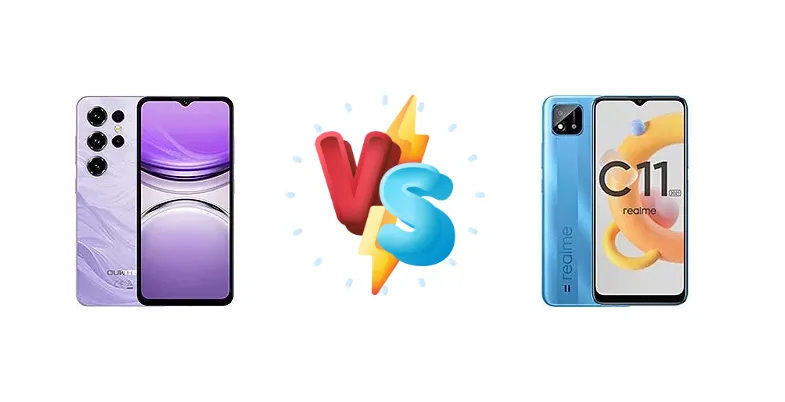
The sub-$150 smartphone market is fiercely competitive. The Oukitel C2 and Realme C11 (2021) both aim to deliver essential functionality at an accessible price point, but they take different approaches. The Oukitel C2 prioritizes exceptional battery endurance, while the Realme C11 (2021) attempts to offer a more balanced experience with an octa-core processor. This comparison will dissect their key differences to determine which device best suits your needs.
🏆 Quick Verdict
For users prioritizing longevity above all else, the Oukitel C2 is the clear winner. Its impressive 55:29h endurance and 1000 charge cycles significantly outperform the Realme C11 (2021). However, those seeking a slightly more responsive everyday experience may prefer the Realme C11 (2021)'s octa-core processor.
| Network |
|---|
| 2G bands | GSM 850 / 900 / 1800 / 1900 | GSM 850 / 900 / 1800 / 1900 |
| 3G bands | HSDPA 850 / 900 / 1700(AWS) / 1900 / 2100 | HSDPA 850 / 900 / 1900 / 2100 |
| 4G bands | 1, 2, 3, 4, 5, 7, 8, 12, 17, 19, 20, 25, 26, 28, 66 | 1, 3, 5, 8, 38, 40, 41 |
| Speed | HSPA, LTE | HSPA, LTE |
| Technology | GSM / HSPA / LTE | GSM / HSPA / LTE |
| Launch |
|---|
| Announced | 2025, July | 2021, June 28 |
| Status | Available. Released 2025, August | Available. Released 2021, June 28 |
| Body |
|---|
| Build | - | Glass front, plastic frame, plastic back |
| Dimensions | 163.6 x 75.9 x 9.3 mm (6.44 x 2.99 x 0.37 in) | 165.2 x 76.4 x 8.9 mm (6.50 x 3.01 x 0.35 in) |
| SIM | Nano-SIM + Nano-SIM | Nano-SIM + Nano-SIM |
| Weight | 198 g (6.98 oz) | 190 g (6.70 oz) |
| | - | Splash resistant design |
| Display |
|---|
| Protection | Sharp glass, Mohs level 5 | - |
| Resolution | 540 x 1200 pixels, 20:9 ratio (~202 ppi density) | 720 x 1600 pixels, 20:9 ratio (~269 ppi density) |
| Size | 6.52 inches, 102.6 cm2 (~82.7% screen-to-body ratio) | 6.52 inches, 102.6 cm2 (~81.3% screen-to-body ratio) |
| Type | IPS LCD, 450 nits | IPS LCD, 400 nits (typ) |
| Platform |
|---|
| CPU | Quad-core (1x2.0 GHz Cortex-A75 & 3x1.8 GHz Cortex-A55) | Octa-core (4x1.6 GHz Cortex-A55 & 4x1.2 GHz Cortex-A55) |
| Chipset | Unisoc T310 (12 nm) | Unisoc SC9863A (28 nm) |
| GPU | PowerVR GE8300 | IMG8322 |
| OS | Android 14 | Android 11, Realme Go UI |
| Memory |
|---|
| Card slot | microSDXC (uses shared SIM slot) | microSDXC (dedicated slot) |
| Internal | 64GB 4GB RAM, 128GB 4GB RAM, 256GB 4GB RAM | 32GB 2GB RAM, 64GB 4GB RAM |
| | - | eMMC 5.1 |
| Main Camera |
|---|
| Features | LED flash, HDR, panorama | LED flash, HDR, panorama |
| Single | 13 MP, f/2.2 (wide), AF | 8 MP, f/2.0, (wide), AF |
| Video | 1080p@30fps | 1080p@30fps |
| Selfie camera |
|---|
| Features | - | HDR, panorama |
| Single | 5 MP, f/2.2, (wide) | 5 MP, f/2.2, (wide) |
| Video | 720p@30fps | 1080p@30fps |
| Sound |
|---|
| 3.5mm jack | - | Yes |
| 35mm jack | Yes | Yes |
| Loudspeaker | Yes | Yes |
| Comms |
|---|
| Bluetooth | 5.0, A2DP, LE | 4.2, A2DP |
| NFC | No | No |
| Positioning | GPS, GALILEO, GLONASS, BDS | GPS, GLONASS, GALILEO, BDS |
| Radio | FM radio | Unspecified |
| USB | USB Type-C | microUSB 2.0, OTG |
| WLAN | Wi-Fi 802.11 a/b/g/n/ac, dual-band | Wi-Fi 802.11 b/g/n |
| Features |
|---|
| Sensors | Accelerometer | Accelerometer, gyro, proximity, compass |
| Battery |
|---|
| Charging | 10W wired | 10W wired
Reverse wired |
| Type | Li-Po 5000 mAh | 5000 mAh |
| Misc |
|---|
| Colors | Gold, Purple, Blue, Black | Cool Blue, Cool Grey |
| Models | - | RMX3231 |
| Price | - | About 80 EUR |
| EU LABEL |
|---|
| Battery | 55:29h endurance, 1000 cycles | - |
| Energy | Class A | - |
| Free fall | Class A (270 falls) | - |
| Repairability | Class B | - |
Oukitel C2
- Exceptional battery life (55:29h endurance)
- Long-lasting battery health (1000 charge cycles)
- More efficient processor (Unisoc T310, 12nm)
- Quad-core processor may feel slower in multitasking
- Likely basic display quality
Realme C11 (2021)
- Octa-core processor for smoother app loading
- Reverse wired charging for accessories
- Potentially better image processing
- Significantly shorter battery life
- Less efficient processor (Unisoc SC9863A, 28nm)
Display Comparison
Neither device boasts a standout display. Both are likely to feature basic LCD panels, typical of this price bracket. The focus here isn't on visual fidelity, but on power efficiency. Details like resolution and brightness are not provided, but we can assume they are comparable, prioritizing cost savings over premium features. The absence of features like high refresh rates or LTPO technology is expected.
Camera Comparison
Camera performance is likely to be similar on both devices, focusing on basic image capture. Without specific sensor details, it's safe to assume both feature modest primary sensors and potentially a depth sensor. The prevalence of 2MP macro lenses in this segment suggests both phones will include one, but its utility is limited. Image processing will be the key differentiator, and Realme generally offers more refined software algorithms, potentially giving it a slight edge in image quality, though this is speculative without testing.
Performance
The core difference lies in the chipset. The Oukitel C2 utilizes the Unisoc T310, a quad-core processor built on a more efficient 12nm process. This contrasts with the Realme C11 (2021)'s Unisoc SC9863A, an octa-core chip fabricated on a less efficient 28nm node. While the Realme C11 (2021) has more cores (4x1.6 GHz Cortex-A55 & 4x1.2 GHz Cortex-A55), the Oukitel C2's Cortex-A75 core at 2.0 GHz provides a significant single-core performance boost. The 12nm process of the T310 should also result in better thermal management and power efficiency, despite having fewer cores. This means the Oukitel C2 will likely handle demanding tasks with less throttling and consume less power during sustained use.
Battery Life
Battery life is where the Oukitel C2 truly shines. Its 55:29h endurance rating is exceptional for a budget smartphone, and the claimed 1000 charge cycles suggest long-term battery health. The Realme C11 (2021) offers a standard battery experience, likely around 30-40 hours of usage. Both devices support 10W wired charging, which is slow by modern standards, but the Oukitel C2's superior capacity mitigates the impact of the slower charging speed. The Realme C11 (2021) adds reverse wired charging, a useful feature for topping up accessories, but it doesn't compensate for the Oukitel C2's overall endurance.
Buying Guide
Buy the Oukitel C2 if you need a phone that can reliably last for days on a single charge, making it ideal for travelers, field workers, or anyone who dislikes frequent charging. Buy the Realme C11 (2021) if you prefer a phone with a more modern octa-core processor for smoother multitasking and app loading, and appreciate the convenience of reverse wired charging.
Frequently Asked Questions
❓ How much faster is the Oukitel C2's charging compared to the Realme C11 (2021) considering both are 10W?
While both phones use 10W charging, the Oukitel C2's significantly larger battery capacity means a full charge will take considerably longer. However, the Oukitel C2's exceptional endurance means you'll need to charge it less frequently, effectively mitigating the slower charging speed.
❓ Will the Unisoc T310 in the Oukitel C2 struggle with popular apps like TikTok or Facebook?
The Unisoc T310 is a budget processor, and while it can handle basic apps like TikTok and Facebook, you may experience occasional slowdowns or longer loading times, especially with multiple apps open simultaneously. The Realme C11 (2021)'s octa-core processor will offer a smoother experience for these types of applications.
❓ Is the reverse wired charging on the Realme C11 (2021) useful for charging a smartwatch or wireless earbuds?
Yes, the reverse wired charging feature on the Realme C11 (2021) can be used to top up accessories like smartwatches or wireless earbuds. However, the 10W output is relatively slow, so it's best suited for small top-ups rather than a full charge.