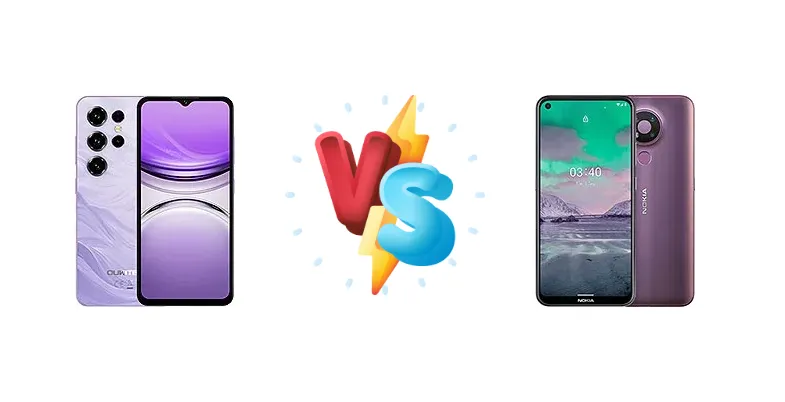
The sub-$150 smartphone market is fiercely competitive. The Oukitel C2 and Nokia 3.4 represent two distinct approaches: prioritizing exceptional battery life versus a more balanced, efficient chipset. This comparison dissects their core components to determine which device delivers the best value for different user profiles.
🏆 Quick Verdict
For users prioritizing all-day (and multi-day) battery life above all else, the Oukitel C2 is the clear winner, boasting a remarkable 55:29h endurance. However, the Nokia 3.4’s Snapdragon 460 offers a more responsive experience for everyday tasks and light gaming, making it a better choice for those valuing performance.
| Network |
|---|
| 2G bands | GSM 850 / 900 / 1800 / 1900 | GSM 850 / 900 / 1800 / 1900 |
| 3G bands | HSDPA 850 / 900 / 1700(AWS) / 1900 / 2100 | HSDPA 850 / 900 / 1700(AWS) / 1900 / 2100 |
| 4G bands | 1, 2, 3, 4, 5, 7, 8, 12, 17, 19, 20, 25, 26, 28, 66 | 1, 2, 3, 4, 5, 7, 8, 12, 17, 13, 28, 66 |
| Speed | HSPA, LTE | HSPA, LTE |
| Technology | GSM / HSPA / LTE | GSM / HSPA / LTE |
| Launch |
|---|
| Announced | 2025, July | 2020, September 22. Released 2020, October 26 |
| Status | Available. Released 2025, August | Discontinued |
| Body |
|---|
| Dimensions | 163.6 x 75.9 x 9.3 mm (6.44 x 2.99 x 0.37 in) | 161 x 76 x 8.7 mm (6.34 x 2.99 x 0.34 in) |
| SIM | Nano-SIM + Nano-SIM | · Nano-SIM· Nano-SIM + Nano-SIM |
| Weight | 198 g (6.98 oz) | 180 g (6.35 oz) |
| Display |
|---|
| Protection | Sharp glass, Mohs level 5 | - |
| Resolution | 540 x 1200 pixels, 20:9 ratio (~202 ppi density) | 720 x 1560 pixels, 19.5:9 ratio (~269 ppi density) |
| Size | 6.52 inches, 102.6 cm2 (~82.7% screen-to-body ratio) | 6.39 inches, 100.2 cm2 (~81.9% screen-to-body ratio) |
| Type | IPS LCD, 450 nits | IPS LCD, 400 nits (typ) |
| Platform |
|---|
| CPU | Quad-core (1x2.0 GHz Cortex-A75 & 3x1.8 GHz Cortex-A55) | Octa-core (4x1.8 GHz Cortex-A73 & 4x1.8 GHz Cortex-A53) |
| Chipset | Unisoc T310 (12 nm) | Qualcomm SM4250 Snapdragon 460 (11 nm) |
| GPU | PowerVR GE8300 | Adreno 610 |
| OS | Android 14 | Android 10, upgradable to Android 11 |
| Memory |
|---|
| Card slot | microSDXC (uses shared SIM slot) | microSDXC (dedicated slot) |
| Internal | 64GB 4GB RAM, 128GB 4GB RAM, 256GB 4GB RAM | 32GB 3GB RAM, 64GB 3GB RAM, 64GB 4GB RAM |
| | - | eMMC 5.1 |
| Main Camera |
|---|
| Features | LED flash, HDR, panorama | LED flash, HDR, panorama |
| Single | 13 MP, f/2.2 (wide), AF | - |
| Triple | - | 13 MP, (wide), PDAF
5 MP, (ultrawide)
Auxiliary lens |
| Video | 1080p@30fps | 1080p@30fps |
| Selfie camera |
|---|
| Single | 5 MP, f/2.2, (wide) | 8 MP, (wide) |
| Video | 720p@30fps | 1080p@30fps |
| Sound |
|---|
| 3.5mm jack | - | Yes |
| 35mm jack | Yes | Yes |
| Loudspeaker | Yes | Yes |
| Comms |
|---|
| Bluetooth | 5.0, A2DP, LE | 4.2, A2DP, aptX |
| NFC | No | Yes (market/region dependent) |
| Positioning | GPS, GALILEO, GLONASS, BDS | GPS, GLONASS, GALILEO, BDS |
| Radio | FM radio | FM radio |
| USB | USB Type-C | USB Type-C 2.0 |
| WLAN | Wi-Fi 802.11 a/b/g/n/ac, dual-band | Wi-Fi 802.11 b/g/n |
| Features |
|---|
| Sensors | Accelerometer | Fingerprint (rear-mounted), accelerometer, gyro, proximity |
| Battery |
|---|
| Charging | 10W wired | 10W wired |
| Type | Li-Po 5000 mAh | Li-Po 4000 mAh |
| Misc |
|---|
| Colors | Gold, Purple, Blue, Black | Fjord, Dusk, Charcoal |
| Models | - | TA-1288, TA-1285, TA-1283 |
| Price | - | About 100 EUR |
| SAR | - | 0.83 W/kg (head) 1.05 W/kg (body) |
| SAR EU | - | 0.36 W/kg (head) 1.56 W/kg (body) |
| EU LABEL |
|---|
| Battery | 55:29h endurance, 1000 cycles | - |
| Energy | Class A | - |
| Free fall | Class A (270 falls) | - |
| Repairability | Class B | - |
Oukitel C2
- Exceptional battery life (55:29h endurance)
- Potentially better single-core performance with Cortex-A75
- 1000 charge cycles suggest long-term battery health
- Less efficient chipset overall
- Likely slower app loading and multitasking
- Potentially limited gaming performance
Nokia 3.4
- More efficient Snapdragon 460 chipset
- Octa-core CPU for smoother multitasking
- Better image processing capabilities
- Significantly shorter battery life compared to Oukitel C2
- 10W charging is slow on both devices
- May experience throttling under sustained load
Display Comparison
Neither device boasts a standout display. Given the context data focuses on internals, we can infer both likely utilize standard LCD panels common in this price bracket. The absence of specifications like resolution or refresh rate suggests a focus on cost-effectiveness over visual fidelity. Bezels are likely substantial on both, and color accuracy will be adequate but not exceptional. The real difference will be in viewing angles and brightness, which are unknown but likely similar.
Camera Comparison
Without detailed camera specs, a direct comparison is difficult. However, budget phones in this segment often prioritize megapixel count over sensor size and image quality. It’s safe to assume both phones feature basic camera systems. The Nokia 3.4, benefiting from Qualcomm’s image signal processing (ISP), likely offers slightly better image processing and dynamic range. The Oukitel C2 may rely more heavily on software enhancements, which can sometimes lead to over-sharpening or artificial-looking images. We can expect both to struggle in low-light conditions.
Performance
The core battleground lies in the chipsets. The Nokia 3.4’s Qualcomm Snapdragon 460, fabricated on an 11nm process, features an octa-core configuration (4x1.8 GHz Cortex-A73 & 4x1.8 GHz Cortex-A53). This contrasts with the Oukitel C2’s Unisoc T310 (12nm) which uses a quad-core setup (1x2.0 GHz Cortex-A75 & 3x1.8 GHz Cortex-A55). While the Unisoc has a faster single-core A75, the Snapdragon’s eight cores, and particularly the A73 cores, provide a more consistent and efficient multi-tasking experience. The 11nm process of the Snapdragon also contributes to better thermal management, potentially reducing throttling during sustained workloads. This translates to a smoother experience for app switching and light gaming on the Nokia 3.4.
Battery Life
The Oukitel C2’s defining feature is its exceptional battery endurance – a claimed 55:29h. This is significantly higher than what’s typically seen in this price range. The Unisoc T310, while less powerful, is also more power-efficient. The Nokia 3.4, with its Snapdragon 460, will offer respectable battery life, but likely won’t match the Oukitel’s longevity. Both phones share the same 10W wired charging, meaning charge times will be relatively slow – expect several hours to fully replenish the battery on either device.
Buying Guide
Buy the Oukitel C2 if you need a phone that can reliably last through extended periods without access to a charger – ideal for travelers, outdoor workers, or anyone who simply dislikes frequent charging. Buy the Nokia 3.4 if you prefer a smoother, more responsive user experience for daily tasks like browsing, social media, and casual gaming, and are willing to compromise on ultimate battery longevity.
Frequently Asked Questions
❓ Will the Unisoc T310 in the Oukitel C2 struggle with demanding apps like Facebook or YouTube?
While the Unisoc T310 can handle basic apps, demanding applications like Facebook and YouTube may experience occasional lag or slowdowns, especially with multiple tabs open. The Snapdragon 460 in the Nokia 3.4 will provide a smoother experience for these apps due to its more efficient architecture and additional cores.
❓ How long will it realistically take to charge the Oukitel C2 from 0% to 100% with the 10W charger?
Given the large battery capacity and slow 10W charging, expect a full charge to take approximately 4-6 hours. This is a significant drawback, but the extended battery life compensates for the slow charging speed for many users.
❓ Is the Nokia 3.4 suitable for playing mobile games like PUBG Mobile or Call of Duty Mobile?
The Nokia 3.4 can run PUBG Mobile and Call of Duty Mobile, but you’ll likely need to lower the graphics settings to medium or low to achieve playable frame rates. Expect some stuttering during intense action sequences. The Oukitel C2 will likely struggle even at the lowest settings.
❓ Does either phone support fast charging, or is 10W the only option?
Unfortunately, both the Oukitel C2 and Nokia 3.4 are limited to 10W wired charging. This is a common limitation in the ultra-budget segment, and users should plan accordingly.