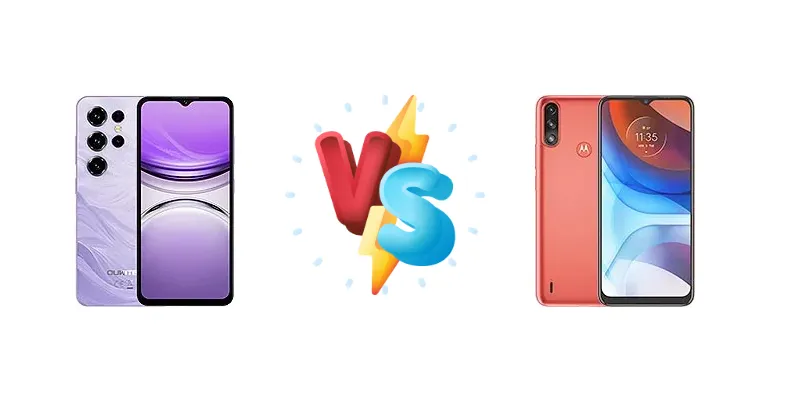
The Oukitel C2 and Motorola Moto E7i Power represent two distinct approaches to the ultra-budget smartphone market. The Oukitel C2 prioritizes exceptional battery life and longevity, boasting a claimed 55+ hour endurance and 1000 charge cycles. Conversely, the Moto E7i Power aims for a more balanced experience with an octa-core processor, though at the cost of a less efficient chipset.
🏆 Quick Verdict
For users prioritizing absolute battery life and long-term device health, the Oukitel C2 is the clear winner. Its superior endurance and impressive 1000 charge cycle rating outweigh the Moto E7i Power’s octa-core processor for most everyday tasks. However, the Moto E7i Power may appeal to those who need a bit more processing power for multitasking.
| Network |
|---|
| 2G bands | GSM 850 / 900 / 1800 / 1900 | GSM 850 / 900 / 1800 / 1900 |
| 3G bands | HSDPA 850 / 900 / 1700(AWS) / 1900 / 2100 | HSDPA 850 / 900 / 1700(AWS) / 1900 / 2100 |
| 4G bands | 1, 2, 3, 4, 5, 7, 8, 12, 17, 19, 20, 25, 26, 28, 66 | LTE |
| Speed | HSPA, LTE | HSPA, LTE |
| Technology | GSM / HSPA / LTE | GSM / HSPA / LTE |
| Launch |
|---|
| Announced | 2025, July | 2021, February 23 |
| Status | Available. Released 2025, August | Available. Released 2021, March 15 |
| Body |
|---|
| Build | - | Glass front, plastic back, plastic frame |
| Dimensions | 163.6 x 75.9 x 9.3 mm (6.44 x 2.99 x 0.37 in) | 165.1 x 75.9 x 9.2 mm (6.5 x 2.99 x 0.36 in) |
| SIM | Nano-SIM + Nano-SIM | Nano-SIM + Nano-SIM |
| Weight | 198 g (6.98 oz) | 200 g (7.05 oz) |
| | - | Water-repellent design |
| Display |
|---|
| Protection | Sharp glass, Mohs level 5 | - |
| Resolution | 540 x 1200 pixels, 20:9 ratio (~202 ppi density) | 720 x 1600 pixels, 20:9 ratio (~270 ppi density) |
| Size | 6.52 inches, 102.6 cm2 (~82.7% screen-to-body ratio) | 6.51 inches, 102.3 cm2 (~81.7% screen-to-body ratio) |
| Type | IPS LCD, 450 nits | IPS LCD, 380 nits (typ) |
| Platform |
|---|
| CPU | Quad-core (1x2.0 GHz Cortex-A75 & 3x1.8 GHz Cortex-A55) | Octa-core (4x1.6 GHz Cortex-A55 & 4x1.2 GHz Cortex-A55) |
| Chipset | Unisoc T310 (12 nm) | Unisoc SC9863A (28 nm) |
| GPU | PowerVR GE8300 | IMG8322 |
| OS | Android 14 | Android 10 (Go edition) |
| Memory |
|---|
| Card slot | microSDXC (uses shared SIM slot) | microSDXC (uses shared SIM slot) |
| Internal | 64GB 4GB RAM, 128GB 4GB RAM, 256GB 4GB RAM | 32GB 2GB RAM |
| | - | eMMC 5.1 |
| Main Camera |
|---|
| Dual | - | 13 MP, f/2.0, 26mm (wide), 1/3.1", 1.12µm, PDAF
2 MP (macro) |
| Features | LED flash, HDR, panorama | LED flash, HDR, panorama |
| Single | 13 MP, f/2.2 (wide), AF | - |
| Video | 1080p@30fps | 1080p@30fps |
| Selfie camera |
|---|
| Features | - | HDR |
| Single | 5 MP, f/2.2, (wide) | 5 MP, f/2.2, 27mm (wide), 1.12µm |
| Video | 720p@30fps | 1080p@30fps |
| Sound |
|---|
| 3.5mm jack | - | Yes |
| 35mm jack | Yes | Yes |
| Loudspeaker | Yes | Yes |
| Comms |
|---|
| Bluetooth | 5.0, A2DP, LE | 4.2, A2DP |
| NFC | No | No |
| Positioning | GPS, GALILEO, GLONASS, BDS | GPS, GLONASS, GALILEO |
| Radio | FM radio | Unspecified |
| USB | USB Type-C | USB Type-C 2.0 |
| WLAN | Wi-Fi 802.11 a/b/g/n/ac, dual-band | Wi-Fi 802.11 b/g/n |
| Features |
|---|
| Sensors | Accelerometer | Fingerprint (rear-mounted), accelerometer, proximity |
| Battery |
|---|
| Charging | 10W wired | 10W wired |
| Type | Li-Po 5000 mAh | Li-Ion 5000 mAh |
| Misc |
|---|
| Colors | Gold, Purple, Blue, Black | Tahiti Blue, Coral Red |
| Models | - | XT2097-13 |
| Price | - | About 120 EUR |
| EU LABEL |
|---|
| Battery | 55:29h endurance, 1000 cycles | - |
| Energy | Class A | - |
| Free fall | Class A (270 falls) | - |
| Repairability | Class B | - |
Oukitel C2
- Exceptional battery life (55:29h endurance)
- Impressive 1000 charge cycle rating
- More efficient Unisoc T310 chipset (12nm)
- Quad-core processor may struggle with heavy multitasking
- Limited camera specifications suggest basic image quality
Motorola Moto E7i Power
- Octa-core processor for smoother multitasking
- Potentially more responsive app switching
- Familiar Motorola software experience
- Less efficient Unisoc SC9863A chipset (28nm)
- Lower battery endurance compared to Oukitel C2
- No specific battery cycle rating provided
Display Comparison
Neither device provides display specifications, so a direct comparison is impossible. However, given the price point, both likely utilize LCD panels with 720p+ resolutions. The focus here is on efficiency, not visual fidelity. Expect similar viewing experiences, but the Oukitel C2’s more efficient chipset may indirectly contribute to slightly better perceived brightness due to reduced power draw.
Camera Comparison
Without detailed camera specifications, a meaningful comparison is limited. Both phones likely feature basic camera setups geared towards casual photography. The absence of information suggests neither device will excel in image quality, and any included 'macro' lenses are likely to be of very low resolution and limited utility. The focus should be on functionality, not photographic prowess.
Performance
The core difference lies in the chipsets. The Oukitel C2’s Unisoc T310 (12nm) features a quad-core configuration with a high-clocked Cortex-A75 core for performance and three Cortex-A55 cores for efficiency. This contrasts with the Motorola Moto E7i Power’s Unisoc SC9863A (28nm) which utilizes an octa-core setup of Cortex-A55 cores. While the Moto E7i Power has more cores, the T310’s A75 core and smaller 12nm process node offer a performance advantage in single-threaded tasks and better power efficiency. The larger 28nm node of the SC9863A will likely result in higher power consumption for similar workloads.
Battery Life
The Oukitel C2’s standout feature is its exceptional battery endurance of 55:29h, coupled with a remarkable 1000 charge cycle rating. This suggests a larger battery capacity and optimized power management. The Moto E7i Power, while also offering a 'Power' designation, lacks specific endurance data. Both devices share 10W wired charging, indicating similar charging speeds. The Oukitel C2’s longevity promise is a significant advantage, suggesting the battery will retain a higher percentage of its original capacity after extended use.
Buying Guide
Buy the Oukitel C2 if you need a phone that will reliably last through multiple days of use, or if you frequently travel and have limited access to charging. Its 55:29h endurance is a significant advantage for power users. Buy the Motorola Moto E7i Power if you prefer a phone with a more conventional octa-core processor for smoother multitasking and slightly improved responsiveness in app switching, even if it means sacrificing battery longevity.
Frequently Asked Questions
❓ How does the Unisoc T310 in the Oukitel C2 compare to the Unisoc SC9863A in real-world app loading times?
While the Moto E7i Power has more cores, the Oukitel C2’s Unisoc T310 benefits from a more modern architecture and a smaller manufacturing process (12nm vs 28nm). This translates to faster single-core performance, meaning apps will likely launch and respond quicker on the Oukitel C2, despite having fewer cores overall.
❓ What does '1000 charge cycles' mean for the Oukitel C2's battery lifespan?
A charge cycle is defined as fully charging and discharging the battery. The Oukitel C2’s 1000 charge cycle rating indicates that the battery is designed to retain a significant portion of its original capacity (typically 80%) even after being fully charged and discharged 1000 times. This is a substantial advantage over phones with lower cycle ratings, ensuring longer-term battery health.
❓ Is the 10W charging on both phones slow compared to other smartphones?
Yes, 10W charging is relatively slow by today’s standards. However, for these ultra-budget devices, it’s a common trade-off to prioritize battery health and longevity. The slower charging speed generates less heat, which can contribute to a longer battery lifespan, especially given the Oukitel C2’s 1000 charge cycle promise.