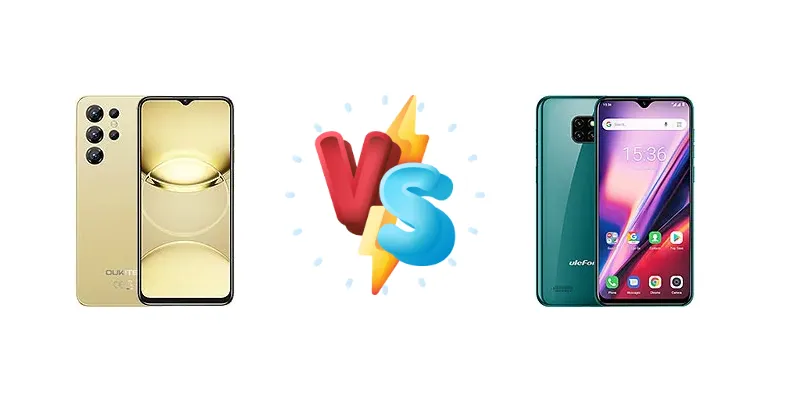
The Oukitel C1 Pro and Ulefone Note 7T represent a segment of the market increasingly focused on delivering maximum value. Both aim to provide essential smartphone functionality at an accessible price point, but they take distinctly different approaches to achieving this. The C1 Pro prioritizes exceptional battery life, while the Note 7T focuses on a slightly higher clock speed CPU. This comparison will dissect their core components to determine which device best suits your needs.
🏆 Quick Verdict
For the average user prioritizing longevity and consistent performance, the Oukitel C1 Pro emerges as the stronger choice. Its Unisoc T606 chipset, coupled with a reported 65:13h endurance, offers a more balanced experience than the Ulefone Note 7T’s Helio A22, which may struggle with demanding tasks despite its higher clock speed.
| Network |
|---|
| 2G bands | GSM 850 / 900 / 1800 / 1900 | GSM 850 / 900 / 1800 / 1900 |
| 3G bands | HSDPA 850 / 900 / 1700(AWS) / 1900 / 2100 | HSDPA 850 / 900 / 2100 |
| 4G bands | 1, 2, 3, 4, 5, 7, 8, 12, 17, 19, 20, 25, 26, 28, 66 | 1, 3, 5, 7, 8, 20 |
| Speed | HSPA, LTE | HSPA 42.2/11.5 Mbps, LTE Cat7 300/150 Mbps |
| Technology | GSM / HSPA / LTE | GSM / HSPA / LTE |
| Launch |
|---|
| Announced | 2025, January | 2020, November 12. Released 2020, November 12 |
| Status | Available. Released 2025, February | Discontinued |
| Body |
|---|
| Dimensions | 163.8 x 75.4 x 9.2 mm (6.45 x 2.97 x 0.36 in) | 156.1 x 73.7 x 9.7 mm (6.15 x 2.90 x 0.38 in) |
| SIM | Nano-SIM + Nano-SIM | Dual SIM |
| Weight | 199 g (7.02 oz) | 177.5 g (6.28 oz) |
| Display |
|---|
| Protection | Panda Glass, Mohs level 5 | - |
| Resolution | 576 x 1280 pixels, 20:9 ratio (~215 ppi density) | 600 x 1280 pixels (~232 ppi density) |
| Size | 6.52 inches, 102.6 cm2 (~83.1% screen-to-body ratio) | 6.1 inches, 92.3 cm2 (~80.2% screen-to-body ratio) |
| Type | IPS LCD, 400 nits | IPS LCD |
| Platform |
|---|
| CPU | Octa-core (2x1.6 GHz Cortex-A75 & 6x1.6 GHz Cortex-A55) | Octa-core 2.0 GHz Cortex-A53 |
| Chipset | Unisoc T606 (12 nm) | Mediatek MT6761 Helio A22 (12 nm) |
| GPU | Mali-G57 MP1 | PowerVR GE8320 |
| OS | Android 15 | Android 10 |
| Memory |
|---|
| Card slot | microSDXC (uses shared SIM slot) | microSDXC (dedicated slot) |
| Internal | 256GB 4GB RAM | 16GB 2GB RAM |
| | - | eMMC 5.1 |
| Main Camera |
|---|
| Features | LED flash, HDR, panorama | LED flash |
| Single | 13 MP, f/2.2, (wide), 1/3.06", AF | - |
| Triple | - | 8 MP, f/2.0, (wide)
2 MP
2 MP |
| Video | 1080p@30fps | 1080p@30fps |
| Selfie camera |
|---|
| Single | 5 MP, f/2.2, (wide), 1/5.0" | 5 MP, f/2.2 |
| Video | 720p@30fps | - |
| Sound |
|---|
| 3.5mm jack | - | Yes |
| 35mm jack | Yes | Yes |
| Loudspeaker | Yes | Yes |
| Comms |
|---|
| Bluetooth | 5.0, A2DP, LE | 5.0, A2DP, LE |
| NFC | No | No |
| Positioning | GPS, GALILEO, GLONASS, BDS | GPS, GLONASS |
| Radio | FM radio | Stereo FM radio, RDS, recording |
| USB | USB Type-C | microUSB 2.0 |
| WLAN | Wi-Fi 802.11 b/g/n/ac, dual-band | Wi-Fi 802.11 a/b/g/n/ac, dual-band |
| Features |
|---|
| Sensors | Fingerprint (side-mounted), accelerometer, compass | Accelerometer, proximity |
| Battery |
|---|
| Charging | 10W wired | - |
| Type | Li-Po 5150 mAh | Li-Ion 3500 mAh |
| Misc |
|---|
| Colors | Black, Blue, Gold, Pink, White | Twilight, Black, Midnight Green |
| SAR | - | 0.67 W/kg (head) 0.59 W/kg (body) |
| EU LABEL |
|---|
| Battery | 65:13h endurance, 1200 cycles | - |
| Energy | Class A | - |
| Free fall | Class A (270 falls) | - |
| Repairability | Class B | - |
Oukitel C1 Pro
- Exceptional battery life (65:13h endurance)
- More efficient chipset architecture (Unisoc T606)
- Long-lasting battery health (1200 cycles)
- Slow 10W charging
- Limited display information available
Ulefone Note 7T
- Higher CPU clock speed (2.0 GHz)
- Potentially lower price point
- Simple and straightforward operation
- Inferior chipset architecture (Helio A22)
- Likely shorter battery life
- Limited long-term battery health
Display Comparison
Neither device provides display specifications, so a direct comparison is limited. However, given their price points, it's reasonable to assume both utilize IPS LCD panels. The absence of details like resolution or refresh rate suggests a focus on cost reduction. The real differentiator will likely be color accuracy and viewing angles, areas where more expensive panels excel. Without further data, it's difficult to assess which device offers a superior visual experience.
Camera Comparison
Both phones likely feature basic camera setups geared towards casual photography. Without sensor size or aperture information, it’s difficult to make a definitive judgment. However, the prevalence of 2MP macro lenses on budget phones suggests both devices may include one, offering limited practical benefit due to the low resolution and lack of optical image stabilization. Image processing will be a key differentiator, but without sample images, it’s impossible to assess which phone produces more pleasing results. The C1 Pro's chipset may offer slightly better image signal processing capabilities.
Performance
The core performance difference lies in the chipsets. The Oukitel C1 Pro’s Unisoc T606 (12nm) employs a heterogeneous core configuration – 2x 1.6 GHz Cortex-A75 and 6x 1.6 GHz Cortex-A55. This architecture balances power and efficiency, with the A75 cores handling more demanding tasks. Conversely, the Ulefone Note 7T utilizes the MediaTek Helio A22 (12nm) with an octa-core 2.0 GHz Cortex-A53 configuration. While the A22 boasts a higher clock speed, the Cortex-A53 cores are less efficient and offer lower single-core performance than the A75. This means the C1 Pro will likely exhibit smoother performance in applications optimized for multi-core processing and more responsive multitasking, despite the lower clock speed.
Battery Life
The Oukitel C1 Pro’s standout feature is its exceptional battery endurance, rated at 65:13h. This suggests a large battery capacity and efficient power management. The 1200 cycle rating indicates the battery is designed to maintain a significant portion of its capacity even after extended use. The Ulefone Note 7T, lacking specific endurance data, likely offers considerably less runtime. The C1 Pro’s 10W charging is slow by modern standards, but the extended battery life mitigates this drawback. Users prioritizing all-day (or multi-day) usage will overwhelmingly benefit from the C1 Pro’s superior battery performance.
Buying Guide
Buy the Oukitel C1 Pro if you need a phone that can reliably last through multiple days of moderate use, and value long-term battery health thanks to the 1200 cycle rating. Buy the Ulefone Note 7T if you prioritize a marginally faster CPU for basic tasks and are willing to compromise on battery endurance and potentially long-term reliability. The Note 7T is best suited for users who primarily make calls, send texts, and browse social media with minimal multitasking.
Frequently Asked Questions
❓ Will the Unisoc T606 in the Oukitel C1 Pro struggle with graphically intensive games?
While the Unisoc T606 isn't a gaming powerhouse, its Cortex-A75 cores provide a noticeable performance boost over the Helio A22. Expect playable frame rates in less demanding titles, but don't anticipate a smooth experience with the latest AAA games. Lowering graphics settings will be necessary for optimal performance.
❓ How does the 1200 charge cycle rating of the Oukitel C1 Pro translate to real-world usage?
A 1200 charge cycle rating means the battery is designed to retain approximately 80% of its original capacity after being fully charged and discharged 1200 times. This translates to several years of reliable use, even with daily charging, offering significantly better long-term battery health compared to phones with lower cycle ratings.
❓ Is the Helio A22 in the Ulefone Note 7T sufficient for basic social media and communication apps?
Yes, the Helio A22 is adequate for running basic apps like Facebook, WhatsApp, and email. However, multitasking between several apps or running more demanding applications may result in noticeable lag and slowdowns. It's best suited for users with light smartphone usage patterns.