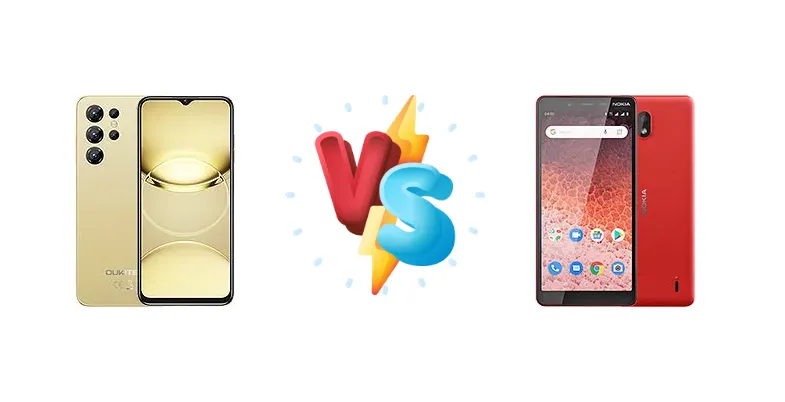
The Oukitel C1 Pro and Nokia 1 Plus represent opposite ends of the ultra-budget smartphone spectrum. The C1 Pro prioritizes processing power and battery endurance, while the Nokia 1 Plus aims for simplicity and brand recognition. This comparison dissects their core components to determine which device delivers the best value for users seeking an affordable mobile experience.
🏆 Quick Verdict
For the average user prioritizing responsiveness and longevity, the Oukitel C1 Pro is the clear winner. Its Unisoc T606 chipset offers significantly better performance than the Nokia 1 Plus’s Mediatek MT6739WW, and its impressive 65:13h battery endurance ensures all-day use. While the Nokia 1 Plus benefits from the Nokia brand, it falls short in core performance metrics.
| Network |
|---|
| 2G bands | GSM 850 / 900 / 1800 / 1900 | GSM 850 / 900 / 1800 / 1900 |
| 3G bands | HSDPA 850 / 900 / 1700(AWS) / 1900 / 2100 | HSDPA 850 / 900 / 2100 - Global |
| 4G bands | 1, 2, 3, 4, 5, 7, 8, 12, 17, 19, 20, 25, 26, 28, 66 | 1, 3, 5, 7, 8, 20, 38, 40 - Global |
| Speed | HSPA, LTE | HSPA 42.2/5.76 Mbps, LTE Cat4 150/50 Mbps |
| Technology | GSM / HSPA / LTE | GSM / HSPA / LTE |
| | - | 1, 2, 3, 4, 5, 7, 8, 12, 17, 28 - LATAM |
| Launch |
|---|
| Announced | 2025, January | 2019, February 24. Released 2019, February 24 |
| Status | Available. Released 2025, February | Discontinued |
| Body |
|---|
| Build | - | Glass front, plastic back, plastic frame |
| Dimensions | 163.8 x 75.4 x 9.2 mm (6.45 x 2.97 x 0.36 in) | 145 x 70.4 x 8.6 mm (5.71 x 2.77 x 0.34 in) |
| SIM | Nano-SIM + Nano-SIM | Nano-SIM + Nano-SIM |
| Weight | 199 g (7.02 oz) | 138.4 g (4.87 oz) |
| Display |
|---|
| Protection | Panda Glass, Mohs level 5 | - |
| Resolution | 576 x 1280 pixels, 20:9 ratio (~215 ppi density) | 480 x 960 pixels, 18:9 ratio (~197 ppi density) |
| Size | 6.52 inches, 102.6 cm2 (~83.1% screen-to-body ratio) | 5.45 inches, 76.7 cm2 (~75.1% screen-to-body ratio) |
| Type | IPS LCD, 400 nits | IPS LCD |
| Platform |
|---|
| CPU | Octa-core (2x1.6 GHz Cortex-A75 & 6x1.6 GHz Cortex-A55) | Quad-core 1.5 GHz Cortex-A53 |
| Chipset | Unisoc T606 (12 nm) | Mediatek MT6739WW (28 nm) |
| GPU | Mali-G57 MP1 | PowerVR GE8100 |
| OS | Android 15 | Android 9.0 Pie (Go edition), upgradable to Android 10 (Go edition) |
| Memory |
|---|
| Card slot | microSDXC (uses shared SIM slot) | microSDXC (dedicated slot) |
| Internal | 256GB 4GB RAM | 8GB 1GB RAM, 16GB 1GB RAM, 16GB 3GB RAM |
| | - | eMMC 5.1 |
| Main Camera |
|---|
| Features | LED flash, HDR, panorama | LED flash |
| Single | 13 MP, f/2.2, (wide), 1/3.06", AF | 8 MP, AF |
| Video | 1080p@30fps | 720p@30fps |
| Selfie camera |
|---|
| Single | 5 MP, f/2.2, (wide), 1/5.0" | 5 MP |
| Video | 720p@30fps | 720p |
| Sound |
|---|
| 3.5mm jack | - | Yes |
| 35mm jack | Yes | Yes |
| Loudspeaker | Yes | Yes |
| Comms |
|---|
| Bluetooth | 5.0, A2DP, LE | 4.2, A2DP |
| NFC | No | No |
| Positioning | GPS, GALILEO, GLONASS, BDS | GPS, GLONASS |
| Radio | FM radio | FM radio |
| USB | USB Type-C | microUSB 2.0 |
| WLAN | Wi-Fi 802.11 b/g/n/ac, dual-band | Wi-Fi 802.11 a/b/g/n |
| Features |
|---|
| Sensors | Fingerprint (side-mounted), accelerometer, compass | Accelerometer, proximity |
| Battery |
|---|
| Charging | 10W wired | - |
| Type | Li-Po 5150 mAh | Li-Ion 2500 mAh, removable |
| Misc |
|---|
| Colors | Black, Blue, Gold, Pink, White | Black, Red, Blue |
| Models | - | TA-1130, TA-1111, TA-1123, TA-1127, TA-1131 |
| Price | - | About 80 EUR |
| SAR | - | 0.96 W/kg (head) 0.72 W/kg (body) |
| SAR EU | - | 0.59 W/kg (head) 1.79 W/kg (body) |
| EU LABEL |
|---|
| Battery | 65:13h endurance, 1200 cycles | - |
| Energy | Class A | - |
| Free fall | Class A (270 falls) | - |
| Repairability | Class B | - |
Oukitel C1 Pro
- Significantly faster processor for smoother performance
- Exceptional battery life (65:13h endurance)
- More modern chipset architecture (12nm)
- Slow 10W charging
- Brand recognition is lower than Nokia
Nokia 1 Plus
- Trusted Nokia brand name
- Clean Android experience (likely)
- Potentially more compact form factor
- Outdated and slow Mediatek MT6739WW chipset
- Poor battery life compared to Oukitel C1 Pro
- Limited performance for demanding tasks
Display Comparison
Neither device provides display specifications, but given their price points, we can assume both utilize LCD panels. The Oukitel C1 Pro’s advantage lies in its more modern chipset, potentially allowing for better image processing and smoother scrolling. The Nokia 1 Plus, with its older chipset, will likely exhibit more noticeable lag when navigating the user interface.
Camera Comparison
Without detailed camera specifications, a direct comparison is difficult. However, given the market segment, both phones likely feature basic camera setups. It’s reasonable to assume the Oukitel C1 Pro, benefiting from its more powerful processor, will have superior image processing capabilities, resulting in better image quality, especially in low-light conditions. The Nokia 1 Plus will likely struggle with image noise and slower processing times.
Performance
The Oukitel C1 Pro’s Unisoc T606 (12nm) is a substantial upgrade over the Nokia 1 Plus’s Mediatek MT6739WW (28nm). The T606’s octa-core configuration (2x1.6 GHz Cortex-A75 & 6x1.6 GHz Cortex-A55) provides significantly more processing power than the MT6739WW’s quad-core 1.5 GHz Cortex-A53. The 12nm process node of the T606 also contributes to improved power efficiency, meaning less heat generation and potentially better sustained performance. Users will experience faster app loading times, smoother multitasking, and a more responsive overall experience with the C1 Pro.
Battery Life
The Oukitel C1 Pro boasts an impressive 65:13h endurance, a testament to its efficient chipset and likely larger battery capacity (though not specified). This translates to multi-day battery life for moderate users. The Nokia 1 Plus, with its older and less efficient chipset, will likely require daily charging. The C1 Pro’s 10W charging is slow by modern standards, but the exceptional battery life mitigates this drawback. The Nokia 1 Plus’s charging speed is also likely similar, offering no significant advantage.
Buying Guide
Buy the Oukitel C1 Pro if you need a phone capable of handling multiple apps, streaming video, and light gaming without significant lag. It’s ideal for users who rely heavily on their phone throughout the day and require extended battery life. Buy the Nokia 1 Plus if you prioritize a clean Android experience, a trusted brand name, and are willing to compromise on performance for simplicity. It’s best suited for basic communication – calls, texts, and light social media use.
Frequently Asked Questions
❓ Is the Unisoc T606 in the Oukitel C1 Pro capable of running popular apps like WhatsApp and Facebook smoothly?
Yes, the Unisoc T606 is more than capable of running apps like WhatsApp and Facebook smoothly. Its octa-core architecture and higher clock speeds provide ample processing power for everyday tasks and social media applications. Users should experience a responsive and lag-free experience.
❓ How does the Mediatek MT6739WW in the Nokia 1 Plus handle multitasking between several apps?
The Mediatek MT6739WW struggles with multitasking. Its quad-core processor and lower clock speed will result in noticeable lag and slowdowns when switching between multiple apps. It’s best suited for running one app at a time.
❓ Will the Oukitel C1 Pro's 10W charging be a significant inconvenience?
While 10W charging is slow compared to modern standards, the C1 Pro’s exceptional battery life (65:13h endurance) largely mitigates this issue. You won’t need to charge it as frequently, reducing the impact of the slow charging speed. Overnight charging is a viable solution.
❓ Does the Nokia 1 Plus receive regular software updates and security patches?
Nokia is known for providing relatively good software support for its budget devices. However, the Nokia 1 Plus is an older model, so its update cycle may be nearing its end. While it likely received Android Go updates, long-term security support may be limited.