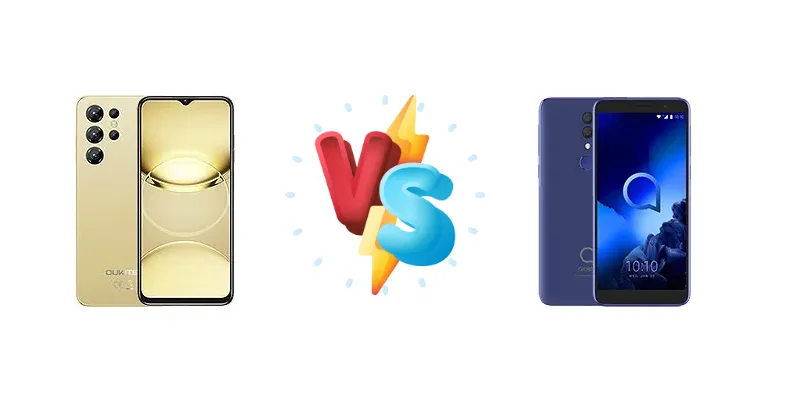
The ultra-budget smartphone market demands compromise, but some phones offer more value than others. We pit the Oukitel C1 Pro, boasting a modern Unisoc chipset and impressive battery life claims, against the older Alcatel 1x (2019), a staple of the entry-level segment, to determine which delivers the best experience for the money.
🏆 Quick Verdict
For the vast majority of users, the Oukitel C1 Pro is the superior choice. Its Unisoc T606 chipset provides a substantial performance uplift over the Alcatel 1x’s Mediatek MT6739, coupled with significantly longer battery endurance. While both are budget devices, the C1 Pro offers a more usable and future-proof experience.
| Network |
|---|
| 2G bands | GSM 850 / 900 / 1800 / 1900 | GSM 850 / 900 / 1800 / 1900 |
| 3G bands | HSDPA 850 / 900 / 1700(AWS) / 1900 / 2100 | HSDPA 850 / 900 / 1700(AWS) / 1900 / 2100 - 5059A |
| 4G bands | 1, 2, 3, 4, 5, 7, 8, 12, 17, 19, 20, 25, 26, 28, 66 | 1, 3, 5, 7, 8, 28, 38, 40 - 5008T |
| Speed | HSPA, LTE | HSPA 42.2/5.76 Mbps, LTE Cat4 150/50 Mbps |
| Technology | GSM / HSPA / LTE | GSM / HSPA / LTE |
| | - | 1, 3, 7, 8, 20, 28 - 5008Y |
| Launch |
|---|
| Announced | 2025, January | 2019, January. Released 2019, Q1 |
| Status | Available. Released 2025, February | Discontinued |
| Body |
|---|
| Dimensions | 163.8 x 75.4 x 9.2 mm (6.45 x 2.97 x 0.36 in) | 146.4 x 68.8 x 8.3 mm (5.76 x 2.71 x 0.33 in) |
| SIM | Nano-SIM + Nano-SIM | · Nano-SIM· Nano-SIM + Nano-SIM |
| Weight | 199 g (7.02 oz) | 130 g (4.59 oz) |
| Display |
|---|
| Protection | Panda Glass, Mohs level 5 | - |
| Resolution | 576 x 1280 pixels, 20:9 ratio (~215 ppi density) | 720 x 1440 pixels, 18:9 ratio (~293 ppi density) |
| Size | 6.52 inches, 102.6 cm2 (~83.1% screen-to-body ratio) | 5.5 inches, 78.1 cm2 (~77.5% screen-to-body ratio) |
| Type | IPS LCD, 400 nits | IPS LCD |
| Platform |
|---|
| CPU | Octa-core (2x1.6 GHz Cortex-A75 & 6x1.6 GHz Cortex-A55) | Quad-core 1.5 GHz Cortex-A53 |
| Chipset | Unisoc T606 (12 nm) | Mediatek MT6739 (28 nm) |
| GPU | Mali-G57 MP1 | PowerVR GE8100 |
| OS | Android 15 | Android 8.1 (Oreo) |
| Memory |
|---|
| Card slot | microSDXC (uses shared SIM slot) | microSDXC |
| Internal | 256GB 4GB RAM | 16GB 2GB RAM |
| | - | eMMC 5.1 |
| Main Camera |
|---|
| Dual | - | 13 MP
2 MP |
| Features | LED flash, HDR, panorama | LED flash, HDR |
| Single | 13 MP, f/2.2, (wide), 1/3.06", AF | - |
| Video | 1080p@30fps | 1080p@30fps |
| Selfie camera |
|---|
| Features | - | LED flash |
| Single | 5 MP, f/2.2, (wide), 1/5.0" | 5 MP |
| Video | 720p@30fps | 720p |
| Sound |
|---|
| 3.5mm jack | - | Yes |
| 35mm jack | Yes | Yes |
| Loudspeaker | Yes | Yes |
| Comms |
|---|
| Bluetooth | 5.0, A2DP, LE | 4.2, A2DP, LE |
| NFC | No | No |
| Positioning | GPS, GALILEO, GLONASS, BDS | GPS |
| Radio | FM radio | FM radio |
| USB | USB Type-C | microUSB 2.0 |
| WLAN | Wi-Fi 802.11 b/g/n/ac, dual-band | Wi-Fi 802.11 b/g/n, Wi-Fi Direct |
| Features |
|---|
| Sensors | Fingerprint (side-mounted), accelerometer, compass | Fingerprint (rear-mounted, 5008T only), accelerometer, proximity |
| Battery |
|---|
| Charging | 10W wired | - |
| Type | Li-Po 5150 mAh | Li-Ion 3000 mAh, removable |
| Misc |
|---|
| Colors | Black, Blue, Gold, Pink, White | Pebble Blue, Pebble Black |
| Models | - | 5008T, 5008Y, 5008U, 5008R, 5008D_EEA, 5008Y_EEA, 5008D |
| Price | - | About 120 EUR |
| EU LABEL |
|---|
| Battery | 65:13h endurance, 1200 cycles | - |
| Energy | Class A | - |
| Free fall | Class A (270 falls) | - |
| Repairability | Class B | - |
Oukitel C1 Pro
- Significantly faster processor for smoother performance
- Exceptional battery life with 65+ hour endurance
- Potentially better image processing due to newer chipset
- Slow 10W charging
- Likely basic display quality
alcatel 1x (2019)
- Extremely low price point
- Simple and easy-to-use interface
- Compact size (likely)
- Poor performance, struggles with multitasking
- Short battery life
- Outdated chipset and software
Display Comparison
Neither device is expected to deliver a premium display experience. Given the context of these phones, display specs are likely basic. We can infer the Alcatel 1x, being older, likely has lower brightness and color accuracy. The Oukitel C1 Pro, while not specified, benefits from a more recent manufacturing process which *could* translate to a slightly better panel, but this is speculative. Bezels are likely substantial on both.
Camera Comparison
Camera performance is likely to be limited on both devices. Without specific sensor details, it’s safe to assume both rely on basic sensors. The Alcatel 1x is notorious for its low-quality camera. The Oukitel C1 Pro, while not a photography powerhouse, likely benefits from the more modern ISP within the Unisoc T606, potentially offering slightly better image processing and detail. Any 2MP macro or depth sensors on either device should be considered marketing fluff.
Performance
The performance gap is the most significant differentiator. The Oukitel C1 Pro’s Unisoc T606, built on a 12nm process, features an octa-core configuration (2x1.6 GHz Cortex-A75 & 6x1.6 GHz Cortex-A55) offering a substantial advantage over the Alcatel 1x’s quad-core 1.5 GHz Cortex-A53 and its older 28nm Mediatek MT6739 chipset. The Cortex-A75 cores in the C1 Pro provide a noticeable boost in single-core performance, crucial for app responsiveness, while the additional cores improve multitasking capabilities. The 12nm process also contributes to better power efficiency, complementing the larger battery.
Battery Life
The Oukitel C1 Pro shines in battery endurance, claiming 65:13h of usage and 1200 charge cycles. This is a significant advantage over what the Alcatel 1x can offer. While the Alcatel 1x’s battery capacity isn’t specified, the less efficient Mediatek MT6739 chipset will drain it faster. The C1 Pro’s 10W charging is slow by modern standards, but the long battery life mitigates this. The 1200 charge cycle claim suggests a focus on long-term battery health, a valuable feature for budget users.
Buying Guide
Buy the Oukitel C1 Pro if you need a phone capable of handling everyday tasks smoothly, enjoy extended battery life for all-day use, and appreciate a more modern processor architecture. Buy the Alcatel 1x (2019) if you absolutely require the lowest possible price point and your usage is limited to basic calling and texting, accepting significant performance limitations.
Frequently Asked Questions
❓ Is the Unisoc T606 in the Oukitel C1 Pro capable of playing modern mobile games?
While not a gaming powerhouse, the Unisoc T606 can handle less demanding games at lower settings. Expect playable frame rates in titles like PUBG Mobile or Call of Duty Mobile on low graphics, but don't expect a flagship gaming experience. The Alcatel 1x’s MT6739 would struggle significantly with even basic games.
❓ How does the 12nm process of the Unisoc T606 impact the Oukitel C1 Pro's battery life compared to the Alcatel 1x?
The 12nm process is significantly more efficient than the 28nm process used in the Alcatel 1x’s Mediatek MT6739. This means the Unisoc T606 consumes less power for the same level of performance, directly contributing to the Oukitel C1 Pro’s impressive 65+ hour battery endurance. The Alcatel 1x will require more frequent charging.
❓ Will the Oukitel C1 Pro receive software updates?
Software update support is a common concern with ultra-budget phones. Oukitel’s track record is inconsistent. Expect at best a single major Android update, and security patches may be infrequent. The Alcatel 1x is likely no longer receiving updates.