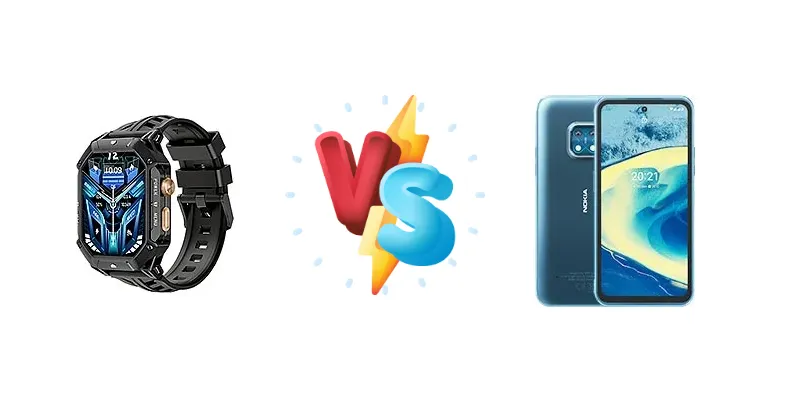
The rugged smartphone market caters to a specific need: durability. While both the Oukitel BT80 and Nokia XR20 aim to deliver on this promise, they approach it from different angles. The Nokia XR20 integrates 5G connectivity and a modern chipset, while the Oukitel BT80, lacking detailed specifications, likely focuses on maximizing value and core rugged features. This comparison will dissect their strengths and weaknesses to determine which device best suits your needs.
🏆 Quick Verdict
For the average user prioritizing 5G connectivity and a more refined software experience, the Nokia XR20 is the clear winner. Its Snapdragon 480 5G chipset provides a noticeable performance boost and future-proofs the device. However, if extreme affordability and a focus solely on ruggedness are paramount, the Oukitel BT80 may offer a compelling, albeit less-defined, alternative.
| Network |
|---|
| 2G bands | N/A | GSM 850 / 900 / 1800 / 1900 |
| 3G bands | N/A | HSDPA 850 / 900 / 1700(AWS) / 1900 / 2100 |
| 4G bands | N/A | 1, 2, 3, 4, 5, 7, 8, 12, 13, 14, 20, 25, 26, 28, 30, 38, 40, 41, 48, 66, 71 |
| 5G bands | - | 2, 5, 25, 38, 41, 48, 66, 77, 78 SA/NSA |
| EDGE | No | - |
| GPRS | No | - |
| Speed | No | HSPA, LTE, 5G |
| Technology | No cellular connectivity | GSM / CDMA / HSPA / EVDO / LTE / 5G |
| | - | CDMA2000 1xEV-DO |
| Launch |
|---|
| Announced | 2024, April | 2021, July 27 |
| Status | Available. Released 2024, May | Available. Released 2021, August 04 |
| Body |
|---|
| Dimensions | 52.7 x 44.5 x 14.2 mm (2.07 x 1.75 x 0.56 in) | 171.6 x 81.5 x 10.6 mm (6.76 x 3.21 x 0.42 in) |
| SIM | No | · Nano-SIM· Nano-SIM + Nano-SIM |
| Weight | - | 248 g (8.75 oz) |
| | - | IP68 dust/water resistant (up to 1.5m for 60 min)
Drop-to-concrete resistance from up to 1.8m
MIL-STD-810H compliant |
| Display |
|---|
| Protection | Tempered glass | Corning Gorilla Glass Victus |
| Resolution | 410 x 502 pixels (~304 ppi density) | 1080 x 2400 pixels, 20:9 ratio (~395 ppi density) |
| Size | 2.13 inches | 6.67 inches, 107.4 cm2 (~76.8% screen-to-body ratio) |
| Type | AMOLED | IPS LCD, 550 nits |
| Platform |
|---|
| CPU | - | Octa-core (2x2.0 GHz Kryo 460 & 6x1.8 GHz Kryo 460) |
| Chipset | - | Qualcomm SM4350 Snapdragon 480 5G (8 nm) |
| GPU | - | Adreno 619 |
| OS | Proprietary OS | Android 11, upgradable to Android 13 |
| Memory |
|---|
| Card slot | No | microSDXC (uses shared SIM slot) |
| Internal | Unspecified | 64GB 4GB RAM, 128GB 6GB RAM |
| Main Camera |
|---|
| Dual | - | 48 MP, f/1.8, (wide), 1/2.25", 0.8µm, PDAF
13 MP, f/2.4, 123˚ (ultrawide), 1/3.0", 1.12µm |
| Features | - | Zeiss optics, Dual-LED dual-tone flash, second LED flash, HDR, panorama |
| Single | - | 8 MP, f/2.0 (wide), 1/4.0", 1.12µm |
| Video | - | 1080p@30fps |
| Selfie camera |
|---|
| Single | - | 8 MP, f/2.0 (wide), 1/4.0", 1.12µm |
| Video | - | 1080p@30fps |
| Sound |
|---|
| 3.5mm jack | - | Yes |
| 35mm jack | No | Yes |
| Loudspeaker | Yes | Yes, with stereo speakers |
| Comms |
|---|
| Bluetooth | 5.2 | 5.1, A2DP, LE, aptX Adaptive |
| NFC | No | Yes |
| Positioning | No | GPS (L1+L5), GLONASS, BDS, GALILEO, QZSS, NavIC |
| Radio | No | Unspecified |
| USB | No | USB Type-C 3.0 |
| WLAN | No | Wi-Fi 802.11 a/b/g/n/ac/6, dual-band, Wi-Fi Direct |
| Features |
|---|
| Sensors | Accelerometer, heart rate, SpO2, blood pressure, barometer, compass | Fingerprint (side-mounted), accelerometer, gyro, proximity, compass, barometer |
| Battery |
|---|
| Charging | - | 18W wired
15W wireless |
| Type | 1000 mAh | Li-Po 4630 mAh |
| Misc |
|---|
| Colors | Black, Titanium | Ultra Blue, Granite Gray |
| Models | - | TA-1368, TA-1362 |
| Price | About 70 EUR | About 270 EUR |
| SAR EU | - | 1.13 W/kg (head) 1.43 W/kg (body) |
Oukitel BT80
- Potentially more affordable price point
- Focus on core rugged features
- Likely larger battery capacity (assumption)
- Lack of 5G connectivity
- Inferior chipset performance
- Limited software support
Nokia XR20
- 5G connectivity with Snapdragon 480
- Wireless charging support
- More refined software experience
- Higher price point
- Potentially less rugged build quality than BT80 (needs further testing)
- 18W charging is relatively slow
Display Comparison
Without specific display details for the Oukitel BT80, a direct comparison is difficult. The Nokia XR20’s display is likely a standard LCD panel, prioritizing visibility over color accuracy. The XR20’s durability is enhanced by Gorilla Glass Victus, a significant advantage over potentially less-protected displays on the BT80. The absence of LTPO technology on the XR20 means the refresh rate is likely fixed, impacting battery efficiency compared to adaptive refresh rate displays.
Camera Comparison
Given the lack of camera specifications for the Oukitel BT80, we can assume it features a basic camera setup geared towards functionality rather than image quality. The Nokia XR20, while not a camera powerhouse, offers a more capable imaging experience. Its main sensor, coupled with image processing algorithms, will likely deliver superior image quality in various lighting conditions. The absence of detailed information on the BT80’s camera makes it difficult to assess its capabilities beyond basic photography.
Performance
The Nokia XR20’s Qualcomm SM4350 Snapdragon 480 5G (8nm) chipset is the defining performance differentiator. Its octa-core configuration, with 2x2.0 GHz Kryo 460 cores and 6x1.8 GHz Kryo 460 cores, provides a substantial performance advantage over what is typically found in budget-oriented rugged phones like the Oukitel BT80. The 8nm process node also contributes to better thermal efficiency, reducing throttling during sustained tasks. The BT80 likely utilizes a MediaTek Helio P-series or similar chipset, offering adequate performance for basic tasks but falling short in demanding applications. The XR20’s 5G modem is a key benefit for users in areas with 5G coverage.
Battery Life
The Nokia XR20 offers 18W wired charging and 15W wireless charging, providing flexibility in charging options. While the battery capacity isn’t specified in the context data, the Snapdragon 480’s efficiency and the XR20’s software optimizations contribute to respectable battery life. The Oukitel BT80 likely has a larger battery capacity to compensate for a less efficient chipset, but without charging wattage information, it’s difficult to determine its charging speed. The XR20’s wireless charging is a convenience feature the BT80 likely lacks.
Buying Guide
Buy the Oukitel BT80 if you need an exceptionally durable phone on a very tight budget and don't require 5G connectivity or advanced features. It's ideal for construction workers, outdoor enthusiasts on a budget, or anyone needing a reliable 'beater' phone. Buy the Nokia XR20 if you prefer a balance of ruggedness, 5G performance, and a more modern smartphone experience, including wireless charging and a more established brand reputation. This phone is suited for users who need reliable connectivity in challenging environments and appreciate software updates.
Frequently Asked Questions
❓ Does the Nokia XR20's Snapdragon 480 5G chipset get hot during extended use, like gaming?
The Snapdragon 480 5G is an efficient chipset, and the Nokia XR20 incorporates thermal management features to mitigate overheating. While some warmth is expected during prolonged gaming sessions, it's unlikely to experience significant throttling compared to more powerful, less-efficient chipsets. The 8nm process node contributes to better thermal performance.
❓ How does the Nokia XR20's software update policy compare to typical Oukitel devices?
Nokia is known for its commitment to software updates, promising at least three years of security updates and two major OS upgrades for the XR20. Oukitel, historically, has a less consistent update track record. This means the XR20 will remain secure and benefit from new features for a longer period.
❓ Is the Nokia XR20 truly waterproof, or just water-resistant?
The Nokia XR20 boasts an IP68 rating, meaning it's dust-tight and can withstand immersion in up to 1.5 meters of freshwater for up to 30 minutes. While highly water-resistant, it's not entirely 'waterproof' and prolonged exposure or saltwater can still cause damage.