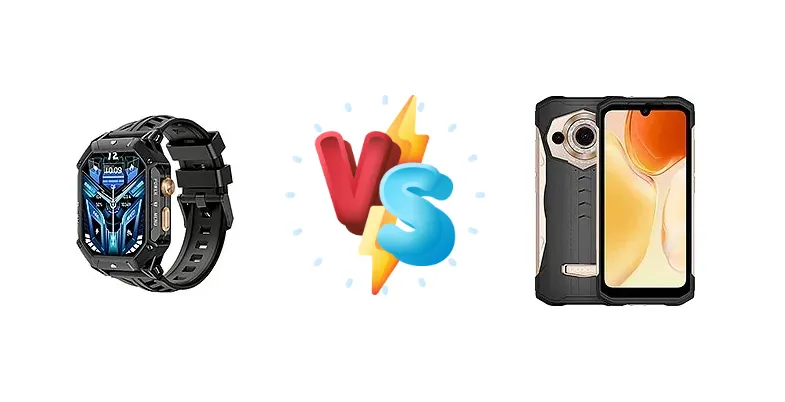
The rugged smartphone market is booming, catering to users who demand durability alongside functionality. We're pitting the Oukitel BT80 against the Doogee S99, two contenders aiming to deliver on that promise. While the Oukitel BT80's specifications remain largely undisclosed, we'll analyze it within the context of its market positioning and compare it to the Doogee S99's known Mediatek Helio G96 chipset and feature set.
🏆 Quick Verdict
For the average user prioritizing performance and charging speed, the Doogee S99 emerges as the stronger choice. Its Mediatek Helio G96 chipset provides a significant performance advantage over the likely entry-level processor in the Oukitel BT80, and the 33W charging is a substantial benefit for those on the go. However, the Oukitel BT80 may appeal to budget-conscious buyers.
| Network |
|---|
| 2G bands | N/A | GSM 850 / 900 / 1800 / 1900 |
| 3G bands | N/A | HSDPA 800 / 850 / 900 / 1700(AWS) / 1900 / 2100 |
| 4G bands | N/A | 1, 2, 3, 4, 5, 7, 8, 12, 13, 17, 18, 19, 20, 25, 26, 28, 34, 38, 39, 40, 41, 66 |
| EDGE | No | - |
| GPRS | No | - |
| Speed | No | HSPA, LTE |
| Technology | No cellular connectivity | GSM / CDMA / HSPA / LTE |
| Launch |
|---|
| Announced | 2024, April | 2022, December 05 |
| Status | Available. Released 2024, May | Available. Released 2022, December 05 |
| Body |
|---|
| Dimensions | 52.7 x 44.5 x 14.2 mm (2.07 x 1.75 x 0.56 in) | 172 x 82 x 15.5 mm (6.77 x 3.23 x 0.61 in) |
| SIM | No | Nano-SIM + Nano-SIM |
| Weight | - | - |
| Display |
|---|
| Protection | Tempered glass | Corning Gorilla Glass |
| Resolution | 410 x 502 pixels (~304 ppi density) | 1080 x 2340 pixels, 19.5:9 ratio (~409 ppi density) |
| Size | 2.13 inches | 6.3 inches, 97.4 cm2 (~69.1% screen-to-body ratio) |
| Type | AMOLED | IPS LCD |
| Platform |
|---|
| CPU | - | Octa-core (2x2.05 GHz Cortex-A76 & 6x2.0 GHz Cortex-A55) |
| Chipset | - | Mediatek MT6781 Helio G96 (12 nm) |
| GPU | - | Mali-G57 MC2 |
| OS | Proprietary OS | Android 12 |
| Memory |
|---|
| Card slot | No | microSDXC (dedicated slot) |
| Internal | Unspecified | 128GB 8GB RAM |
| Main Camera |
|---|
| Features | - | Dual-LED flash, HDR, panorama |
| Triple | - | 108 MP, f/1.9, (wide), 1/1.52", 0.7µm, PDAF
64 MP, f/1.8, (night vision), 2 infrared night vision lights
16 MP, f/1.8, 130˚ (ultrawide) |
| Video | - | 1440p@30fps, 1080p@30fps |
| Selfie camera |
|---|
| Single | - | 32 MP, f/2.0, (wide), 1/2.8", 0.8µm |
| Video | - | 1080p@30fps |
| Sound |
|---|
| 35mm jack | No | No |
| Loudspeaker | Yes | Yes |
| Comms |
|---|
| Bluetooth | 5.2 | 5.1, A2DP, LE |
| NFC | No | Yes (market/region dependent) |
| Positioning | No | GPS, GLONASS, GALILEO, BDS |
| Radio | No | FM radio |
| USB | No | USB Type-C 2.0, OTG |
| WLAN | No | Wi-Fi 802.11 a/b/g/n/ac, dual-band |
| Features |
|---|
| Sensors | Accelerometer, heart rate, SpO2, blood pressure, barometer, compass | Fingerprint (side-mounted), accelerometer, gyro, proximity, compass |
| Battery |
|---|
| Charging | - | 33W wired, 45% in 30 min
15W wireless
Reverse wired |
| Type | 1000 mAh | 6000 mAh |
| Misc |
|---|
| Colors | Black, Titanium | Gold, Black |
| Price | About 70 EUR | About 250 EUR |
Oukitel BT80
- Potentially lower price point
- Rugged design for durability
- Likely long software support (given brand focus)
- Significantly lower performance
- Slow charging speeds (estimated)
- Limited camera capabilities (estimated)
Doogee S99
- Powerful Mediatek Helio G96 chipset
- Fast 33W wired and 15W wireless charging
- More capable camera system
- Higher price compared to Oukitel BT80 (likely)
- May require more frequent charging with heavy use
- Software updates may be less frequent
Display Comparison
Without specific display details for the Oukitel BT80, it's reasonable to assume it utilizes a standard IPS LCD panel, common in this price segment. The Doogee S99, while not boasting a high-end display, benefits from a likely higher brightness output due to the chipset's display engine. Color accuracy is likely similar between the two, leaning towards practical rather than color-critical applications. Bezels are expected to be substantial on both devices, prioritizing drop protection over maximizing screen real estate.
Camera Comparison
Given the lack of camera specifications for the Oukitel BT80, a conservative assumption places it with a basic camera setup focused on functionality rather than image quality. The Doogee S99, while not a camera powerhouse, likely features a more capable main sensor, potentially paired with image processing algorithms optimized for outdoor conditions. We can expect the Doogee S99 to deliver more detailed and vibrant photos, particularly in good lighting. The prevalence of 2MP macro lenses on both devices suggests limited utility; these sensors typically lack the resolution and optics to produce truly compelling macro shots.
Performance
The Doogee S99's Mediatek Helio G96 (12nm) chipset is the clear performance leader. Its octa-core configuration, featuring 2x2.05 GHz Cortex-A76 and 6x2.0 GHz Cortex-A55 cores, provides a noticeable boost in CPU and GPU performance compared to the likely entry-level processor found in the Oukitel BT80. This translates to smoother multitasking, faster app loading times, and a more enjoyable gaming experience on the Doogee S99. The 12nm process node, while not the most advanced, offers a good balance between performance and power efficiency. The Oukitel BT80 will likely suffice for basic tasks, but will struggle with demanding applications.
Battery Life
The Doogee S99's 33W wired charging is a significant advantage, capable of delivering a 45% charge in just 30 minutes. This rapid charging capability is crucial for users who rely heavily on their phones throughout the day. The inclusion of 15W wireless charging and reverse wired charging further enhances the S99's versatility. While the Oukitel BT80's battery capacity is unknown, its charging speed is likely significantly slower, potentially requiring several hours for a full charge. The Doogee S99's faster charging offsets any potential difference in battery capacity.
Buying Guide
Buy the Oukitel BT80 if you need a basic, extremely durable phone for essential communication and are on a very tight budget, prioritizing longevity over speed. Buy the Doogee S99 if you prefer a more responsive experience for apps, streaming, and occasional gaming, and value faster charging capabilities alongside rugged construction. The S99 is for users who need a workhorse, not just a lifeline.
Frequently Asked Questions
❓ Does the Doogee S99's Helio G96 chipset get hot during extended gaming sessions?
The Mediatek Helio G96 is known for decent thermal management, but prolonged gaming will inevitably generate heat. The Doogee S99's rugged design likely incorporates heat dissipation features to mitigate throttling, but users should expect some performance reduction after extended periods of intense gaming. It's unlikely the Oukitel BT80 will have the thermal headroom to sustain gaming for long periods.
❓ How does the Doogee S99's reverse wired charging work, and what can it charge?
The Doogee S99's reverse wired charging allows you to use the phone as a power bank to charge other devices via a USB-C cable. It's ideal for topping up accessories like wireless earbuds, smartwatches, or even another smartphone in an emergency. However, charging speeds will be limited, and it will drain the S99's battery.
❓ Is the Oukitel BT80 likely to receive regular software updates?
Oukitel, while focusing on rugged devices, historically has a less consistent software update track record compared to larger brands. Users should not expect frequent or long-term software support for the BT80. The Doogee S99 may receive more frequent updates, but it's still not guaranteed.