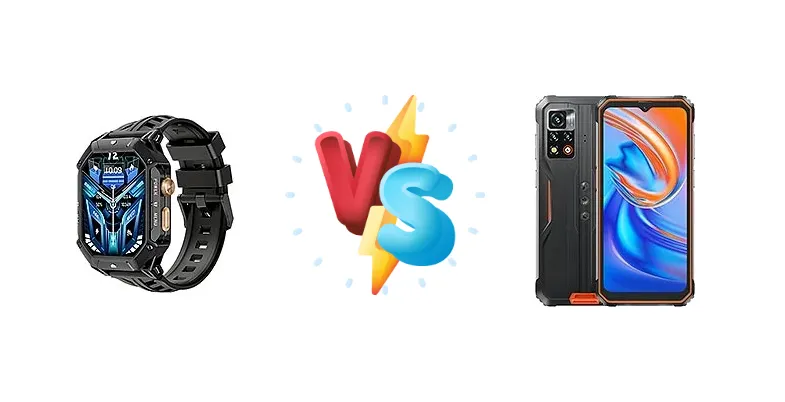
The rugged smartphone market caters to a specific user – those needing durability and reliability in challenging environments. Both the Oukitel BT80 and Blackview BV9200 aim to deliver on this promise, but they approach it with different strengths. The BV9200 boasts a known chipset and charging capabilities, while the BT80 remains largely a mystery in terms of detailed specifications, making a direct comparison a challenge of inference and market positioning.
🏆 Quick Verdict
For the average user prioritizing proven performance and fast charging, the Blackview BV9200 is the clear winner. Its Mediatek Helio G96 chipset and 66W wired/30W wireless charging provide a tangible advantage over the Oukitel BT80, which lacks publicly available specifications, suggesting a potentially lower performance tier.
| Network |
|---|
| 2G bands | N/A | GSM 850 / 900 / 1800 / 1900 |
| 3G bands | N/A | HSDPA 850 / 900 / 1700(AWS) / 1900 / 2100 |
| 4G bands | N/A | 1, 2, 3, 4, 5, 7, 8, 12, 13, 17, 18, 19, 20, 25, 26, 28, 34, 38, 39, 40, 41, 66 |
| EDGE | No | - |
| GPRS | No | - |
| Speed | No | HSPA, LTE |
| Technology | No cellular connectivity | GSM / CDMA / HSPA / LTE |
| | - | CDMA 800 / 1900 |
| Launch |
|---|
| Announced | 2024, April | 2022, December 28 |
| Status | Available. Released 2024, May | Available. Released 2023, January 09 |
| Body |
|---|
| Dimensions | 52.7 x 44.5 x 14.2 mm (2.07 x 1.75 x 0.56 in) | 174.5 x 81.8 x 13.6 mm (6.87 x 3.22 x 0.54 in) |
| SIM | No | Nano-SIM + Nano-SIM |
| Weight | - | 310 g (10.93 oz) |
| | - | IP68/IP69K dust/water resistant (up to 1.5m for 30 min)
Drop-to-concrete resistance from up to 1.8m
MIL-STD-810H compliant |
| Display |
|---|
| Protection | Tempered glass | Corning Gorilla Glass 5 |
| Resolution | 410 x 502 pixels (~304 ppi density) | 1080 x 2408 pixels, 20:9 ratio (~400 ppi density) |
| Size | 2.13 inches | 6.6 inches, 104.9 cm2 (~73.5% screen-to-body ratio) |
| Type | AMOLED | IPS LCD, 120Hz |
| Platform |
|---|
| CPU | - | Octa-core (2x2.05 GHz Cortex-A76 & 6x2.0 GHz Cortex-A55) |
| Chipset | - | Mediatek MT6781 Helio G96 (12 nm) |
| GPU | - | Mali-G52 MC2 |
| OS | Proprietary OS | Android 12, Doke-OS 3.1 |
| Memory |
|---|
| Card slot | No | microSDXC (dedicated slot) |
| Internal | Unspecified | 256GB 8GB RAM |
| | - | UFS 2.1 |
| Main Camera |
|---|
| Features | - | LED flash, HDR, panorama |
| Single | - | 16 MP, (wide), 1/3", 1.0µm |
| Triple | - | 50 MP, f/1.8, (wide), 1/2.76", 0.64µm, PDAF
8 MP, f/1.8, 120˚, (ultrawide), AF
Auxiliary lens |
| Video | - | 1440p@30fps, 1080p@30fps |
| Selfie camera |
|---|
| Single | - | 16 MP, f/2.0, (wide), 1/3", 1.0µm |
| Video | - | 1080p |
| Sound |
|---|
| 3.5mm jack | - | No |
| 35mm jack | No | No |
| Loudspeaker | Yes | Yes, with dual speakers |
| Comms |
|---|
| Bluetooth | 5.2 | 5.2, A2DP, LE |
| NFC | No | Yes |
| Positioning | No | GPS, GLONASS, GALILEO, BDS |
| Radio | No | FM radio |
| USB | No | USB Type-C, OTG |
| WLAN | No | Wi-Fi 802.11 a/b/g/n/ac, dual-band |
| Features |
|---|
| Sensors | Accelerometer, heart rate, SpO2, blood pressure, barometer, compass | Fingerprint (side-mounted), accelerometer, gyro, proximity, compass, barometer |
| Battery |
|---|
| Charging | - | 66W wired
30W wireless |
| Type | 1000 mAh | 5000 mAh |
| Misc |
|---|
| Colors | Black, Titanium | Black, Orange, Green |
| Price | About 70 EUR | About 200 EUR |
Oukitel BT80
- Potentially lower price point
- Rugged design for durability
- Likely long-lasting battery (assuming conservative chipset)
- Unknown chipset and specifications
- Potentially slow performance
- Likely lower quality display
Blackview BV9200
- Mediatek Helio G96 chipset for solid performance
- 66W wired and 30W wireless charging
- Bright and high-contrast display (481 nits, 1423:1)
- Higher price compared to the Oukitel BT80 (likely)
- Rugged design may add bulk
- Software updates may be infrequent
Display Comparison
The Blackview BV9200 features a display capable of 481 nits of peak brightness and a 1423:1 contrast ratio. This indicates a reasonably viewable screen even in outdoor conditions, a crucial feature for a rugged device. The Oukitel BT80’s display specifications are unknown, but given its likely lower price point, it likely features a lower brightness panel, potentially impacting usability in direct sunlight. The contrast ratio is also likely to be lower, resulting in less vibrant colors.
Camera Comparison
Without specific camera details for the Oukitel BT80, a comparison is limited. The Blackview BV9200’s camera setup is also not detailed beyond the chipset, but it’s reasonable to assume it includes a primary sensor, and potentially ultrawide and macro lenses. The focus should be on the primary sensor’s size and aperture, as these directly impact low-light performance. The presence of Optical Image Stabilization (OIS) would be a significant advantage, but is unconfirmed. The BT80 likely features a more basic camera system, prioritizing functionality over image quality.
Performance
The Blackview BV9200 is powered by the Mediatek MT6781 Helio G96 (12 nm). This chipset utilizes an octa-core configuration with two Cortex-A76 cores clocked at 2.05 GHz and six Cortex-A55 cores at 2.0 GHz, offering a balance of performance and efficiency. The Oukitel BT80’s processor is unspecified. Given Oukitel’s typical market segment, it likely utilizes a less powerful, and potentially older, chipset, resulting in slower app loading times and reduced multitasking capabilities. The G96’s 12nm process node also suggests better thermal management than potentially older, larger-node chips that might be found in the BT80.
Battery Life
The Blackview BV9200 stands out with its charging capabilities: 66W wired and 30W wireless. This allows for rapid replenishment, minimizing downtime. The Oukitel BT80’s battery and charging specifications are unknown. While a larger battery capacity doesn’t always translate to longer battery life (due to chipset efficiency and software optimization), the BV9200’s fast charging is a significant advantage for users who rely on their phone throughout the day. The inclusion of wireless charging further enhances convenience.
Buying Guide
Buy the Oukitel BT80 if you need a basic, extremely durable phone for essential communication and are on a very tight budget, accepting potential compromises in processing power and features. Buy the Blackview BV9200 if you prefer a more capable device for everyday tasks, media consumption, and occasional gaming, benefiting from faster charging, a brighter display, and a known, reasonably powerful chipset.
Frequently Asked Questions
❓ Is the Mediatek Helio G96 in the Blackview BV9200 capable of handling demanding games like PUBG Mobile?
The Helio G96 is a capable mid-range chipset. It can run PUBG Mobile at medium settings with reasonable frame rates. However, prolonged gaming sessions may lead to some thermal throttling, reducing performance slightly. It's not a flagship gaming experience, but it's perfectly adequate for casual gaming.
❓ Given the rugged nature of the Blackview BV9200, how does the 66W fast charging perform with a potentially hot battery?
Blackview likely incorporates thermal management systems to mitigate heat during fast charging. The G96 chipset's 12nm process also contributes to better efficiency. While the phone may warm up during charging, the system should prevent overheating and maintain safe charging speeds. The BV9200's design likely includes heat dissipation features to manage temperature effectively.
❓ What kind of warranty or support can I expect with the Oukitel BT80, considering its limited public information?
Oukitel typically offers a standard 12-month warranty. However, support can be limited, and response times may be slower compared to more established brands. Finding detailed troubleshooting resources or replacement parts for the BT80 may also prove challenging due to the lack of widespread documentation.