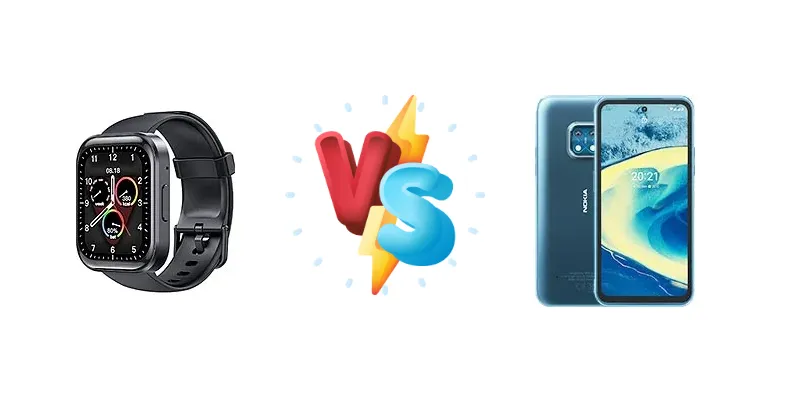
The smartphone market offers a growing niche of rugged devices, but often at the expense of modern features. We pit the Oukitel BT103, a device focused on durability and potentially extended battery life, against the Nokia XR20, which prioritizes 5G connectivity and a more mainstream feature set. This comparison aims to determine which phone best suits users needing resilience versus those demanding modern mobile capabilities.
🏆 Quick Verdict
For the average user prioritizing 5G connectivity, wireless charging, and a known chipset, the Nokia XR20 is the better choice. Its Snapdragon 480 5G offers a tangible performance advantage and future-proofing. However, if extreme durability and potentially longer battery life are paramount, and 5G isn't a necessity, the Oukitel BT103 may be a viable option, though its specifications remain largely unknown.
| Network |
|---|
| 2G bands | N/A | GSM 850 / 900 / 1800 / 1900 |
| 3G bands | N/A | HSDPA 850 / 900 / 1700(AWS) / 1900 / 2100 |
| 4G bands | N/A | 1, 2, 3, 4, 5, 7, 8, 12, 13, 14, 20, 25, 26, 28, 30, 38, 40, 41, 48, 66, 71 |
| 5G bands | - | 2, 5, 25, 38, 41, 48, 66, 77, 78 SA/NSA |
| EDGE | No | - |
| GPRS | No | - |
| Speed | No | HSPA, LTE, 5G |
| Technology | No cellular connectivity | GSM / CDMA / HSPA / EVDO / LTE / 5G |
| | - | CDMA2000 1xEV-DO |
| Launch |
|---|
| Announced | 2024, June | 2021, July 27 |
| Status | Available. Released 2024, June | Available. Released 2021, August 04 |
| Body |
|---|
| Dimensions | 49.5 x 40 x 10.9 mm (1.95 x 1.57 x 0.43 in) | 171.6 x 81.5 x 10.6 mm (6.76 x 3.21 x 0.42 in) |
| SIM | No | · Nano-SIM· Nano-SIM + Nano-SIM |
| Weight | 100 g (3.53 oz) | 248 g (8.75 oz) |
| | - | IP68 dust/water resistant (up to 1.5m for 60 min)
Drop-to-concrete resistance from up to 1.8m
MIL-STD-810H compliant |
| Display |
|---|
| Protection | Tempered glass | Corning Gorilla Glass Victus |
| Resolution | 320 x 380 pixels (~260 ppi density) | 1080 x 2400 pixels, 20:9 ratio (~395 ppi density) |
| Size | 1.91 inches | 6.67 inches, 107.4 cm2 (~76.8% screen-to-body ratio) |
| Type | TFT LCD | IPS LCD, 550 nits |
| Platform |
|---|
| CPU | - | Octa-core (2x2.0 GHz Kryo 460 & 6x1.8 GHz Kryo 460) |
| Chipset | - | Qualcomm SM4350 Snapdragon 480 5G (8 nm) |
| GPU | - | Adreno 619 |
| OS | Proprietary OS | Android 11, upgradable to Android 13 |
| Memory |
|---|
| Card slot | No | microSDXC (uses shared SIM slot) |
| Internal | - | 64GB 4GB RAM, 128GB 6GB RAM |
| Main Camera |
|---|
| Dual | - | 48 MP, f/1.8, (wide), 1/2.25", 0.8µm, PDAF
13 MP, f/2.4, 123˚ (ultrawide), 1/3.0", 1.12µm |
| Features | - | Zeiss optics, Dual-LED dual-tone flash, second LED flash, HDR, panorama |
| Single | - | 8 MP, f/2.0 (wide), 1/4.0", 1.12µm |
| Video | - | 1080p@30fps |
| Selfie camera |
|---|
| Single | - | 8 MP, f/2.0 (wide), 1/4.0", 1.12µm |
| Video | - | 1080p@30fps |
| Sound |
|---|
| 3.5mm jack | - | Yes |
| 35mm jack | No | Yes |
| Loudspeaker | No | Yes, with stereo speakers |
| Comms |
|---|
| Bluetooth | 5.2 | 5.1, A2DP, LE, aptX Adaptive |
| NFC | No | Yes |
| Positioning | No | GPS (L1+L5), GLONASS, BDS, GALILEO, QZSS, NavIC |
| Radio | No | Unspecified |
| USB | No | USB Type-C 3.0 |
| WLAN | No | Wi-Fi 802.11 a/b/g/n/ac/6, dual-band, Wi-Fi Direct |
| Features |
|---|
| Sensors | Accelerometer, heart rate, SpO2 | Fingerprint (side-mounted), accelerometer, gyro, proximity, compass, barometer |
| Battery |
|---|
| Charging | - | 18W wired
15W wireless |
| Type | 300 mAh | Li-Po 4630 mAh |
| Misc |
|---|
| Colors | Black, White | Ultra Blue, Granite Gray |
| Models | - | TA-1368, TA-1362 |
| Price | - | About 270 EUR |
| SAR EU | - | 1.13 W/kg (head) 1.43 W/kg (body) |
Oukitel BT103
- Potentially superior ruggedness and drop protection
- Likely longer battery life due to simpler features
- Potentially lower price point
- Unknown chipset and performance limitations
- Lack of 5G connectivity
- Potentially outdated software and limited updates
Nokia XR20
- 5G connectivity with Snapdragon 480 5G
- Wireless charging support (15W)
- More refined software experience and updates from Nokia
- Less extreme ruggedness compared to dedicated rugged phones
- Battery life may be shorter than the Oukitel BT103
- Higher price point
Display Comparison
Without specific display details for the Oukitel BT103, a direct comparison is difficult. The Nokia XR20’s display is likely to offer a more refined experience due to its modern manufacturing process. We can assume the BT103 will prioritize durability over display quality, potentially using a simpler, more robust panel. The XR20’s display benefits from Gorilla Glass Victus, enhancing scratch and shatter resistance, a feature likely absent on the BT103 to reduce cost and complexity.
Camera Comparison
The Nokia XR20’s camera system, while not flagship-level, benefits from Qualcomm’s image signal processor (ISP) integrated within the Snapdragon 480. This allows for improved image processing and noise reduction. Without camera specifications for the Oukitel BT103, it’s reasonable to assume a simpler camera setup focused on functionality rather than image quality. The XR20’s camera is likely to deliver more consistent and detailed photos, especially in challenging lighting conditions. We can expect the BT103 to have a lower-resolution sensor and fewer features like optical image stabilization (OIS).
Performance
The Nokia XR20’s Qualcomm SM4350 Snapdragon 480 5G (8nm) represents a significant performance advantage over the unknown chipset in the Oukitel BT103. The Snapdragon 480’s octa-core CPU, with its 2x2.0 GHz Kryo 460 and 6x1.8 GHz Kryo 460 cores, provides a noticeable boost in multitasking and app loading speeds. The 8nm process node also contributes to better thermal efficiency, reducing throttling during sustained workloads. The BT103 likely utilizes a less powerful, older chipset, making it suitable for basic tasks but struggling with demanding applications.
Battery Life
The Nokia XR20 offers 18W wired and 15W wireless charging, providing flexibility in how you replenish the battery. The Oukitel BT103’s battery capacity is unknown, but rugged phones often prioritize large batteries for extended uptime. However, without knowing the charging capabilities of the BT103, it’s difficult to assess its convenience. The XR20’s wireless charging is a significant advantage for users who prefer cable-free charging. The Snapdragon 480’s efficiency also contributes to better battery life compared to older, less efficient chipsets likely found in the BT103.
Buying Guide
Buy the Oukitel BT103 if you need a phone primarily for work in harsh environments, prioritize maximum uptime over app performance, and are comfortable with a potentially less refined software experience. Buy the Nokia XR20 if you prefer a balance of durability with modern features like 5G, wireless charging, and a more polished Android experience, and value the backing of a well-known brand.
Frequently Asked Questions
❓ Is the Nokia XR20 truly waterproof, or just water-resistant? What IP rating does it have?
The Nokia XR20 boasts an IP68 rating, meaning it's dust-tight and can withstand immersion in up to 1.5 meters of freshwater for up to 30 minutes. While highly water-resistant, it's not entirely waterproof and prolonged exposure or saltwater can still cause damage. This is a significant advantage over many phones, but caution is still advised.
❓ What kind of software support can I expect from Nokia for the XR20? How many Android updates are guaranteed?
Nokia is known for its commitment to software updates. The XR20 is guaranteed to receive 3 years of security updates and 2 major Android OS upgrades. This ensures your phone remains secure and benefits from new features for a longer period than many competitors, offering peace of mind and extending the device's lifespan.
❓ Given the Oukitel BT103's focus on ruggedness, does that mean it's significantly heavier and bulkier than the Nokia XR20?
It's highly probable. Ruggedization typically comes at the cost of size and weight. The Oukitel BT103 likely incorporates thicker materials and reinforced construction, resulting in a noticeably heavier and bulkier device compared to the Nokia XR20, which aims for a more balanced design.