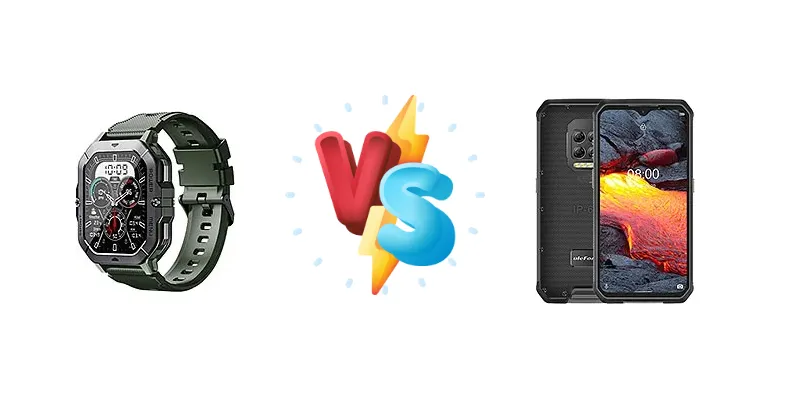
The rugged smartphone market caters to a specific need: durability. Both the Oukitel BT101 and Ulefone Armor 9E aim to deliver on that promise, but they diverge significantly in their internal specifications. While the BT101's details remain sparse, the Armor 9E boasts a Mediatek Helio P90 chipset, suggesting a focus on performance within the rugged form factor. This comparison will dissect the available information to determine which device best suits your needs.
🏆 Quick Verdict
For the average user prioritizing performance and a known chipset, the Ulefone Armor 9E is the clear winner. Its Helio P90 provides a substantial processing advantage over the unknown internals of the Oukitel BT101. However, the BT101 may appeal to budget-conscious buyers if it offers a significantly lower price point, despite the performance compromise.
| Network |
|---|
| 2G bands | N/A | GSM 850 / 900 / 1800 / 1900 |
| 3G bands | N/A | HSDPA 850 / 900 / 1700(AWS) / 1900 / 2100 |
| 4G bands | N/A | 1, 2, 3, 4, 5, 7, 8, 12, 13, 17, 18, 19, 20, 25, 26, 28, 34, 38, 39, 40, 41, 66 |
| EDGE | No | - |
| GPRS | No | - |
| Speed | No | HSPA 42.2/11.5 Mbps, LTE Cat12 600/150 Mbps |
| Technology | No cellular connectivity | GSM / CDMA / HSPA / EVDO / LTE |
| | - | CDMA2000 1xEV-DO |
| Launch |
|---|
| Announced | 2024, September | 2020, September 08. Released 2020, September 08 |
| Status | Available. Released 2024, September | Discontinued |
| Body |
|---|
| Build | - | Front glass, aluminum back with rubber, aluminum frame |
| Dimensions | 58.3 x 46.1 x 13.3 mm (2.30 x 1.81 x 0.52 in) | 168.2 x 82 x 15 mm (6.62 x 3.23 x 0.59 in) |
| SIM | No | Nano-SIM + Nano-SIM |
| Weight | 61.7 (2.19 oz) | 324 g (11.43 oz) |
| | - | IP68/IP69K dust/water resistant (up to 1.5m for 30 min)
Drop-to-concrete resistance from up to 1.2m
MIL-STD-810G compliant |
| Display |
|---|
| Protection | Tempered glass | Scratch-resistant glass, oleophobic coating |
| Resolution | 320 x 390 pixels (~250 ppi density) | 1080 x 2340 pixels, 19.5:9 ratio (~409 ppi density) |
| Size | 2.02 inches | 6.3 inches, 97.4 cm2 (~70.6% screen-to-body ratio) |
| Type | TFT LCD | IPS LCD |
| Platform |
|---|
| CPU | - | Octa-core (2x2.2 GHz Cortex-A75 & 6x2.0 GHz Cortex-A55) |
| Chipset | - | Mediatek MT6779 Helio P90 (12 nm) |
| GPU | - | PowerVR GM9446 |
| OS | Proprietary OS | Android 10 |
| Memory |
|---|
| Card slot | No | microSDXC (uses shared SIM slot) |
| Internal | - | 128GB 8GB RAM |
| | - | UFS 2.1 |
| Main Camera |
|---|
| Features | - | Quad-LED flash, HDR, panorama |
| Quad | - | 64 MP, f/1.9, 26mm (wide), 1/1.72", 0.8µm, PDAF
8 MP, f/2.4, 100˚ (ultrawide), 1/4.0", 1.12µm
2 MP (macro)
Auxiliary lens |
| Video | - | 4K@30fps, 1080p@30fps |
| Selfie camera |
|---|
| Features | - | HDR, panorama |
| Single | - | 8 MP, f/2.2 |
| Video | - | 1080p@30fps |
| Sound |
|---|
| 3.5mm jack | - | Yes |
| 35mm jack | No | Yes |
| Loudspeaker | Yes | Yes |
| Comms |
|---|
| Bluetooth | 5.3 | 5.0, A2DP, LE |
| NFC | No | Yes |
| Positioning | No | GPS, GLONASS, GALILEO, BDS |
| Radio | No | FM radio, RDS, recording |
| USB | No | USB Type-C 2.0, OTG, accessory connector |
| WLAN | No | Wi-Fi 802.11 a/b/g/n/ac, Wi-Fi Direct |
| Features |
|---|
| Sensors | Accelerometer, heart rate, SpO2, blood pressure, barometer, compass | Fingerprint (side-mounted), accelerometer, gyro, proximity, compass, coulombmeter |
| | - | Endoscope mount (camera sold separately) |
| Battery |
|---|
| Charging | - | 18W wired |
| Type | 410 mAh | Li-Po 6600 mAh |
| Misc |
|---|
| Colors | Black | Black |
| Price | About 50 EUR | About 290 EUR |
Oukitel BT101
- Potentially lower price point
- Rugged design for durability
- May offer long standby time (speculation)
- Unknown chipset and performance
- Likely limited software support
- Uncertain camera quality
Ulefone Armor 9E
- Mediatek Helio P90 for strong performance
- 18W fast charging
- Rugged and durable construction
- May be more expensive than the BT101
- IPS LCD panel may lack vibrant colors
- Battery capacity not specified
Display Comparison
Without specific display details for the Oukitel BT101, a direct comparison is difficult. The Ulefone Armor 9E, typical of its class, likely features an IPS LCD panel prioritizing visibility in direct sunlight over color accuracy. The absence of information regarding refresh rate or resolution on the BT101 suggests a more basic display experience. Users prioritizing media consumption should lean towards a device with confirmed higher resolution and brightness, which the Armor 9E is more likely to offer.
Camera Comparison
Given the lack of camera specifications for the Oukitel BT101, it’s difficult to assess its imaging capabilities. The Ulefone Armor 9E, while not a camera powerhouse, likely features a more capable main sensor than what is typically found in ultra-budget rugged phones. The focus should be on the primary sensor's megapixel count and aperture, as auxiliary sensors (like the often-present 2MP macro) offer limited real-world benefit. Users prioritizing photography should seek out detailed camera reviews of the Armor 9E to understand its image processing style and low-light performance.
Performance
The Ulefone Armor 9E’s Mediatek Helio P90 (12 nm) chipset is the defining performance factor. Its octa-core configuration – 2x2.2 GHz Cortex-A75 and 6x2.0 GHz Cortex-A55 – provides a significant advantage over the unknown processor in the Oukitel BT101. The Cortex-A75 cores offer substantial single-core performance improvements over older Cortex-A53 designs often found in budget rugged phones. This translates to snappier app launches and smoother multitasking. The 12nm process node also contributes to better thermal efficiency compared to older, larger nodes, potentially reducing throttling during sustained workloads. The BT101, lacking any published chipset information, is likely to offer significantly lower performance, suitable only for basic tasks.
Battery Life
The Ulefone Armor 9E’s 18W wired charging is a reasonable, though not exceptional, charging speed for a rugged phone. Battery capacity is not specified for either device. However, the Helio P90’s 12nm process node contributes to improved power efficiency, potentially offsetting a smaller battery capacity compared to a device with a less efficient chipset. Real-world battery life will depend heavily on usage patterns, but the Armor 9E’s more efficient processor gives it an advantage.
Buying Guide
Buy the Oukitel BT101 if you need a basic, extremely durable phone for essential communication and are on a very tight budget, and are willing to sacrifice processing power. Buy the Ulefone Armor 9E if you prefer a rugged phone capable of handling demanding tasks like gaming or running multiple apps simultaneously, and value a known, capable chipset like the Helio P90.
Frequently Asked Questions
❓ Is the Helio P90 in the Ulefone Armor 9E powerful enough for gaming?
The Helio P90 is a capable mid-range chipset that can handle many popular mobile games at medium to high settings. While it won't match the performance of flagship processors, it provides a smooth gaming experience for titles like PUBG Mobile and Call of Duty Mobile. Expect some frame rate drops in very demanding games or at maximum settings.
❓ What level of water and dust resistance do these phones offer?
Both phones are marketed as rugged, but specific IP ratings are crucial. The Ulefone Armor 9E typically boasts an IP68 rating, meaning it's dust-tight and can withstand immersion in up to 1.5 meters of water for 30 minutes. The Oukitel BT101's IP rating is unknown, so its level of protection is uncertain. Always check the manufacturer's specifications for precise details.
❓ Does the Ulefone Armor 9E support NFC for contactless payments?
Yes, the Ulefone Armor 9E does support NFC, allowing for contactless payments via Google Pay or other compatible services. This is a valuable feature for users who frequently make mobile payments. The Oukitel BT101's NFC support is unconfirmed.