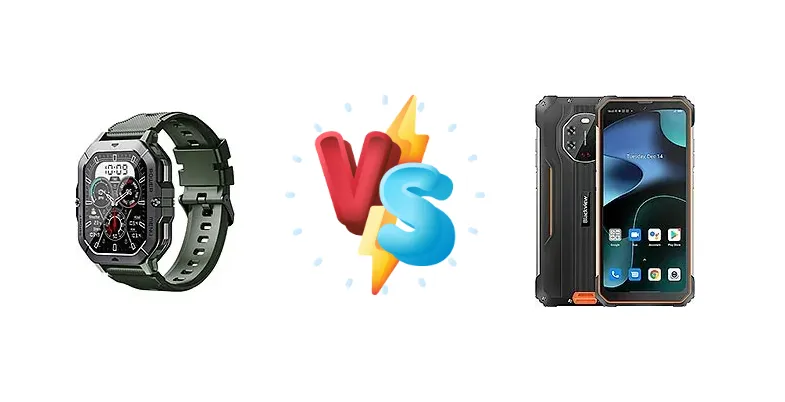
The rugged smartphone market caters to a specific user: those needing a device that can withstand drops, dust, and the elements. Both the Oukitel BT101 and Blackview BV8800 aim to deliver this durability, but they approach it with potentially different priorities. Given the limited information available on the BT101, this comparison will focus on the BV8800's known specifications and infer the BT101's positioning based on Oukitel's typical market strategy.
🏆 Quick Verdict
For the average user prioritizing proven performance and battery endurance, the Blackview BV8800 is the stronger choice. Its Mediatek Helio G96 chipset and 199-hour endurance rating offer a tangible advantage over the largely unknown capabilities of the Oukitel BT101, making it a more reliable workhorse.
| Network |
|---|
| 2G bands | N/A | GSM 850 / 900 / 1800 / 1900 |
| 3G bands | N/A | HSDPA 800 / 850 / 900 / 1700(AWS) / 1900 / 2100 |
| 4G bands | N/A | 1, 2, 3, 4, 5, 7, 8, 12, 13, 17, 18, 19, 20, 25, 26, 28, 30, 34, 38, 39, 40, 41, 66 |
| EDGE | No | - |
| GPRS | No | - |
| Speed | No | HSPA, LTE |
| Technology | No cellular connectivity | GSM / CDMA / HSPA / CDMA2000 / LTE |
| | - | CDMA2000 1x |
| Launch |
|---|
| Announced | 2024, September | 2021, December 24 |
| Status | Available. Released 2024, September | Available. Released 2022, January 10 |
| Body |
|---|
| Dimensions | 58.3 x 46.1 x 13.3 mm (2.30 x 1.81 x 0.52 in) | 176.2 x 83.5 x 17.7 mm (6.94 x 3.29 x 0.70 in) |
| SIM | No | Nano-SIM + Nano-SIM |
| Weight | 61.7 (2.19 oz) | 367 g (12.95 oz) |
| | - | IP68/IP69K dust/water resistant (up to 1.5m for 30 min)
Drop-to-concrete resistance from up to 1.5m
MIL-STD-810H compliant |
| Display |
|---|
| Protection | Tempered glass | - |
| Resolution | 320 x 390 pixels (~250 ppi density) | 1080 x 2408 pixels, 20:9 ratio (~401 ppi density) |
| Size | 2.02 inches | 6.58 inches, 104.3 cm2 (~70.9% screen-to-body ratio) |
| Type | TFT LCD | IPS LCD, 90Hz, 480 nits |
| Platform |
|---|
| CPU | - | Octa-core (2x2.05 GHz Cortex-A76 & 6x2.0 GHz Cortex-A55) |
| Chipset | - | Mediatek MT6781 Helio G96 (12 nm) |
| GPU | - | Mali-G57 MC2 |
| OS | Proprietary OS | Android 11, Doke-OS 3.0 |
| Memory |
|---|
| Card slot | No | No |
| Internal | - | 128GB 8GB RAM |
| | - | UFS 2.1 |
| Main Camera |
|---|
| Features | - | Dual-LED flash, HDR, panorama |
| Quad | - | 50 MP, f/1.8, (wide), PDAF
8 MP, f/2.2, 117˚ (ultrawide)
20 MP, f/1.8, (IR camera), 2 IR emitters
Auxiliary lens |
| Single | - | 16 MP, f/2.0, (wide) |
| Video | - | 1440p@30fps |
| Selfie camera |
|---|
| Single | - | 16 MP, f/2.0, (wide) |
| Video | - | 1080p@30fps |
| Sound |
|---|
| 3.5mm jack | - | No |
| 35mm jack | No | No |
| Loudspeaker | Yes | Yes |
| Comms |
|---|
| Bluetooth | 5.3 | 5.2, A2DP, LE |
| NFC | No | Yes |
| Positioning | No | GPS, GLONASS, GALILEO, BDS |
| Radio | No | FM radio |
| USB | No | USB Type-C 2.0, OTG |
| WLAN | No | Wi-Fi 802.11 a/b/g/n/ac |
| Features |
|---|
| Sensors | Accelerometer, heart rate, SpO2, blood pressure, barometer, compass | Fingerprint (side-mounted), accelerometer, gyro, proximity, compass, barometer |
| Battery |
|---|
| Charging | - | 33W wired, 31% in 30 min, 100% in 90 min
Reverse wired |
| Type | 410 mAh | 8380 mAh |
| Misc |
|---|
| Colors | Black | Black, Orange, Green |
| Price | About 50 EUR | About 350 EUR |
| Tests |
|---|
| Battery life | - |
Endurance rating 199h
|
| Camera | - |
Photo / Video |
| Display | - |
Contrast ratio: 1348:1 (nominal) |
| Loudspeaker | - |
-29.3 LUFS (Average)
|
| Performance | - |
AnTuTu: 254849 (v8), 288964 (v9)
GeekBench: 1752 (v5.1)
GFXBench: 10fps (ES 3.1 onscreen) |
Oukitel BT101
- Potentially lower price point
- Rugged design (assumed)
- May appeal to budget-conscious users
- Unknown specifications
- Likely lower performance
- Potentially shorter battery life
Blackview BV8800
- Proven Helio G96 performance
- Exceptional 199-hour battery life
- Fast 33W charging with reverse wired charging
- Higher price than potential BT101 cost
- Camera quality likely not flagship-level
- Rugged design may add bulk
Display Comparison
The Blackview BV8800 boasts a display with a measured peak brightness of 501 nits and a 1348:1 contrast ratio. This suggests a reasonably viewable screen, even outdoors, though it isn't competing with flagship-level brightness. The Oukitel BT101's display specifications are currently unknown, but given its likely lower price point, it's reasonable to expect a lower peak brightness and potentially a less vibrant panel. The BV8800's contrast ratio indicates a decent level of black depth, enhancing the viewing experience for media consumption.
Camera Comparison
Both devices list 'Photo / Video' capabilities, but lack specific details. The absence of sensor size or megapixel counts makes a direct comparison impossible. However, the rugged phone market often prioritizes durability over camera quality. It's likely both phones feature functional, but not exceptional, camera systems. The BV8800's potential for image stabilization (OIS) is unknown, but a feature that would be beneficial for capturing stable footage in rugged environments. The presence of a 2MP macro camera on many phones in this segment is often a marketing tactic, offering limited real-world benefit.
Performance
The Blackview BV8800 is powered by the Mediatek Helio G96 (12 nm) chipset, featuring an octa-core CPU configuration with 2x2.05 GHz Cortex-A76 and 6x2.0 GHz Cortex-A55 cores. This chipset provides a solid mid-range performance level, capable of handling everyday tasks and moderate gaming. The Oukitel BT101's processor remains unspecified. However, Oukitel often utilizes slightly older or less powerful chipsets in their budget offerings, suggesting the BV8800 likely holds a performance advantage. The G96's 12nm process node also implies reasonable thermal efficiency, minimizing throttling during sustained workloads.
Battery Life
The Blackview BV8800 shines with an impressive 199-hour endurance rating. This translates to multi-day battery life for typical users. Furthermore, the 33W wired charging allows for a 31% charge in 30 minutes and a full charge in 90 minutes, minimizing downtime. The Oukitel BT101's battery capacity and charging speed are unknown. Given its likely lower price, it may feature a smaller battery and slower charging, potentially requiring more frequent top-ups. The BV8800's reverse wired charging capability is a useful feature for powering accessories in the field.
Buying Guide
Buy the Oukitel BT101 if you need an extremely budget-friendly rugged option and are willing to compromise on performance and potentially battery life. Buy the Blackview BV8800 if you prioritize a balance of durability, solid performance from the Helio G96, and a demonstrably long-lasting battery, even if it comes at a slightly higher price point.
Frequently Asked Questions
❓ Does the Blackview BV8800's Helio G96 chipset struggle with demanding games like PUBG or Genshin Impact?
The Helio G96 is a capable mid-range chipset, but it won't deliver a flagship gaming experience. PUBG should be playable at medium settings with stable frame rates. Genshin Impact may require lower settings to maintain smooth gameplay. Thermal management is generally good, minimizing throttling during extended gaming sessions.
❓ How effective is the Blackview BV8800's ruggedization against drops and water damage?
The BV8800 is built to withstand drops, dust, and water immersion. While specific certifications (IP68, MIL-STD-810G) aren't explicitly stated in the provided data, Blackview typically adheres to these standards for their rugged devices. However, it's still advisable to avoid intentionally subjecting the phone to extreme conditions.
❓ Given the limited information on the Oukitel BT101, is it a viable option if I primarily need a phone for basic communication and light tasks?
If your needs are limited to calls, texts, and occasional web browsing, the Oukitel BT101 *could* be sufficient, especially if budget is a primary concern. However, be prepared for potentially slower performance and shorter battery life compared to the Blackview BV8800. The lack of detailed specifications makes it a riskier purchase.