
Oscal Tiger 8 vs. Doogee S98 Pro: A Deep Dive into Rugged Performance and Battery Life
| Phones Images | |||||
|---|---|---|---|---|---|
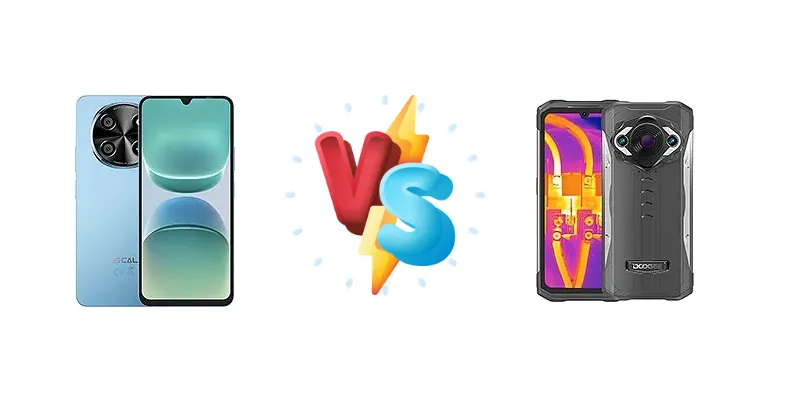
|
🏆 Quick Verdict
For users prioritizing all-day (and multi-day) battery life and long-term reliability, the Oscal Tiger 8 is the clear winner. Its impressive 53:38h endurance and 800 charge cycles outweigh the Doogee S98 Pro’s faster charging and marginally quicker CPU. However, those who value quicker top-ups and a bit more processing power will find the S98 Pro a suitable choice.
| PHONES | ||
|---|---|---|
| Phone Names | Oscal Tiger 8 | Doogee S98 Pro |
| Network | ||
|---|---|---|
| 2G bands | GSM 850 / 900 / 1800 / 1900 | GSM 850 / 900 / 1800 / 1900 |
| 3G bands | HSDPA 850 / 900 / 1900 / 2100 | HSDPA 800 / 850 / 900 / 1700(AWS) / 1900 / 2100 |
| 4G bands | 1, 2, 3, 4, 5, 7, 8, 12, 17, 19, 20, 26, 28, 38, 40, 41, 66 | 1, 2, 3, 4, 5, 7, 8, 12, 13, 17, 18, 19, 20, 25, 26, 28, 34, 38, 39, 40, 41, 66 |
| 5G bands | 1, 2, 3, 5, 7, 8, 20, 26, 28, 38, 40, 41, 66, 77, 78 SA/NSA | - |
| Speed | HSPA, LTE, 5G | HSPA, LTE |
| Technology | GSM / HSPA / LTE / 5G | GSM / CDMA / HSPA / LTE |
| Launch | ||
|---|---|---|
| Announced | 2025, September | 2022, May 27 |
| Status | Available. Released 2025, September | Available. Released 2022, June 06 |
| Body | ||
|---|---|---|
| Dimensions | 171.1 x 77.7 x 8.5 mm (6.74 x 3.06 x 0.33 in) | 172 x 82 x 15.5 mm (6.77 x 3.23 x 0.61 in) |
| SIM | Nano-SIM + Nano-SIM | Nano-SIM + Nano-SIM |
| Weight | 210.5 g (7.44 oz) | 320 g (11.29 oz) |
| Display | ||
|---|---|---|
| Protection | Mohs level 7 | Corning Gorilla Glass |
| Resolution | 720 x 1640 pixels (~260 ppi density) | 1080 x 2340 pixels, 19.5:9 ratio (~409 ppi density) |
| Size | 6.88 inches, 112.4 cm2 (~84.6% screen-to-body ratio) | 6.3 inches, 97.4 cm2 (~69.1% screen-to-body ratio) |
| Type | IPS LCD, 120Hz, 450 nits | IPS LCD, 500 nits (peak) |
| Platform | ||
|---|---|---|
| CPU | Octa-core (4x2.2 GHz Cortex-A76 & 4x2.0 GHz Cortex-A55) | Octa-core (2x2.05 GHz Cortex-A76 & 6x2.0 GHz Cortex-A55) |
| Chipset | Unisoc T8100 (6 nm) | Mediatek MT6781 Helio G96 (12 nm) |
| GPU | Mali-G57 | Mali-G57 MC2 |
| OS | Android 15, DokeOS 4.2 | Android 12 |
| Memory | ||
|---|---|---|
| Card slot | microSDXC (uses shared SIM slot) | microSDXC (dedicated slot) |
| Internal | 128GB 4GB RAM, 128GB 8GB RAM | 256GB 8GB RAM |
| Main Camera | ||
|---|---|---|
| Dual | 16 MP, f/2.2, (wide), 1/3.06", AF Auxiliary lens | - |
| Features | LED flash, HDR, panorama | Dual-LED flash, HDR, panorama |
| Triple | - | 48 MP, f/1.8, (wide), PDAF 20 MP, f/1.8, (night vision), 2 infrared night vision lights Thermal imaging camera |
| Video | 4K@30fps, 1080p@30fps | 1440p, 1080p |
| Selfie camera | ||
|---|---|---|
| Single | 8 MP, (wide), 1/5.0" | 16 MP, f/2.0, (wide) |
| Video | 1080p@30fps | 1080p |
| Sound | ||
|---|---|---|
| 35mm jack | Yes | Unspecified |
| Loudspeaker | Yes | Yes |
| Comms | ||
|---|---|---|
| Bluetooth | 5.0, A2DP, LE | 5.1, A2DP, LE |
| NFC | Yes | Yes |
| Positioning | GPS, GLONASS, GALILEO, BDS | GPS, GLONASS, BDS, GALILEO |
| Radio | FM radio | FM radio |
| USB | USB Type-C | USB Type-C 2.0, OTG |
| WLAN | Wi-Fi 802.11 a/b/g/n/ac, dual-band | Wi-Fi 802.11 a/b/g/n/ac, dual-band |
| Features | ||
|---|---|---|
| Sensors | Fingerprint (side-mounted), accelerometer, proximity | Fingerprint (side-mounted), accelerometer, gyro, proximity, compass |
| Battery | ||
|---|---|---|
| Charging | 18W wired | 33W wired 15W wireless |
| Type | Li-Ion 5000 mAh | 6000 mAh |
| Misc | ||
|---|---|---|
| Colors | Phantom Black, Glacier Blue | Black |
| Price | - | About 470 EUR |
| EU LABEL | ||
|---|---|---|
| Battery | 53:38h endurance, 800 cycles | - |
| Energy | Class A | - |
| Free fall | Class C (98 falls) | - |
| Repairability | Class B | - |
Oscal Tiger 8
- Exceptional battery life (53:38h endurance)
- Long-lasting battery health (800 charge cycles)
- More efficient chipset (Unisoc T8100 6nm)
- Slower charging speed (18W)
- Potentially less peak CPU performance
Doogee S98 Pro
- Faster charging (33W wired, 15W wireless)
- Slightly more powerful CPU (Helio G96)
- Potentially higher refresh rate display
- Lower battery endurance
- Less efficient chipset (Helio G96 12nm)
Display Comparison
Neither device’s display specifications are provided, so a direct comparison is limited. However, considering the price points, both likely utilize IPS LCD panels. The S98 Pro’s chipset suggests a potentially higher refresh rate capability, though this isn’t confirmed. The absence of LTPO technology on either device implies standard refresh rate control, impacting power consumption. Bezels are likely comparable, typical of rugged designs prioritizing protection over slimness.
Camera Comparison
Without detailed camera specs, a comprehensive comparison is impossible. However, the market segment suggests both phones will feature multi-camera setups with a primary sensor, ultrawide, and potentially macro/depth sensors. The absence of information regarding sensor size and optical image stabilization (OIS) makes it difficult to assess image quality. It’s reasonable to assume the S98 Pro, being positioned slightly higher, might have a larger primary sensor, leading to better low-light performance. The inclusion of a 2MP macro camera on either device is likely a marketing feature with limited practical utility.
Performance
The Doogee S98 Pro’s Mediatek Helio G96 (12nm) offers a slight CPU advantage with its 2x2.05 GHz Cortex-A76 cores compared to the Oscal Tiger 8’s Unisoc T8100 (6nm) which has 4x2.2 GHz Cortex-A76 cores. However, the Unisoc T8100’s 6nm fabrication process is significantly more efficient. This translates to better thermal management and potentially sustained performance under load. While the G96 might show a brief lead in benchmarks, the T8100 is likely to maintain higher average performance over extended gaming sessions due to reduced throttling. The T8100’s architecture also benefits from newer Cortex-A76 cores, potentially offsetting the clock speed difference.
Battery Life
The Oscal Tiger 8’s standout feature is its exceptional 53:38h endurance rating and 800 charge cycles. This indicates a significantly longer lifespan and usability between charges compared to the Doogee S98 Pro. While the S98 Pro boasts 33W wired and 15W wireless charging, offering faster top-ups, the Tiger 8’s 18W charging is sufficient given its massive endurance. The 800 charge cycle rating suggests the Tiger 8’s battery will retain a higher percentage of its original capacity after years of use, a crucial factor for long-term ownership.
Buying Guide
Buy the Oscal Tiger 8 if you need a phone that can reliably last through extended trips without access to power, or if you’re hard on your devices and want a battery that will hold its capacity for years. Buy the Doogee S98 Pro if you prefer the convenience of faster 33W wired and 15W wireless charging, and if you occasionally engage in moderately demanding gaming or multitasking where the Helio G96’s performance edge will be noticeable.