
Oscal Tiger 8 vs Cubot KingKong 7: A Deep Dive into Rugged Smartphone Performance
| Phones Images | |||||
|---|---|---|---|---|---|
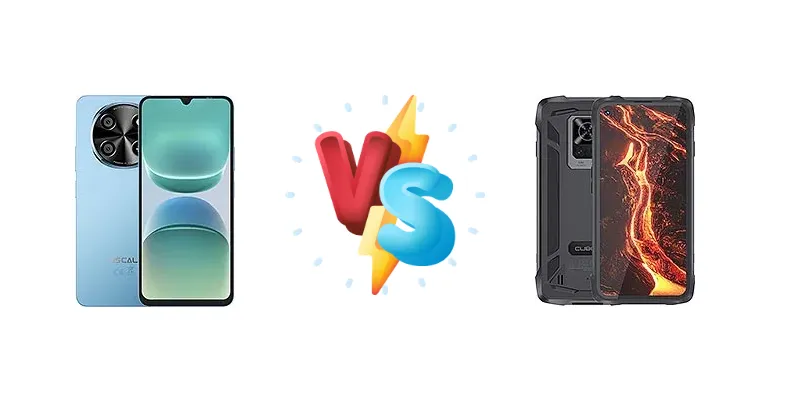
|
🏆 Quick Verdict
For the average user, the Oscal Tiger 8 emerges as the stronger contender. Its Unisoc T8100 chipset, built on a 6nm process, provides a noticeable performance advantage and superior efficiency compared to the Cubot KingKong 7’s 12nm Helio P60, translating to better multitasking and potentially smoother gaming. The impressive 53:38h battery endurance further solidifies its position.
| PHONES | ||
|---|---|---|
| Phone Names | Oscal Tiger 8 | Cubot KingKong 7 |
| Network | ||
|---|---|---|
| 2G bands | GSM 850 / 900 / 1800 / 1900 | GSM 850 / 900 / 1800 / 1900 |
| 3G bands | HSDPA 850 / 900 / 1900 / 2100 | HSDPA 850 / 900 / 1700(AWS) / 1900 / 2100 |
| 4G bands | 1, 2, 3, 4, 5, 7, 8, 12, 17, 19, 20, 26, 28, 38, 40, 41, 66 | 1, 2, 3, 4, 5, 7, 8, 12, 13, 17, 18, 19, 20, 25, 26, 28, 38, 40, 41, 66 |
| 5G bands | 1, 2, 3, 5, 7, 8, 20, 26, 28, 38, 40, 41, 66, 77, 78 SA/NSA | - |
| Speed | HSPA, LTE, 5G | HSPA, LTE |
| Technology | GSM / HSPA / LTE / 5G | GSM / CDMA / HSPA / LTE |
| Launch | ||
|---|---|---|
| Announced | 2025, September | 2022 |
| Status | Available. Released 2025, September | Available. Released 2022 |
| Body | ||
|---|---|---|
| Dimensions | 171.1 x 77.7 x 8.5 mm (6.74 x 3.06 x 0.33 in) | 166.8 x 83.5 x 14 mm (6.57 x 3.29 x 0.55 in) |
| SIM | Nano-SIM + Nano-SIM | Nano-SIM + Nano-SIM |
| Weight | 210.5 g (7.44 oz) | 267 g (9.42 oz) |
| Display | ||
|---|---|---|
| Protection | Mohs level 7 | - |
| Resolution | 720 x 1640 pixels (~260 ppi density) | 1080 x 2300 pixels (~400 ppi density) |
| Size | 6.88 inches, 112.4 cm2 (~84.6% screen-to-body ratio) | 6.36 inches, 100.4 cm2 (~72.1% screen-to-body ratio) |
| Type | IPS LCD, 120Hz, 450 nits | IPS LCD |
| Platform | ||
|---|---|---|
| CPU | Octa-core (4x2.2 GHz Cortex-A76 & 4x2.0 GHz Cortex-A55) | Octa-core (4x2.0 GHz Cortex-A73 & 4x2.0 GHz Cortex-A53) |
| Chipset | Unisoc T8100 (6 nm) | Mediatek MT6771V/CA Helio P60 (12 nm) |
| GPU | Mali-G57 | Mali-G72 MP3 |
| OS | Android 15, DokeOS 4.2 | Android 11 |
| Memory | ||
|---|---|---|
| Card slot | microSDXC (uses shared SIM slot) | microSDXC (uses shared SIM slot) |
| Internal | 128GB 4GB RAM, 128GB 8GB RAM | 128GB 8GB RAM |
| Main Camera | ||
|---|---|---|
| Dual | 16 MP, f/2.2, (wide), 1/3.06", AF Auxiliary lens | - |
| Features | LED flash, HDR, panorama | LED flash |
| Triple | - | 64 MP, (wide), AF 16 MP, (ultrawide) 5 MP (macro) |
| Video | 4K@30fps, 1080p@30fps | Yes |
| Selfie camera | ||
|---|---|---|
| Single | 8 MP, (wide), 1/5.0" | 32 MP |
| Video | 1080p@30fps | Yes |
| Sound | ||
|---|---|---|
| 35mm jack | Yes | Unspecified |
| Loudspeaker | Yes | Yes |
| Comms | ||
|---|---|---|
| Bluetooth | 5.0, A2DP, LE | 4.2, A2DP |
| NFC | Yes | Yes |
| Positioning | GPS, GLONASS, GALILEO, BDS | GPS, GLONASS, BDS |
| Radio | FM radio | Unspecified |
| USB | USB Type-C | USB Type-C, OTG |
| WLAN | Wi-Fi 802.11 a/b/g/n/ac, dual-band | Wi-Fi 802.11 a/b/g/n |
| Features | ||
|---|---|---|
| Sensors | Fingerprint (side-mounted), accelerometer, proximity | Fingerprint (rear-mounted), accelerometer, gyro, proximity, compass |
| Battery | ||
|---|---|---|
| Charging | 18W wired | - |
| Type | Li-Ion 5000 mAh | 5000 mAh |
| Misc | ||
|---|---|---|
| Colors | Phantom Black, Glacier Blue | Black |
| EU LABEL | ||
|---|---|---|
| Battery | 53:38h endurance, 800 cycles | - |
| Energy | Class A | - |
| Free fall | Class C (98 falls) | - |
| Repairability | Class B | - |
Oscal Tiger 8
- Superior chipset performance with the Unisoc T8100
- Exceptional battery endurance (53:38h)
- More efficient 6nm fabrication process
- 18W charging is relatively slow
- Display specifications are unknown
Cubot KingKong 7
- Potentially lower price point
- Rugged design for durability
- Acceptable performance for basic tasks
- Older and less efficient Helio P60 chipset
- Likely shorter battery life
- 12nm fabrication process generates more heat
Display Comparison
Neither device's display specifications are provided, so a direct comparison is limited. However, given the target market, both likely utilize IPS LCD panels. The age difference suggests the Oscal Tiger 8 *may* benefit from improved color calibration and viewing angles. The absence of high refresh rate or advanced panel technologies (like LTPO) is expected in this price bracket, focusing instead on durability and visibility in outdoor conditions.
Camera Comparison
Without detailed camera specifications, a comprehensive comparison is impossible. However, the rugged phone segment often prioritizes durability over camera quality. It’s reasonable to assume both devices feature basic camera setups. The Oscal Tiger 8’s potential for a more modern ISP (Image Signal Processor) within the T8100 chipset *could* result in slightly better image processing, particularly in low-light conditions. The prevalence of 2MP macro lenses in this segment suggests both devices likely include one, offering limited practical benefit.
Performance
The core difference lies in the chipsets. The Oscal Tiger 8’s Unisoc T8100 (6nm) boasts a more modern architecture – Cortex-A76 cores alongside A55s – compared to the Cubot KingKong 7’s MediaTek Helio P60 (12nm) with its Cortex-A73 and A53 cores. The 6nm fabrication process of the T8100 is significantly more efficient, leading to lower heat generation and improved sustained performance. While both are octa-core CPUs, the A76 cores in the T8100 offer a substantial performance uplift over the A73 cores in the Helio P60. This translates to faster app loading times, smoother multitasking, and a more responsive user experience for the Oscal Tiger 8.
Battery Life
The Oscal Tiger 8’s standout feature is its exceptional 53:38h endurance. This is a significant advantage over what is typically expected from a phone in this price range. While the charging speed of 18W is relatively standard, the battery endurance suggests the Unisoc T8100’s efficiency plays a crucial role. The Cubot KingKong 7’s battery capacity is unknown, but given the less efficient Helio P60, it’s likely to require more frequent charging to achieve comparable usage times. The 800 charge cycles rating for the Oscal Tiger 8 also indicates a focus on long-term battery health.
Buying Guide
Buy the Oscal Tiger 8 if you need a phone capable of handling demanding applications, enjoy occasional gaming, and prioritize long-lasting battery life. Its modern chipset and efficient design make it ideal for users who push their devices. Buy the Cubot KingKong 7 if you are on a very tight budget and primarily need a durable phone for basic communication and light tasks. It offers a rugged build at a potentially lower price point, but compromises on processing power and efficiency.