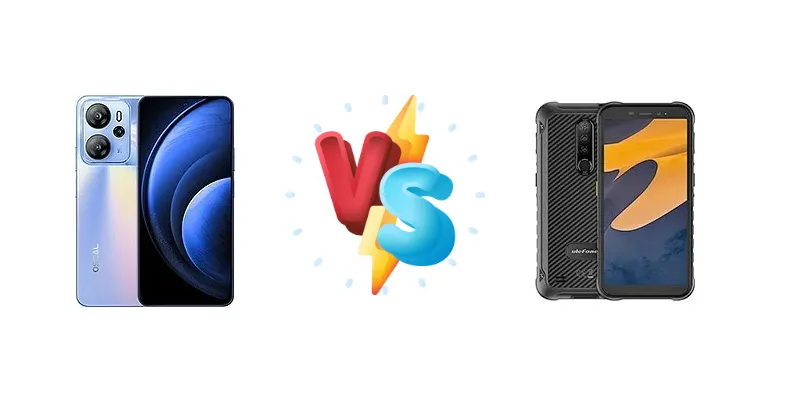
The rugged smartphone market is booming, but finding a balance between durability, performance, and price can be tricky. We pit the Oscal Tiger 13, powered by the newer Unisoc T760, against the Ulefone Armor X8i, featuring the older MediaTek Helio A25, to determine which offers the best value for users needing a tough and reliable device.
🏆 Quick Verdict
For most users, the Oscal Tiger 13 is the superior choice. Its significantly more powerful Unisoc T760 chipset and impressive 49-hour battery endurance outweigh the Ulefone Armor X8i’s lower price point, offering a smoother and more future-proof experience.
| Network |
|---|
| 2G bands | GSM 850 / 900 / 1800 / 1900 | GSM 850 / 900 / 1800 / 1900 |
| 3G bands | HSDPA 850 / 900 / 1900 / 2100 | HSDPA 850 / 900 / 1700(AWS) / 1900 / 2100 |
| 4G bands | 1, 2, 3, 4, 5, 7, 8, 12, 17, 19, 20, 26, 28, 38, 39, 40, 41, 66 | 1, 2, 3, 4, 5, 7, 8, 12, 17, 19, 20, 28 |
| 5G bands | 1, 2, 3, 5, 7, 8, 20, 26, 28, 38, 40, 41, 66, 77, 78 SA/NSA | - |
| Speed | HSPA, LTE, 5G | HSPA 21.1/5.76 Mbps, LTE Cat7 300/150 Mbps |
| Technology | GSM / HSPA / LTE / 5G | GSM / HSPA / LTE |
| | - | eMMC 5.1 |
| Launch |
|---|
| Announced | 2024, October 21 | 2021, September 23 |
| Status | Available. Released 2024, October 21 | Available. Released 2021, September 23 |
| Body |
|---|
| Dimensions | 164.8 x 75.6 x 8.7 mm (6.49 x 2.98 x 0.34 in) | 160.3 x 79 x 13.8 mm (6.31 x 3.11 x 0.54 in) |
| SIM | Nano-SIM + Nano-SIM | Nano-SIM + Nano-SIM |
| Weight | 200 g (7.05 oz) | 256 g (9.03 oz) |
| | - | IP68/IP69K dust/water resistant (up to 1.5m for 30 min)
Drop-to-concrete resistance from up to 1.2m
MIL-STD-810G compliant |
| Display |
|---|
| Protection | Mohs level 7 | - |
| Resolution | 720 x 1604 pixels, 20:9 ratio (~264 ppi density) | 720 x 1440 pixels, 18:9 ratio (~282 ppi density) |
| Size | 6.67 inches, 107.2 cm2 (~86.1% screen-to-body ratio) | 5.7 inches, 83.8 cm2 (~66.2% screen-to-body ratio) |
| Type | IPS LCD, 90Hz, 700 nits | IPS LCD |
| Platform |
|---|
| CPU | Octa-core (1x2.2 GHz Cortex-A76 & 3x Cortex-A76 & 4x Cortex-A55) | Octa-core (4x1.8 GHz Cortex-A53 & 4x1.5 GHz Cortex-A53) |
| Chipset | Unisoc T760 (6 nm) | Mediatek MT6762D Helio A25 (12 nm) |
| GPU | Mali-G57 | PowerVR GE8320 |
| OS | Android 14, Doke OS 4.0 | Android 11 |
| Memory |
|---|
| Card slot | microSDXC (uses shared SIM slot) | microSDXC (uses shared SIM slot) |
| Internal | 256GB 8GB RAM | 32GB 3GB RAM |
| Main Camera |
|---|
| Features | LED flash, HDR, panorama | Dual-LED flash, HDR, panorama |
| Single | - | 8 MP, f/2.4 |
| Triple | 50 MP, (wide), PDAF
2 MP (macro)
Auxiliary lens | 13 MP, f/2.2, (wide), AF
Auxiliary lenses |
| Video | 4K@30fps, 1080p@30fps | 1080p@30fps |
| Selfie camera |
|---|
| Single | 8 MP, (wide) | 8 MP, f/2.4 |
| Video | 1080p@30fps | 1080p@30fps |
| Sound |
|---|
| 3.5mm jack | - | Yes |
| 35mm jack | Yes | Yes |
| Loudspeaker | Yes, with stereo speakers | Yes |
| Comms |
|---|
| Bluetooth | 5.0, A2DP, LE | 5.0, A2DP, LE |
| NFC | Yes | Yes |
| Positioning | GPS, GLONASS, GALILEO, BDS | GPS, GLONASS, GALILEO, BDS |
| Radio | FM radio | FM radio, RDS, recording |
| USB | USB Type-C 2.0, OTG | USB Type-C 2.0 |
| WLAN | Wi-Fi 802.11 a/b/g/n/ac, dual-band | Wi-Fi 802.11 a/b/g/n/ac, Wi-Fi Direct |
| Features |
|---|
| Sensors | Fingerprint (side-mounted), accelerometer, proximity | Fingerprint (rear-mounted), accelerometer, proximity, compass |
| Battery |
|---|
| Charging | 18W wired | 10W wired |
| Type | 5000 mAh | Li-Po 5080 mAh |
| Misc |
|---|
| Colors | Hurricane Black, Violet Blue | Black, Orange, Red |
| Price | - | About 150 EUR |
| EU LABEL |
|---|
| Battery | 49:06h endurance, 800 cycles | - |
| Energy | Class B | - |
| Free fall | Class C (138 falls) | - |
| Repairability | Class B | - |
Oscal Tiger 13
- Significantly faster processor for smoother performance
- Longer battery life with 49:06h endurance
- Faster 18W charging
- More efficient 6nm chipset
- Likely higher price point
- May be slightly larger/heavier due to larger battery
Ulefone Armor X8i
- Lower price point
- Rugged design for durability
- Acceptable battery life for basic use
- Compact form factor (likely)
- Slow Helio A25 processor limits performance
- Slow 10W charging
- Less efficient 12nm chipset
- Limited multitasking capabilities
Display Comparison
Neither device boasts a standout display. Given the context data focuses on internals, we can infer both likely utilize LCD panels common in this price bracket. The key difference will be color accuracy and brightness, which are likely comparable. Bezels are expected to be noticeable on both, prioritizing durability over a modern edge-to-edge design. The focus here is clearly not on media consumption.
Camera Comparison
Without detailed camera specs, it’s difficult to make a definitive judgment. However, given the price points, both phones likely feature basic camera setups. The Ulefone Armor X8i’s camera is likely to be limited by the Helio A25’s image signal processor (ISP). The Oscal Tiger 13, benefiting from the T760’s more capable ISP, should offer better image quality and faster processing. We can assume both will include a standard macro lens, but its utility will be limited by the sensor resolution.
Performance
The performance gap between these two is substantial. The Oscal Tiger 13’s Unisoc T760 (6nm) is a clear upgrade over the Ulefone Armor X8i’s MediaTek Helio A25 (12nm). The T760’s architecture – featuring a Cortex-A76 prime core alongside additional A76 cores – provides significantly more processing power than the A25’s all-Cortex-A53 configuration. This translates to faster app loading times, smoother multitasking, and a more responsive user experience. The 6nm process node also contributes to better thermal efficiency, reducing the likelihood of throttling under sustained load. Users who intend to run demanding apps or games will find the Tiger 13 far more capable.
Battery Life
The Oscal Tiger 13 dominates in battery endurance with a reported 49:06 hours of usage. This is likely due to a combination of a larger battery capacity (inferred) and the more efficient 6nm Unisoc T760 chipset. The Ulefone Armor X8i, with its 10W charging, will take considerably longer to fully charge compared to the Tiger 13’s 18W charging. While the exact 0-100% times aren’t provided, the difference in wattage suggests a significant disparity. The Tiger 13’s 800 charge cycles also indicate a focus on long-term battery health.
Buying Guide
Buy the Oscal Tiger 13 if you prioritize performance for multitasking, streaming, or light gaming, and value extended battery life. It’s ideal for users who demand responsiveness and don’t want to compromise on usability. Buy the Ulefone Armor X8i if your primary need is a basic, durable phone for essential communication and you’re on a very tight budget, accepting limitations in processing power and speed.
Frequently Asked Questions
❓ Will the Unisoc T760 in the Oscal Tiger 13 handle demanding games like PUBG or Call of Duty?
The Unisoc T760 is capable of running PUBG and Call of Duty, but you’ll likely need to lower the graphics settings to medium or low for a smooth experience. It’s not a flagship-level gaming chip, but it’s a significant step up from the Helio A25 and will provide a playable experience.
❓ Is the 10W charging on the Ulefone Armor X8i a major drawback?
Yes, 10W charging is quite slow by today’s standards. Expect it to take several hours to fully charge the device. This is a significant inconvenience if you’re a heavy user or frequently find yourself needing to top up your battery quickly.
❓ How does the 6nm process node of the Unisoc T760 benefit the Oscal Tiger 13?
The 6nm process node allows the Unisoc T760 to be more power-efficient and generate less heat compared to the 12nm Helio A25. This translates to longer battery life and reduced thermal throttling, meaning the phone can maintain peak performance for longer periods.
❓ Are these phones truly rugged? What kind of protection do they offer?
Both phones are marketed as rugged, but specific certifications (IP68, MIL-STD-810G) aren't provided in the context data. Generally, rugged phones offer protection against dust, water, and drops. Expect a reinforced chassis and potentially a screen protector built-in, but the level of protection will vary.