
Oscal Tiger 13 vs. Doogee S98 Pro: A Deep Dive into Rugged Smartphone Performance and Battery Life
| Phones Images | |||||
|---|---|---|---|---|---|
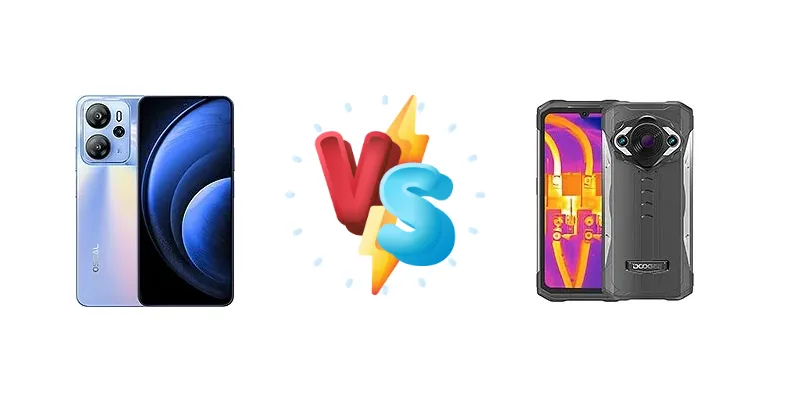
|
🏆 Quick Verdict
For users prioritizing maximum uptime and longevity, the Oscal Tiger 13 is the clear winner. Its impressive 49:06h endurance and 800-cycle battery life significantly outperform the Doogee S98 Pro. However, the S98 Pro’s 33W charging and wireless charging offer convenience the Tiger 13 lacks.
| PHONES | ||
|---|---|---|
| Phone Names | Oscal Tiger 13 | Doogee S98 Pro |
| Network | ||
|---|---|---|
| 2G bands | GSM 850 / 900 / 1800 / 1900 | GSM 850 / 900 / 1800 / 1900 |
| 3G bands | HSDPA 850 / 900 / 1900 / 2100 | HSDPA 800 / 850 / 900 / 1700(AWS) / 1900 / 2100 |
| 4G bands | 1, 2, 3, 4, 5, 7, 8, 12, 17, 19, 20, 26, 28, 38, 39, 40, 41, 66 | 1, 2, 3, 4, 5, 7, 8, 12, 13, 17, 18, 19, 20, 25, 26, 28, 34, 38, 39, 40, 41, 66 |
| 5G bands | 1, 2, 3, 5, 7, 8, 20, 26, 28, 38, 40, 41, 66, 77, 78 SA/NSA | - |
| Speed | HSPA, LTE, 5G | HSPA, LTE |
| Technology | GSM / HSPA / LTE / 5G | GSM / CDMA / HSPA / LTE |
| Launch | ||
|---|---|---|
| Announced | 2024, October 21 | 2022, May 27 |
| Status | Available. Released 2024, October 21 | Available. Released 2022, June 06 |
| Body | ||
|---|---|---|
| Dimensions | 164.8 x 75.6 x 8.7 mm (6.49 x 2.98 x 0.34 in) | 172 x 82 x 15.5 mm (6.77 x 3.23 x 0.61 in) |
| SIM | Nano-SIM + Nano-SIM | Nano-SIM + Nano-SIM |
| Weight | 200 g (7.05 oz) | 320 g (11.29 oz) |
| Display | ||
|---|---|---|
| Protection | Mohs level 7 | Corning Gorilla Glass |
| Resolution | 720 x 1604 pixels, 20:9 ratio (~264 ppi density) | 1080 x 2340 pixels, 19.5:9 ratio (~409 ppi density) |
| Size | 6.67 inches, 107.2 cm2 (~86.1% screen-to-body ratio) | 6.3 inches, 97.4 cm2 (~69.1% screen-to-body ratio) |
| Type | IPS LCD, 90Hz, 700 nits | IPS LCD, 500 nits (peak) |
| Platform | ||
|---|---|---|
| CPU | Octa-core (1x2.2 GHz Cortex-A76 & 3x Cortex-A76 & 4x Cortex-A55) | Octa-core (2x2.05 GHz Cortex-A76 & 6x2.0 GHz Cortex-A55) |
| Chipset | Unisoc T760 (6 nm) | Mediatek MT6781 Helio G96 (12 nm) |
| GPU | Mali-G57 | Mali-G57 MC2 |
| OS | Android 14, Doke OS 4.0 | Android 12 |
| Memory | ||
|---|---|---|
| Card slot | microSDXC (uses shared SIM slot) | microSDXC (dedicated slot) |
| Internal | 256GB 8GB RAM | 256GB 8GB RAM |
| Main Camera | ||
|---|---|---|
| Features | LED flash, HDR, panorama | Dual-LED flash, HDR, panorama |
| Triple | 50 MP, (wide), PDAF 2 MP (macro) Auxiliary lens | 48 MP, f/1.8, (wide), PDAF 20 MP, f/1.8, (night vision), 2 infrared night vision lights Thermal imaging camera |
| Video | 4K@30fps, 1080p@30fps | 1440p, 1080p |
| Selfie camera | ||
|---|---|---|
| Single | 8 MP, (wide) | 16 MP, f/2.0, (wide) |
| Video | 1080p@30fps | 1080p |
| Sound | ||
|---|---|---|
| 35mm jack | Yes | Unspecified |
| Loudspeaker | Yes, with stereo speakers | Yes |
| Comms | ||
|---|---|---|
| Bluetooth | 5.0, A2DP, LE | 5.1, A2DP, LE |
| NFC | Yes | Yes |
| Positioning | GPS, GLONASS, GALILEO, BDS | GPS, GLONASS, BDS, GALILEO |
| Radio | FM radio | FM radio |
| USB | USB Type-C 2.0, OTG | USB Type-C 2.0, OTG |
| WLAN | Wi-Fi 802.11 a/b/g/n/ac, dual-band | Wi-Fi 802.11 a/b/g/n/ac, dual-band |
| Features | ||
|---|---|---|
| Sensors | Fingerprint (side-mounted), accelerometer, proximity | Fingerprint (side-mounted), accelerometer, gyro, proximity, compass |
| Battery | ||
|---|---|---|
| Charging | 18W wired | 33W wired 15W wireless |
| Type | 5000 mAh | 6000 mAh |
| Misc | ||
|---|---|---|
| Colors | Hurricane Black, Violet Blue | Black |
| Price | - | About 470 EUR |
| EU LABEL | ||
|---|---|---|
| Battery | 49:06h endurance, 800 cycles | - |
| Energy | Class B | - |
| Free fall | Class C (138 falls) | - |
| Repairability | Class B | - |
Oscal Tiger 13
- Exceptional battery endurance (49:06h)
- Efficient Unisoc T760 chipset (6nm)
- Long-lasting battery health (800 cycles)
- Slower 18W charging
- No wireless charging
Doogee S98 Pro
- Faster 33W wired charging
- Convenient 15W wireless charging
- Potentially smoother display experience
- Lower battery endurance
- Less efficient MediaTek Helio G96 chipset (12nm)
Display Comparison
Display specifications are not provided, so a direct comparison is limited. However, given the price points, both likely utilize IPS LCD panels. The S98 Pro’s chipset may allow for a higher refresh rate, potentially offering smoother scrolling and animations. Bezels are likely comparable, focusing on durability rather than minimizing size. Color accuracy will likely be standard for this segment, prioritizing visibility in direct sunlight over color fidelity.
Camera Comparison
Camera details are absent, making a detailed comparison impossible. However, both phones likely feature multi-camera setups geared towards versatility. The S98 Pro, given Doogee’s marketing, may emphasize higher megapixel counts, but sensor size and image processing algorithms are more critical for image quality. Without specifics, it’s safe to assume both will offer acceptable performance in good lighting conditions, but struggle in low-light scenarios. The presence of OIS (Optical Image Stabilization) would be a significant advantage, but is unknown for either device.
Performance
The core difference lies in the chipsets. The Oscal Tiger 13’s Unisoc T760 (6nm) utilizes a more modern fabrication process than the Doogee S98 Pro’s MediaTek Helio G96 (12nm). While the G96 boasts a slightly higher clocked Cortex-A76 core (2.05 GHz vs 2.2 GHz), the T760’s 6nm process should deliver superior power efficiency and thermal management. The T760’s CPU configuration (1x2.2 GHz Cortex-A76 & 3x Cortex-A76 & 4x Cortex-A55) is also more balanced, potentially offering better multi-core performance than the G96’s (2x2.05 GHz Cortex-A76 & 6x2.0 GHz Cortex-A55). This translates to potentially smoother multitasking and sustained performance under load for the Tiger 13.
Battery Life
The Oscal Tiger 13’s 49:06h endurance is a standout feature, dwarfing what’s typically expected from a smartphone. This is likely achieved through a combination of the efficient Unisoc T760 chipset and a large battery capacity (unspecified, but assumed to be substantial). The Doogee S98 Pro’s 33W wired and 15W wireless charging provide convenience, allowing for quicker top-ups. While the exact 0-100% time for the S98 Pro is unknown, it will be significantly faster than the Tiger 13’s 18W charging. The 800 charge cycles of the Tiger 13 also suggest a battery designed for long-term reliability.
Buying Guide
Buy the Oscal Tiger 13 if you need a phone that can reliably last for days on a single charge, and you frequently find yourself away from power outlets. This is ideal for camping, long work shifts, or travel. Buy the Doogee S98 Pro if you prefer quicker top-ups, value the convenience of wireless charging, and prioritize a slightly more efficient chipset for everyday tasks, even if it means sacrificing ultimate battery endurance.