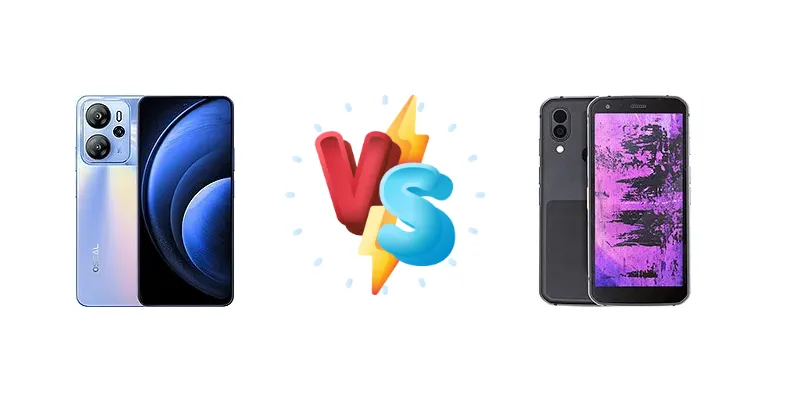
The rugged smartphone market caters to a specific need: durability. However, compromises are often made in other areas. We pit the Oscal Tiger 13, a newer entrant focusing on extended battery life, against the Cat S62 Pro, a well-established name known for its robust build and Qualcomm chipset, to determine which offers the best balance of features for demanding users.
🏆 Quick Verdict
For the average user prioritizing longevity and value, the Oscal Tiger 13 emerges as the winner. Its significantly longer 49:06h battery endurance and modern Unisoc T760 chipset offer a compelling package, despite the Cat S62 Pro's established brand reputation and Qualcomm pedigree.
| Network |
|---|
| 2G bands | GSM 850 / 900 / 1800 / 1900 | GSM 850 / 900 / 1800 / 1900 |
| 3G bands | HSDPA 850 / 900 / 1900 / 2100 | HSDPA 850 / 900 / 1700(AWS) / 1900 / 2100 |
| 4G bands | 1, 2, 3, 4, 5, 7, 8, 12, 17, 19, 20, 26, 28, 38, 39, 40, 41, 66 | 1, 2, 3, 4, 5, 7, 8, 20, 28, 38, 40 |
| 5G bands | 1, 2, 3, 5, 7, 8, 20, 26, 28, 38, 40, 41, 66, 77, 78 SA/NSA | - |
| Speed | HSPA, LTE, 5G | HSPA 42.2/5.76 Mbps, LTE (2CA) Cat13 400/150 Mbps |
| Technology | GSM / HSPA / LTE / 5G | GSM / HSPA / LTE |
| Launch |
|---|
| Announced | 2024, October 21 | 2020, June 28. Released 2020, August 17 |
| Status | Available. Released 2024, October 21 | Discontinued |
| Body |
|---|
| Build | - | Glass front (Gorilla Glass 6), plastic back, aluminum frame |
| Dimensions | 164.8 x 75.6 x 8.7 mm (6.49 x 2.98 x 0.34 in) | 158.5 x 76.7 x 11.9 mm (6.24 x 3.02 x 0.47 in) |
| SIM | Nano-SIM + Nano-SIM | · Nano-SIM· Nano-SIM + Nano-SIM |
| Weight | 200 g (7.05 oz) | 248 g (8.75 oz) |
| | - | IP68/IP69 dust/water resistant (up to 1.5m for 35 mins)
Drop-to-concrete resistance from up to 1.8m
MIL-STD-810H compliant |
| Display |
|---|
| Protection | Mohs level 7 | Corning Gorilla Glass 6 |
| Resolution | 720 x 1604 pixels, 20:9 ratio (~264 ppi density) | 1080 x 2160 pixels, 18:9 ratio (~424 ppi density) |
| Size | 6.67 inches, 107.2 cm2 (~86.1% screen-to-body ratio) | 5.7 inches, 83.8 cm2 (~69.0% screen-to-body ratio) |
| Type | IPS LCD, 90Hz, 700 nits | IPS LCD |
| Platform |
|---|
| CPU | Octa-core (1x2.2 GHz Cortex-A76 & 3x Cortex-A76 & 4x Cortex-A55) | Octa-core (4x2.2 GHz Kryo 260 Gold & 4x1.8 GHz Kryo 260 Silver) |
| Chipset | Unisoc T760 (6 nm) | Qualcomm SDM660 Snapdragon 660 (14 nm) |
| GPU | Mali-G57 | Adreno 512 |
| OS | Android 14, Doke OS 4.0 | Android 10 |
| Memory |
|---|
| Card slot | microSDXC (uses shared SIM slot) | microSDXC (dedicated slot) |
| Internal | 256GB 8GB RAM | 128GB 6GB RAM |
| Main Camera |
|---|
| Dual | - | 12 MP, f/1.8, (wide), 1/2.55", 1.4µm, dual pixel PDAF
FLIR thermal camera (Lepton 3.5 module) |
| Features | LED flash, HDR, panorama | Thermal imaging, heat palettes, temp. spot meter, LED flash |
| Triple | 50 MP, (wide), PDAF
2 MP (macro)
Auxiliary lens | - |
| Video | 4K@30fps, 1080p@30fps | 1080p@30fps, gyro-EIS |
| Selfie camera |
|---|
| Single | 8 MP, (wide) | 8 MP |
| Video | 1080p@30fps | 1080p@30fps |
| Sound |
|---|
| 3.5mm jack | - | No |
| 35mm jack | Yes | No |
| Loudspeaker | Yes, with stereo speakers | Yes |
| Comms |
|---|
| Bluetooth | 5.0, A2DP, LE | 5.0, A2DP, LE |
| NFC | Yes | Yes |
| Positioning | GPS, GLONASS, GALILEO, BDS | GPS, GLONASS, GALILEO, BDS |
| Radio | FM radio | FM radio |
| USB | USB Type-C 2.0, OTG | USB Type-C 2.0, OTG |
| WLAN | Wi-Fi 802.11 a/b/g/n/ac, dual-band | Wi-Fi 802.11 a/b/g/n/ac, dual-band, Wi-Fi Direct |
| Features |
|---|
| Sensors | Fingerprint (side-mounted), accelerometer, proximity | Fingerprint (rear-mounted), accelerometer, gyro, proximity, compass |
| Battery |
|---|
| Charging | 18W wired | - |
| Type | 5000 mAh | Li-Ion 4000 mAh |
| Misc |
|---|
| Colors | Hurricane Black, Violet Blue | Black |
| Price | - | About 530 EUR |
| EU LABEL |
|---|
| Battery | 49:06h endurance, 800 cycles | - |
| Energy | Class B | - |
| Free fall | Class C (138 falls) | - |
| Repairability | Class B | - |
Oscal Tiger 13
- Exceptional battery life (49:06h endurance)
- Modern Unisoc T760 chipset (6nm)
- Potentially better thermal management
- Brand recognition is lower than Cat
- Camera performance likely average
Cat S62 Pro
- Established brand reputation for ruggedness
- Qualcomm Snapdragon 660 chipset
- Potential for optimized software experience
- Significantly shorter battery life
- Older, less efficient chipset (14nm)
Display Comparison
Display specifications are absent from the provided data, but considering the market segment, both likely feature LCD panels optimized for outdoor visibility. The Cat S62 Pro, being an older model, may have lower peak brightness. The Oscal Tiger 13's newer chipset *could* support more advanced display features, but this is speculative without further information. Bezels are likely substantial on both to contribute to shock absorption.
Camera Comparison
Camera details are limited. Without sensor size or aperture information, a direct comparison is difficult. However, the market positioning suggests neither phone will excel in photography. The Cat S62 Pro may benefit from Qualcomm’s image signal processor (ISP), potentially offering slightly better image processing, but this is unlikely to be a significant advantage. We can assume both will feature basic camera functionality suitable for documentation, but not for serious photography.
Performance
The core difference lies in the chipsets. The Oscal Tiger 13’s Unisoc T760 (6nm) boasts a more modern architecture than the Cat S62 Pro’s Qualcomm Snapdragon 660 (14nm). The 6nm process node inherently offers better power efficiency, translating to less heat generation and potentially more sustained performance. While both are octa-core CPUs with similar clock speeds (2.2 GHz), the Unisoc T760’s Cortex-A76 cores are generally more efficient than the Snapdragon 660’s Kryo 260 Gold cores. This suggests the Tiger 13 will handle demanding tasks and multitasking with greater ease and less thermal throttling.
Battery Life
The Oscal Tiger 13 dominates in battery endurance with a reported 49:06h of usage, a substantial lead over what the Cat S62 Pro likely offers. While the Cat S62 Pro’s battery capacity is unknown, the older Snapdragon 660 chipset is less power-efficient. The Tiger 13’s 18W charging is standard, but the longer battery life minimizes the need for frequent top-ups. The Unisoc T760’s efficiency is the key factor here, allowing for significantly extended usage between charges.
Buying Guide
Buy the Oscal Tiger 13 if you need a phone that can genuinely last for days on a single charge, and if you prioritize a newer chipset architecture for potentially better efficiency and future software support. Buy the Cat S62 Pro if you prefer a brand with a proven track record in rugged devices, and if you value the Qualcomm ecosystem and its associated software optimizations, even at the cost of battery life.
Frequently Asked Questions
❓ Will the Unisoc T760 in the Oscal Tiger 13 struggle with graphically intensive games?
While the Unisoc T760 isn't a flagship gaming chip, its Cortex-A76 cores and modern architecture should handle most mobile games at medium settings. The 6nm process also helps mitigate thermal throttling, allowing for more sustained performance compared to the Snapdragon 660.
❓ How does the ruggedness of the Oscal Tiger 13 compare to the Cat S62 Pro, given Cat's established reputation?
Specific ruggedness certifications (IP68, MIL-STD-810H) are not provided for the Oscal Tiger 13. However, it is marketed as a rugged phone, implying a degree of shock, water, and dust resistance. The Cat S62 Pro benefits from Cat’s long-standing expertise in this area, and likely has more comprehensive certifications, making it potentially more durable in extreme conditions.
❓ Does the Oscal Tiger 13 support fast charging beyond the stated 18W?
The provided specifications only list 18W wired charging. While it *might* be compatible with Power Delivery (PD) chargers offering higher wattage, it's unlikely to charge significantly faster than 18W due to internal limitations.