
Oscal Tiger 12 vs. Ulefone Armor 10 5G: A Deep Dive into Rugged Phone Performance
| Phones Images | |||||
|---|---|---|---|---|---|
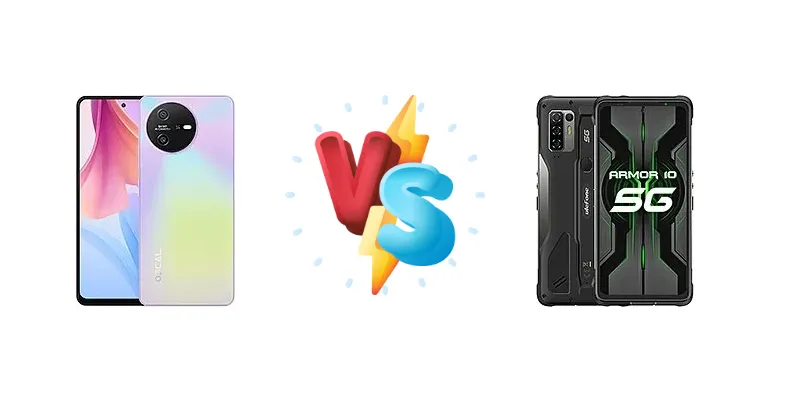
|
🏆 Quick Verdict
For the average user prioritizing longevity and consistent performance, the Oscal Tiger 12 is the better choice. Its impressive 48:18h endurance and efficient Helio G99 chipset outweigh the Ulefone Armor 10 5G’s faster processor, especially considering the Armor 10’s significantly slower charging speeds.
| PHONES | ||
|---|---|---|
| Phone Names | Oscal Tiger 12 | Ulefone Armor 10 5G |
| Network | ||
|---|---|---|
| 2G bands | GSM 850 / 900 / 1800 / 1900 | GSM 850 / 900 / 1800 / 1900 |
| 3G bands | HSDPA 900 / 2100 | HSDPA 850 / 900 / 1700(AWS) / 1900 / 2100 |
| 4G bands | 1, 3, 7, 8, 19, 20, 28, 40, 41 | 1, 2, 3, 4, 5, 7, 8, 12, 13, 17, 18, 19, 20, 25, 26, 28, 34, 38, 39, 40, 41, 66 |
| 5G bands | - | 1, 3, 41, 77, 78, 79 SA/NSA |
| Speed | HSPA, LTE | HSPA, LTE, 5G |
| Technology | GSM / HSPA / LTE | GSM / CDMA / HSPA / EVDO / LTE / 5G |
| - | CDMA2000 1xEV-DO | |
| Launch | ||
|---|---|---|
| Announced | 2023, November 14 | 2020, November 17. Released 2020, December 07 |
| Status | Available. Released 2023, November | Discontinued |
| Body | ||
|---|---|---|
| Build | - | Front glass, aluminum back with rubber, aluminum frame |
| Dimensions | 168.5 x 76.6 x 8.4 mm (6.63 x 3.02 x 0.33 in) | 176.5 x 82.8 x 14.6 mm (6.95 x 3.26 x 0.57 in) |
| SIM | Nano-SIM + Nano-SIM | Nano-SIM + Nano-SIM |
| Weight | 198.3 g (6.98 oz) | 328 g (11.57 oz) |
| - | IP68 dust/water resistant (up to 1.5m for 30 min) Drop-to-concrete resistance from up to 1.2m MIL-STD-810G compliant | |
| Display | ||
|---|---|---|
| Protection | Mohs level 7 | Scratch-resistant glass, oleophobic coating |
| Resolution | 1080 x 2460 pixels (~396 ppi density) | 1080 x 2400 pixels, 20:9 ratio (~395 ppi density) |
| Size | 6.78 inches, 109.2 cm2 (~84.6% screen-to-body ratio) | 6.67 inches, 107.4 cm2 (~73.5% screen-to-body ratio) |
| Type | IPS LCD, 120Hz, 500 nits | IPS LCD |
| Platform | ||
|---|---|---|
| CPU | Octa-core (2x2.2 GHz Cortex-A76 & 6x2.0 GHz Cortex-A55) | Octa-core (4x2.0 GHz Cortex-A76 & 4x2.0 GHz Cortex-A55) |
| Chipset | Mediatek Helio G99 (6 nm) | Mediatek Dimensity 800 (7 nm) |
| GPU | Mali-G57 MC2 | Mali-G57 MP4 |
| OS | Android 13, Doke OS 4.0 | Android 10, planned upgrade to Android 11 |
| Memory | ||
|---|---|---|
| Card slot | microSDXC (dedicated slot) | microSDXC (uses shared SIM slot) |
| Internal | 128GB 8GB RAM, 256GB 12GB RAM | 128GB 8GB RAM |
| Main Camera | ||
|---|---|---|
| Dual | 64 MP, (wide), 1/1.97", 0.7µm, PDAF Auxiliary lens | - |
| Features | LED flash, HDR, panorama | LED flash, Panorama, HDR |
| Quad | - | 64 MP, f/1.9, 26mm (wide), 1/1.72", 0.8µm, PDAF 8 MP, f/2.2, 119˚ (ultrawide) 5 MP (macro) Auxiliary lens |
| Video | 1440p@30fps, 1080p@30fps | 4K@30fps, 1080p@30fps |
| Selfie camera | ||
|---|---|---|
| Single | 13 MP, (wide), 1/3", 1.12µm | 16 MP, f/2.2 |
| Video | 1080p@30fps | 1080p@30fps |
| Sound | ||
|---|---|---|
| 3.5mm jack | - | Yes |
| 35mm jack | Yes | Yes |
| Loudspeaker | Yes | Yes |
| Comms | ||
|---|---|---|
| Bluetooth | 5.0, A2DP, LE | 5.2, A2DP, LE |
| NFC | Yes | Yes |
| Positioning | GPS, GLONASS, GALILEO, BDS | GPS, GLONASS, GALILEO, BDS |
| Radio | FM radio | FM radio, RDS, recording |
| USB | USB Type-C 2.0, OTG | USB Type-C 2.0, OTG |
| WLAN | Wi-Fi 802.11 a/b/g/n/ac, dual-band | Wi-Fi 802.11 a/b/g/n/ac, Wi-Fi Direct |
| Features | ||
|---|---|---|
| Sensors | Fingerprint (rear-mounted), accelerometer, proximity | Fingerprint (side-mounted), accelerometer, gyro, proximity, compass, baroceptor, coulombmeter |
| Battery | ||
|---|---|---|
| Charging | 33W wired | 15W wired 15W wireless |
| Type | 5000 mAh | Li-Po 5800 mAh |
| Misc | ||
|---|---|---|
| Colors | Cerulean Blue, Flowing Purple, Cloudwing Grey | Black |
| Price | About 190 EUR | About 420 EUR |
| EU LABEL | ||
|---|---|---|
| Battery | 48:18h endurance, 800 cycles | - |
| Energy | Class B | - |
| Free fall | Class C (114 falls) | - |
| Repairability | Class B | - |
Oscal Tiger 12
- Exceptional battery life (48:18h endurance)
- Efficient Helio G99 chipset for sustained performance
- Faster 33W wired charging
- Potentially better thermal management due to 6nm process
- Less powerful chipset compared to the Dimensity 800
- May struggle with very demanding games at maximum settings
Ulefone Armor 10 5G
- More powerful Mediatek Dimensity 800 chipset
- 5G connectivity for faster data speeds
- Wireless charging convenience
- Potentially better image processing capabilities
- Significantly lower battery endurance
- Slower 15W charging (wired and wireless)
- Likely higher thermal throttling under sustained load
- Less efficient 7nm process
Display Comparison
Neither device’s display specifications are provided, so a direct comparison is limited. However, given the price points, we can assume both utilize IPS LCD panels. The focus here shifts to the internal hardware. The Tiger 12’s efficiency is likely aided by a lower-resolution display, contributing to its superior battery performance. The Armor 10 5G, with its more powerful chipset, may support a higher refresh rate, but this would come at the cost of battery life.
Camera Comparison
Without detailed camera specifications, a comprehensive comparison is impossible. However, the market segment suggests both phones will feature a multi-camera setup with a primary sensor, ultrawide, and potentially macro/depth sensors. The image processing capabilities of the Dimensity 800 in the Ulefone Armor 10 5G *could* offer slightly better dynamic range and noise reduction, but this is heavily dependent on software optimization. The absence of sensor size information makes it difficult to assess low-light performance.
Performance
The Ulefone Armor 10 5G boasts the Mediatek Dimensity 800 (7nm), a more powerful chipset than the Oscal Tiger 12’s Helio G99 (6nm). The Dimensity 800 features a quad-core Cortex-A76 configuration (4x2.0 GHz) versus the Tiger 12’s dual-core Cortex-A76 (2x2.2 GHz). While the Tiger 12’s A76 cores are clocked slightly higher, the Dimensity 800’s additional cores provide a significant advantage in multi-threaded tasks. However, the 7nm process node of the Dimensity 800 is less efficient than the 6nm node of the Helio G99, meaning the Armor 10 5G will likely generate more heat and consume more power under sustained load. This impacts the real-world benefit of the more powerful chipset.
Battery Life
The Oscal Tiger 12’s 48:18h endurance is a standout feature, significantly exceeding what’s typically found in this price range. This is a direct result of the efficient Helio G99 chipset and likely a larger battery capacity (though not specified). The Ulefone Armor 10 5G, while offering 15W wired and wireless charging, is hampered by its lower endurance. The slower charging speed means a full charge will take considerably longer than the Tiger 12’s 33W wired charging. The inclusion of wireless charging is a convenience feature, but doesn’t offset the overall battery disadvantage.
Buying Guide
Buy the Oscal Tiger 12 if you need a phone that will reliably last through multi-day trips, demanding work shifts, or simply prefer not to worry about daily charging. Buy the Ulefone Armor 10 5G if you absolutely require 5G connectivity and prioritize raw processing power for tasks like video editing or more graphically intensive gaming, and are willing to compromise on battery life and charging speed.