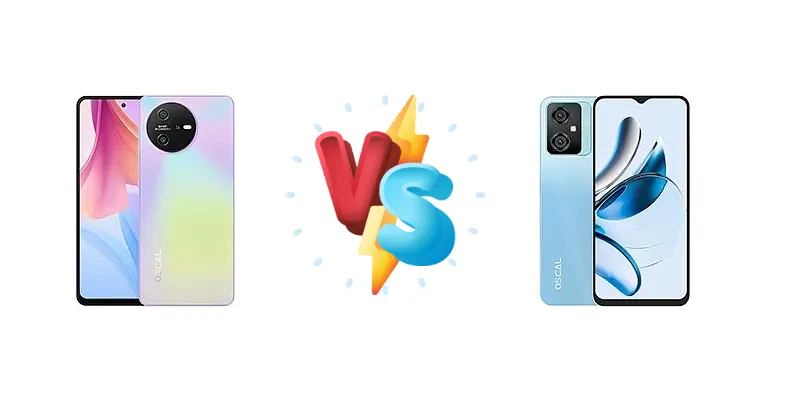
The Oscal Tiger series aims to deliver rugged durability and respectable performance at competitive price points. The Tiger 12 represents a step up in processing power, leveraging the Mediatek Helio G99 chipset, while the Tiger 10 relies on the Unisoc T606. This comparison dissects the key differences to help you determine which Tiger best suits your needs and budget.
🏆 Quick Verdict
For users prioritizing performance and longevity, the Oscal Tiger 12 is the clear winner. Its Helio G99 chipset provides a substantial performance boost over the Tiger 10’s Unisoc T606, and the 48:18h endurance suggests a more robust user experience. However, the Tiger 10 remains a viable option for those on a tighter budget.
| Network |
|---|
| 2G bands | GSM 850 / 900 / 1800 / 1900 | GSM 850 / 900 / 1800 / 1900 |
| 3G bands | HSDPA 900 / 2100 | HSDPA 900 / 2100 |
| 4G bands | 1, 3, 7, 8, 19, 20, 28, 40, 41 | 1, 3, 7, 8, 19, 20, 40 |
| Speed | HSPA, LTE | HSPA, LTE |
| Technology | GSM / HSPA / LTE | GSM / HSPA / LTE |
| Launch |
|---|
| Announced | 2023, November 14 | 2023, November |
| Status | Available. Released 2023, November | Available. Released 2023, November |
| Body |
|---|
| Dimensions | 168.5 x 76.6 x 8.4 mm (6.63 x 3.02 x 0.33 in) | 163.2 x 75.2 x 8.8 mm (6.43 x 2.96 x 0.35 in) |
| SIM | Nano-SIM + Nano-SIM | Nano-SIM + Nano-SIM |
| Weight | 198.3 g (6.98 oz) | 195 g (6.88 oz) |
| Display |
|---|
| Protection | Mohs level 7 | - |
| Resolution | 1080 x 2460 pixels (~396 ppi density) | 720 x 1612 pixels, 20:9 ratio (~267 ppi density) |
| Size | 6.78 inches, 109.2 cm2 (~84.6% screen-to-body ratio) | 6.6 inches, 104.6 cm2 (~85.3% screen-to-body ratio) |
| Type | IPS LCD, 120Hz, 500 nits | IPS LCD, 90Hz, 400 nits |
| Platform |
|---|
| CPU | Octa-core (2x2.2 GHz Cortex-A76 & 6x2.0 GHz Cortex-A55) | Octa-core (2x1.6 GHz Cortex-A75 & 6x1.6 GHz Cortex-A55) |
| Chipset | Mediatek Helio G99 (6 nm) | Unisoc T606 (12 nm) |
| GPU | Mali-G57 MC2 | Mali-G57 MP1 |
| OS | Android 13, Doke OS 4.0 | Android 13, Doke OS 4.0 |
| Memory |
|---|
| Card slot | microSDXC (dedicated slot) | microSDXC (uses shared SIM slot) |
| Internal | 128GB 8GB RAM, 256GB 12GB RAM | 256GB 8GB RAM |
| Main Camera |
|---|
| Dual | 64 MP, (wide), 1/1.97", 0.7µm, PDAF
Auxiliary lens | 50 MP, (wide), 1/2.76, 0.64µm, PDAF
Auxiliary lens |
| Features | LED flash, HDR, panorama | LED flash, HDR, panorama |
| Video | 1440p@30fps, 1080p@30fps | 1080p@30fps |
| Selfie camera |
|---|
| Single | 13 MP, (wide), 1/3", 1.12µm | 8 MP |
| Video | 1080p@30fps | 1080p@30fps |
| Sound |
|---|
| 35mm jack | Yes | Yes |
| Loudspeaker | Yes | Yes |
| Comms |
|---|
| Bluetooth | 5.0, A2DP, LE | 5.0, A2DP, LE |
| NFC | Yes | No |
| Positioning | GPS, GLONASS, GALILEO, BDS | GPS, GLONASS, GALILEO, BDS |
| Radio | FM radio | FM radio |
| USB | USB Type-C 2.0, OTG | USB Type-C, OTG |
| WLAN | Wi-Fi 802.11 a/b/g/n/ac, dual-band | Wi-Fi 802.11 a/b/g/n/ac, dual-band |
| Features |
|---|
| Sensors | Fingerprint (rear-mounted), accelerometer, proximity | Fingerprint (side-mounted), accelerometer, proximity |
| Battery |
|---|
| Charging | 33W wired | - |
| Type | 5000 mAh | 5180 mAh |
| Misc |
|---|
| Colors | Cerulean Blue, Flowing Purple, Cloudwing Grey | Dim Forest Green, Summer Sky Blue, Stardust Grey |
| Price | About 190 EUR | - |
| EU LABEL |
|---|
| Battery | 48:18h endurance, 800 cycles | - |
| Energy | Class B | - |
| Free fall | Class C (114 falls) | - |
| Repairability | Class B | - |
Oscal Tiger 12
- Significantly faster processor (Helio G99)
- Improved power efficiency (6nm process)
- Longer battery endurance (48:18h)
- Faster charging (33W)
- Likely higher price point
- No specific display details available
Oscal Tiger 10
- More affordable price
- Decent performance for basic tasks
- Potentially good battery life due to efficient chipset
- Suitable for light users
- Slower processor (Unisoc T606)
- Less efficient 12nm process
- Charging speed unknown
- Limited performance for demanding apps
Display Comparison
Display specifications are absent from the provided data, but given the price bracket, we can anticipate both devices utilize LCD panels. The key differentiator will likely be brightness and color accuracy. Without specific data, it's reasonable to assume the Tiger 12, being the higher-tier model, may offer slightly better display quality. The absence of information regarding refresh rates suggests both likely operate at a standard 60Hz.
Camera Comparison
Camera details are unavailable, but it’s safe to assume both phones feature basic camera setups geared towards casual photography. Given the price point, expect primary sensors in the 13-50MP range. The absence of any mention of OIS or advanced features suggests image quality will be heavily reliant on software processing. Without further information, it’s difficult to assess the camera performance beyond speculation.
Performance
The core difference lies in the chipsets. The Oscal Tiger 12’s Mediatek Helio G99 (6nm) is a significant upgrade over the Tiger 10’s Unisoc T606 (12nm). The 6nm process node allows for greater transistor density and improved power efficiency, translating to better sustained performance and reduced thermal throttling. The Helio G99’s CPU configuration – 2x2.2 GHz Cortex-A76 & 6x2.0 GHz Cortex-A55 – is demonstrably faster than the T606’s 2x1.6 GHz Cortex-A75 & 6x1.6 GHz Cortex-A55. This will be noticeable in app launch times, multitasking, and gaming. The G99 also benefits from a more capable GPU, further widening the performance gap.
Battery Life
The Oscal Tiger 12 boasts a 48:18h endurance rating, indicating excellent battery life. While the capacity isn't specified, this endurance suggests a well-optimized combination of battery size and power efficiency. The 33W wired charging is a welcome addition, allowing for relatively quick top-ups. The Tiger 10’s battery specifications are missing, but given the less power-hungry chipset, it may offer comparable battery life despite potentially having a smaller capacity. However, the lack of charging speed information puts it at a disadvantage.
Buying Guide
Buy the Oscal Tiger 12 if you need a phone capable of handling demanding tasks like gaming or video editing, and if you value long-term performance and battery health with its 800 charge cycles. Buy the Oscal Tiger 10 if you prioritize affordability and basic smartphone functionality, and are willing to trade raw power for a lower price point. It's ideal for users who primarily browse, message, and make calls.
Frequently Asked Questions
❓ Will the Oscal Tiger 12 handle demanding games like Genshin Impact or Call of Duty Mobile?
The Helio G99 in the Tiger 12 is capable of running these games, but expect to make compromises on graphics settings. The chipset is a significant step up from the T606, but it's not a flagship-level processor. Medium settings should provide a playable experience, while high settings may result in frame drops.
❓ How does the 800 charge cycle rating of the Oscal Tiger 12 impact long-term battery health?
The 800 charge cycle rating indicates the battery is designed to retain at least 80% of its original capacity after 800 full charge/discharge cycles. This is a strong indicator of battery longevity, suggesting the Tiger 12 will maintain good battery health for a longer period compared to phones with lower cycle ratings.
❓ Is the Unisoc T606 in the Oscal Tiger 10 sufficient for everyday tasks like browsing, social media, and calling?
Yes, the Unisoc T606 is perfectly adequate for everyday tasks. It's designed for efficiency and can handle browsing, social media, messaging, and calling without significant issues. However, it will struggle with more demanding applications or multitasking.