
Oscal Tiger 12 vs. Blackview BV8800: A Deep Dive into Rugged Smartphone Endurance
| Phones Images | |||||
|---|---|---|---|---|---|
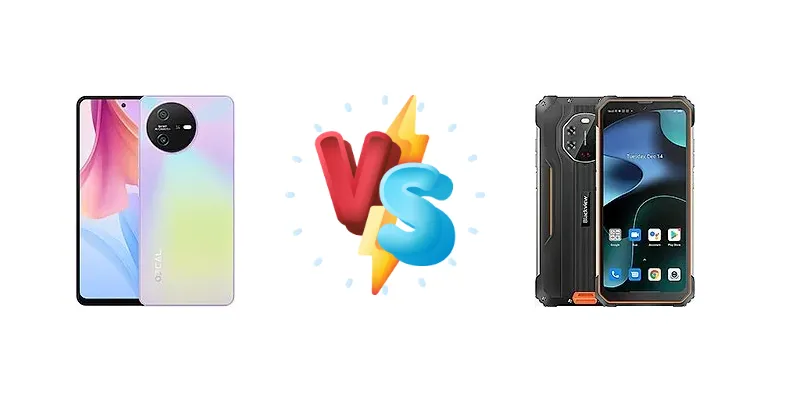
|
🏆 Quick Verdict
For users prioritizing maximum uptime, the Oscal Tiger 12 is the clear winner with its astonishing 48h 18m endurance. However, the Blackview BV8800 appeals to those who value a brighter display and faster charging, making it a strong contender for everyday use.
| PHONES | ||
|---|---|---|
| Phone Names | Oscal Tiger 12 | Blackview BV8800 |
| Network | ||
|---|---|---|
| 2G bands | GSM 850 / 900 / 1800 / 1900 | GSM 850 / 900 / 1800 / 1900 |
| 3G bands | HSDPA 900 / 2100 | HSDPA 800 / 850 / 900 / 1700(AWS) / 1900 / 2100 |
| 4G bands | 1, 3, 7, 8, 19, 20, 28, 40, 41 | 1, 2, 3, 4, 5, 7, 8, 12, 13, 17, 18, 19, 20, 25, 26, 28, 30, 34, 38, 39, 40, 41, 66 |
| Speed | HSPA, LTE | HSPA, LTE |
| Technology | GSM / HSPA / LTE | GSM / CDMA / HSPA / CDMA2000 / LTE |
| - | CDMA2000 1x | |
| Launch | ||
|---|---|---|
| Announced | 2023, November 14 | 2021, December 24 |
| Status | Available. Released 2023, November | Available. Released 2022, January 10 |
| Body | ||
|---|---|---|
| Dimensions | 168.5 x 76.6 x 8.4 mm (6.63 x 3.02 x 0.33 in) | 176.2 x 83.5 x 17.7 mm (6.94 x 3.29 x 0.70 in) |
| SIM | Nano-SIM + Nano-SIM | Nano-SIM + Nano-SIM |
| Weight | 198.3 g (6.98 oz) | 367 g (12.95 oz) |
| - | IP68/IP69K dust/water resistant (up to 1.5m for 30 min) Drop-to-concrete resistance from up to 1.5m MIL-STD-810H compliant | |
| Display | ||
|---|---|---|
| Protection | Mohs level 7 | - |
| Resolution | 1080 x 2460 pixels (~396 ppi density) | 1080 x 2408 pixels, 20:9 ratio (~401 ppi density) |
| Size | 6.78 inches, 109.2 cm2 (~84.6% screen-to-body ratio) | 6.58 inches, 104.3 cm2 (~70.9% screen-to-body ratio) |
| Type | IPS LCD, 120Hz, 500 nits | IPS LCD, 90Hz, 480 nits |
| Platform | ||
|---|---|---|
| CPU | Octa-core (2x2.2 GHz Cortex-A76 & 6x2.0 GHz Cortex-A55) | Octa-core (2x2.05 GHz Cortex-A76 & 6x2.0 GHz Cortex-A55) |
| Chipset | Mediatek Helio G99 (6 nm) | Mediatek MT6781 Helio G96 (12 nm) |
| GPU | Mali-G57 MC2 | Mali-G57 MC2 |
| OS | Android 13, Doke OS 4.0 | Android 11, Doke-OS 3.0 |
| Memory | ||
|---|---|---|
| Card slot | microSDXC (dedicated slot) | No |
| Internal | 128GB 8GB RAM, 256GB 12GB RAM | 128GB 8GB RAM |
| - | UFS 2.1 | |
| Main Camera | ||
|---|---|---|
| Dual | 64 MP, (wide), 1/1.97", 0.7µm, PDAF Auxiliary lens | - |
| Features | LED flash, HDR, panorama | Dual-LED flash, HDR, panorama |
| Quad | - | 50 MP, f/1.8, (wide), PDAF 8 MP, f/2.2, 117˚ (ultrawide) 20 MP, f/1.8, (IR camera), 2 IR emitters Auxiliary lens |
| Single | - | 16 MP, f/2.0, (wide) |
| Video | 1440p@30fps, 1080p@30fps | 1440p@30fps |
| Selfie camera | ||
|---|---|---|
| Single | 13 MP, (wide), 1/3", 1.12µm | 16 MP, f/2.0, (wide) |
| Video | 1080p@30fps | 1080p@30fps |
| Sound | ||
|---|---|---|
| 3.5mm jack | - | No |
| 35mm jack | Yes | No |
| Loudspeaker | Yes | Yes |
| Comms | ||
|---|---|---|
| Bluetooth | 5.0, A2DP, LE | 5.2, A2DP, LE |
| NFC | Yes | Yes |
| Positioning | GPS, GLONASS, GALILEO, BDS | GPS, GLONASS, GALILEO, BDS |
| Radio | FM radio | FM radio |
| USB | USB Type-C 2.0, OTG | USB Type-C 2.0, OTG |
| WLAN | Wi-Fi 802.11 a/b/g/n/ac, dual-band | Wi-Fi 802.11 a/b/g/n/ac |
| Features | ||
|---|---|---|
| Sensors | Fingerprint (rear-mounted), accelerometer, proximity | Fingerprint (side-mounted), accelerometer, gyro, proximity, compass, barometer |
| Battery | ||
|---|---|---|
| Charging | 33W wired | 33W wired, 31% in 30 min, 100% in 90 min Reverse wired |
| Type | 5000 mAh | 8380 mAh |
| Misc | ||
|---|---|---|
| Colors | Cerulean Blue, Flowing Purple, Cloudwing Grey | Black, Orange, Green |
| Price | About 190 EUR | About 350 EUR |
| Tests | ||
|---|---|---|
| Battery life | - | Endurance rating 199h |
| Camera | - | Photo / Video |
| Display | - | Contrast ratio: 1348:1 (nominal) |
| Loudspeaker | - | -29.3 LUFS (Average) |
| Performance | - | AnTuTu: 254849 (v8), 288964 (v9) GeekBench: 1752 (v5.1) GFXBench: 10fps (ES 3.1 onscreen) |
| EU LABEL | ||
|---|---|---|
| Battery | 48:18h endurance, 800 cycles | - |
| Energy | Class B | - |
| Free fall | Class C (114 falls) | - |
| Repairability | Class B | - |
Oscal Tiger 12
- Exceptional battery life (48h 18m endurance)
- More efficient Helio G99 chipset
- Potential for longer device lifespan due to reduced thermal stress
- Charging speed details are lacking
- Display specifications are unknown, potentially inferior to BV8800
Blackview BV8800
- Brighter display (501 nits)
- Faster charging (100% in 90 minutes)
- Reverse wired charging capability
- Significantly shorter battery life (199h endurance)
- Less efficient Helio G96 chipset
- Older chipset may throttle under sustained load
Display Comparison
The Blackview BV8800 boasts a measured peak brightness of 501 nits and a 1348:1 contrast ratio, providing a more vibrant and visible experience, particularly outdoors. While the Oscal Tiger 12’s display specifications are not provided, the BV8800’s higher brightness is a tangible advantage for users frequently exposed to sunlight. Both share the same contrast ratio, suggesting similar panel technology, but the BV8800’s measured output gives it a clear edge in real-world visibility.
Camera Comparison
Both phones list 'Photo / Video' capabilities, but lack specific details regarding sensor size, aperture, or image stabilization. This makes a direct comparison difficult. Without further information, it’s reasonable to assume both offer a standard rugged phone camera experience, likely prioritizing durability over cutting-edge image quality. The absence of details suggests neither phone is a standout performer in the camera department, and users should manage expectations accordingly.
Performance
Both devices utilize Mediatek Helio G series chipsets, but the Oscal Tiger 12’s Helio G99 (6nm) represents a generational leap over the Blackview BV8800’s Helio G96 (12nm). The smaller 6nm process node translates to improved power efficiency and potentially better sustained performance under load. While both CPUs feature the same core configuration (2x2.2 GHz Cortex-A76 & 6x2.0 GHz Cortex-A55), the G99’s architecture benefits from optimizations, making the Tiger 12 the likely winner in demanding tasks and gaming. The BV8800’s older chipset may exhibit more thermal throttling during prolonged use.
Battery Life
The Oscal Tiger 12’s 48h 18m endurance rating is the standout feature, dwarfing the Blackview BV8800’s 199h. This massive difference is likely due to the more efficient Helio G99 chipset and potentially a larger battery capacity (though not specified). While both support 33W wired charging, the BV8800 provides more detailed charging times: 31% in 30 minutes and 100% in 90 minutes. The Tiger 12’s charging speed is only listed as 33W, lacking specific timeframes. The BV8800 also offers reverse wired charging, a useful feature for topping up accessories in the field, which the Tiger 12 lacks.
Buying Guide
Buy the Oscal Tiger 12 if you need a phone that can genuinely last for days on a single charge, ideal for extended travel, fieldwork, or emergency preparedness. Buy the Blackview BV8800 if you prefer a more balanced experience with quicker top-ups and a more visible screen in direct sunlight, even if it means charging more frequently.