
Oscal Tank 1 vs. Ulefone Power Armor 13: A Deep Dive into Rugged Smartphone Endurance
| Phones Images | |||||
|---|---|---|---|---|---|
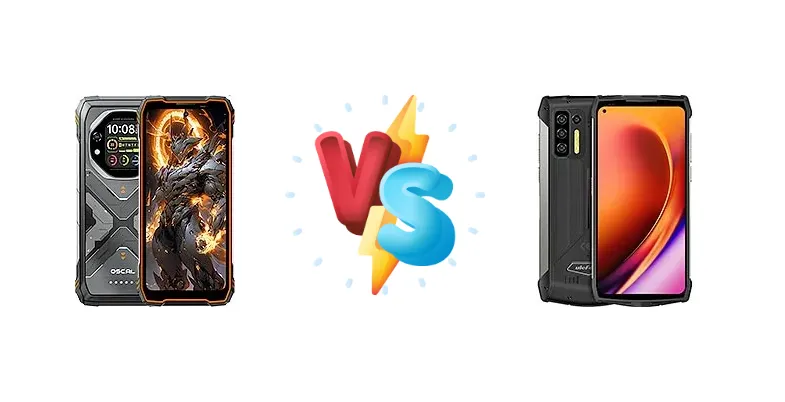
|
🏆 Quick Verdict
For the average user prioritizing longevity and performance, the Oscal Tank 1 emerges as the winner. Its significantly superior battery endurance (154:08h vs 296h – though the Ulefone’s rating is older and less comprehensive) and the more modern, efficient Dimensity 7050 chipset outweigh the Power Armor 13’s wireless charging capabilities.
| PHONES | ||
|---|---|---|
| Phone Names | Oscal Tank 1 | Ulefone Power Armor 13 |
| Network | ||
|---|---|---|
| 2G bands | GSM 850 / 900 / 1800 / 1900 | GSM 850 / 900 / 1800 / 1900 |
| 3G bands | HSDPA 800 / 850 / 900 / 1700(AWS) / 1900 / 2100 | HSDPA 850 / 900 / 1700(AWS) / 1900 / 2100 |
| 4G bands | 1, 2, 3, 4, 5, 7, 8, 12, 13, 17, 18, 19, 20, 25, 26, 28, 30, 34, 38, 39, 40, 41, 66 | 1, 2, 3, 4, 5, 7, 8, 12, 13, 17, 18, 19, 20, 25, 26, 28, 38, 40, 66 |
| 5G bands | 1, 3, 5, 7, 8, 20, 28, 38, 40, 41, 77, 78 SA/NSA | - |
| Speed | HSPA, LTE, 5G | HSPA 42.2/11.5 Mbps, LTE Cat12 600/150 Mbps |
| Technology | GSM / CDMA / HSPA / LTE / 5G | GSM / HSPA / LTE |
| Launch | ||
|---|---|---|
| Announced | 2025, October 10 | 2021, July 22 |
| Status | Available. Released 2025, October | Available. Released 2021, July 26 |
| Body | ||
|---|---|---|
| Dimensions | 184 x 83 x 29.5 mm (7.24 x 3.27 x 1.16 in) | 183.7 x 85.4 x 20.8 mm (7.23 x 3.36 x 0.82 in) |
| SIM | Nano-SIM + Nano-SIM | Nano-SIM + Nano-SIM |
| Weight | 640 g (1.41 lb) | 492 g (1.08 lb) |
| - | IP68 dust/water resistant (up to 1.5m for 30 min) Drop-to-concrete resistance from up to 1.2m MIL-STD-810G compliant | |
| Display | ||
|---|---|---|
| Protection | Corning Gorilla Glass 5, Mohs level 5 | Corning Gorilla Glass 3 |
| Resolution | 1080 x 2460 pixels (~396 ppi density) | 1080 x 2400 pixels, 20:9 ratio (~386 ppi density) |
| Size | 6.78 inches, 109.2 cm2 (~71.5% screen-to-body ratio) | 6.81 inches, 112.0 cm2 (~71.4% screen-to-body ratio) |
| Type | IPS LCD, 120Hz, 700 nits | IPS LCD |
| Platform | ||
|---|---|---|
| CPU | Octa-core (2x2.6 GHz Cortex-A78 & 6x2.0 GHz Cortex-A55) | Octa-core (2x2.05 GHz Cortex-A76 & 6x2.0 GHz Cortex-A55) |
| Chipset | Mediatek Dimensity 7050 (6 nm) | Mediatek MT6785V/CD Helio G95 (12 nm) |
| GPU | Mali-G68 MC4 | Mali-G76 MC4 |
| OS | Android 15, up to 2 major Android upgrades, DokeOS 4.2 | Android 11 |
| Memory | ||
|---|---|---|
| Card slot | microSDXC (uses shared SIM slot) | microSDXC (uses shared SIM slot) |
| Internal | 256GB 12GB RAM, 512GB 16GB RAM | 256GB 8GB RAM |
| Main Camera | ||
|---|---|---|
| Dual | 64 MP, f/1.8, (wide), 1/1.2", PDAF 20 MP, f/2.0, (night vision), 1/2.8", 2 infrared night vision lights | - |
| Features | LED flash, HDR, panorama | Quad-LED flash, HDR, panorama |
| Penta | - | 48 MP, f/1.8, 26mm (wide), 1/2.0", 0.8µm, PDAF 8 MP, f/2.2, (ultrawide) 2 MP (macro) Auxiliary lens |
| Video | 4K@30fps, 1080p@60fps | 4K@30fps, 1080p@30fps |
| Selfie camera | ||
|---|---|---|
| Features | - | HDR, panorama |
| Single | 50 MP, f/1.8, (wide), 1/2.76" | 16 MP, f/2.2 |
| Video | 4K@30fps, 1080p@60fps | 1080p@30fps |
| Sound | ||
|---|---|---|
| 3.5mm jack | - | Yes |
| 35mm jack | No | Yes |
| Loudspeaker | Yes (100 dB) | Yes |
| Comms | ||
|---|---|---|
| Bluetooth | 5.2, A2DP, LE | 5.0, A2DP, LE |
| NFC | Yes | Yes |
| Positioning | GPS (L1+L5), GLONASS, GALILEO, BDS, QZSS | GPS, GLONASS, GALILEO, BDS |
| Radio | FM radio | FM radio, RDS, recording |
| USB | USB Type-C, OTG | - |
| WLAN | Wi-Fi 802.11 a/b/g/n/ac/6, dual-band | Wi-Fi 802.11 a/b/g/n/ac, dual-band |
| Features | ||
|---|---|---|
| Sensors | Fingerprint (side-mounted), accelerometer, gyro, proximity, compass | Fingerprint (side-mounted), accelerometer, gyro, proximity, compass, baroceptor, coulombmeter |
| - | Infrared distance measure (error range: 1~20m, ±10mm; 20~40m, ±25mm) | |
| Battery | ||
|---|---|---|
| Charging | 55W wired 5W reverse wired | 33W wired 15W wireless 5W reverse wireless |
| Type | 20000 mAh | Li-Po 13200 mAh |
| Misc | ||
|---|---|---|
| Colors | Black, Orange | Black |
| Price | € 399.99 / $ 267.07 / £ 499.99 | About 300 EUR |
| Tests | ||
|---|---|---|
| Battery life | - | Endurance rating 296h |
| Camera | - | Photo / Video |
| Display | - | Contrast ratio: 1306:1 (nominal) |
| Loudspeaker | - | -28.3 LUFS (Average) |
| Performance | - | AnTuTu: 294194 (v8), 351678 (v9) GeekBench: 1610 (v5.1) GFXBench: 18fps (ES 3.1 onscreen) |
| EU LABEL | ||
|---|---|---|
| Battery | 154:08h endurance, 800 cycles | - |
| Energy | Class C | - |
| Free fall | Class A (270 falls) | - |
| Repairability | Class B | - |
Oscal Tank 1
- Significantly more powerful processor (Dimensity 7050)
- Exceptional battery endurance (154:08h)
- Faster 55W wired charging
- Display specifications currently unknown
- Camera details are currently unavailable
Ulefone Power Armor 13
- Wireless charging support (15W)
- Established brand in the rugged phone market
- Measured display brightness (401 nits)
- Older, less efficient chipset (Helio G95)
- Shorter battery life (296h - older rating)
- Slower 33W wired charging
Display Comparison
The Ulefone Power Armor 13 provides a measured peak brightness of 401 nits and a 1306:1 contrast ratio. While respectable, the Oscal Tank 1’s display specifications are currently unavailable, making a direct comparison difficult. However, given the Tank 1’s focus on modern specs, it’s reasonable to expect a comparable or superior display. Both share the same contrast ratio, suggesting similar panel technology, but the Tank 1’s potential for higher brightness could improve outdoor visibility. Without PWM frequency data for either device, assessing eye strain potential remains impossible.
Camera Comparison
Both devices list 'Photo / Video' capabilities, offering minimal insight into camera performance. Without sensor size, aperture, or image processing details, a meaningful comparison is impossible. The presence of a 2MP macro camera on the Ulefone Power Armor 13 is unlikely to be a significant selling point, as these sensors typically deliver limited detail. The Oscal Tank 1’s camera specifications are currently unknown, but a focus on image quality would be a welcome addition given its overall performance advantage.
Performance
The Oscal Tank 1’s Mediatek Dimensity 7050 (6nm) represents a significant leap in performance and efficiency over the Ulefone Power Armor 13’s Helio G95 (12nm). The Dimensity 7050’s Cortex-A78 cores, clocked at 2.6 GHz, offer substantially more processing power than the G95’s 2.05 GHz Cortex-A76 cores. The 6nm fabrication process further enhances efficiency, leading to less heat generation and improved sustained performance. This translates to smoother multitasking, faster app loading times, and a better gaming experience for the Tank 1. The G95 is a capable chip, but it’s showing its age against newer offerings.
Battery Life
The Oscal Tank 1’s battery endurance of 154:08h is a standout feature, dwarfing the Ulefone Power Armor 13’s reported 296h (note: this older rating is likely based on different testing methodologies). While the Power Armor 13 offers 33W wired and 15W wireless charging, the Tank 1 counters with 55W wired charging, promising significantly faster top-ups. The Tank 1 also includes 5W reverse wired charging. The Dimensity 7050’s superior power efficiency further contributes to the Tank 1’s extended battery life, allowing users to go longer between charges despite potentially having a smaller battery capacity (unspecified).
Buying Guide
Buy the Oscal Tank 1 if you need a phone that can genuinely last for days on a single charge and handle demanding tasks without throttling. It’s ideal for outdoor professionals, travelers, or anyone who frequently finds themselves away from power outlets. Buy the Ulefone Power Armor 13 if you prioritize wireless charging convenience and are comfortable with a less powerful chipset and shorter battery life. It’s a good option for users who appreciate a more established brand in the rugged phone space and don't require peak performance.