
Oscal Tank 1 vs. Motorola Defy 2: A Deep Dive into Rugged Smartphone Choices
| Phones Images | |||||
|---|---|---|---|---|---|
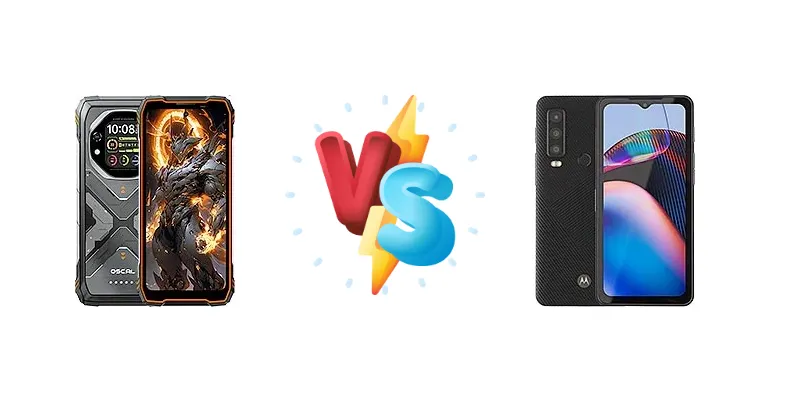
|
🏆 Quick Verdict
For users prioritizing maximum uptime and rapid replenishment, the Oscal Tank 1 is the clear winner. Its 154-hour endurance and 55W charging significantly outperform the Defy 2. However, those valuing wireless charging convenience and a marginally faster processor will find the Motorola Defy 2 a compelling alternative.
| PHONES | ||
|---|---|---|
| Phone Names | Oscal Tank 1 | Motorola Defy 2 |
| Network | ||
|---|---|---|
| 2G bands | GSM 850 / 900 / 1800 / 1900 | GSM 850 / 900 / 1800 / 1900 |
| 3G bands | HSDPA 800 / 850 / 900 / 1700(AWS) / 1900 / 2100 | HSDPA 850 / 900 / 1700(AWS) / 1900 / 2100 |
| 4G bands | 1, 2, 3, 4, 5, 7, 8, 12, 13, 17, 18, 19, 20, 25, 26, 28, 30, 34, 38, 39, 40, 41, 66 | 1, 2, 3, 4, 5, 7, 8, 12, 13, 14, 17, 20, 25, 26, 28, 30, 38, 40, 41, 46, 48, 66, 71 |
| 5G bands | 1, 3, 5, 7, 8, 20, 28, 38, 40, 41, 77, 78 SA/NSA | 2, 5, 23, 25, 26, 28, 38, 41, 48, 66, 70, 71, 77, 78, 255, 256 SA/NSA/Sub6/mmWave |
| Speed | HSPA, LTE, 5G | HSPA, LTE, 5G |
| Technology | GSM / CDMA / HSPA / LTE / 5G | GSM / HSPA / LTE / 5G |
| Launch | ||
|---|---|---|
| Announced | 2025, October 10 | 2023, February 24 |
| Status | Available. Released 2025, October | Available. Released 2023, October |
| Body | ||
|---|---|---|
| Build | - | Glass front (Gorilla Glass Victus), plastic back, aluminum frame |
| Dimensions | 184 x 83 x 29.5 mm (7.24 x 3.27 x 1.16 in) | 171 x 80 x 11.9 mm (6.73 x 3.15 x 0.47 in) |
| SIM | Nano-SIM + Nano-SIM | Nano-SIM + Nano-SIM |
| Weight | 640 g (1.41 lb) | 268 g (9.45 oz) |
| - | IP68/IP69 dust/water resistant (up to 5m for 35 min) Drop-to-concrete resistance from up to 1.8m MIL-STD-810H compliant | |
| Display | ||
|---|---|---|
| Protection | Corning Gorilla Glass 5, Mohs level 5 | Corning Gorilla Glass Victus |
| Resolution | 1080 x 2460 pixels (~396 ppi density) | 1080 x 2408 pixels, 20:9 ratio (~400 ppi density) |
| Size | 6.78 inches, 109.2 cm2 (~71.5% screen-to-body ratio) | 6.6 inches, 104.9 cm2 (~76.7% screen-to-body ratio) |
| Type | IPS LCD, 120Hz, 700 nits | IPS LCD, 120Hz |
| Platform | ||
|---|---|---|
| CPU | Octa-core (2x2.6 GHz Cortex-A78 & 6x2.0 GHz Cortex-A55) | Octa-core (2x2.2 GHz Cortex-A78 & 6x2.0 GHz Cortex-A55) |
| Chipset | Mediatek Dimensity 7050 (6 nm) | Mediatek Dimensity 930 (6 nm) |
| GPU | Mali-G68 MC4 | IMG BXM-8-256 |
| OS | Android 15, up to 2 major Android upgrades, DokeOS 4.2 | Android 12 |
| Memory | ||
|---|---|---|
| Card slot | microSDXC (uses shared SIM slot) | microSDXC (uses shared SIM slot) |
| Internal | 256GB 12GB RAM, 512GB 16GB RAM | 128GB 6GB RAM |
| Main Camera | ||
|---|---|---|
| Dual | 64 MP, f/1.8, (wide), 1/1.2", PDAF 20 MP, f/2.0, (night vision), 1/2.8", 2 infrared night vision lights | - |
| Features | LED flash, HDR, panorama | Dual-LED flash, HDR, panorama |
| Triple | - | 50 MP, f/1.8, (wide), PDAF 8 MP, f/2.2, (ultrawide) 2 MP (macro) |
| Video | 4K@30fps, 1080p@60fps | 1080p@30fps |
| Selfie camera | ||
|---|---|---|
| Single | 50 MP, f/1.8, (wide), 1/2.76" | 8 MP, f/2.0, (wide) |
| Video | 4K@30fps, 1080p@60fps | 1080p@30fps |
| Sound | ||
|---|---|---|
| 3.5mm jack | - | No |
| 35mm jack | No | No |
| Loudspeaker | Yes (100 dB) | Yes |
| Comms | ||
|---|---|---|
| Bluetooth | 5.2, A2DP, LE | 5.1, A2DP, LE |
| NFC | Yes | Yes |
| Positioning | GPS (L1+L5), GLONASS, GALILEO, BDS, QZSS | GPS (L1+L5), GLONASS, GALILEO, BDS |
| Radio | FM radio | Unspecified |
| USB | USB Type-C, OTG | USB Type-C 2.0, OTG |
| WLAN | Wi-Fi 802.11 a/b/g/n/ac/6, dual-band | Wi-Fi 802.11 a/b/g/n/ac, dual-band |
| Features | ||
|---|---|---|
| Sensors | Fingerprint (side-mounted), accelerometer, gyro, proximity, compass | Fingerprint (rear-mounted), accelerometer, gyro, proximity, compass |
| - | Emergency SOS via satellite (Bullitt Satellite Connect service) | |
| Battery | ||
|---|---|---|
| Charging | 55W wired 5W reverse wired | 15W wireless |
| Type | 20000 mAh | Li-Po 5000 mAh |
| Misc | ||
|---|---|---|
| Colors | Black, Orange | Black |
| Models | - | BM1S1B |
| Price | € 399.99 / $ 267.07 / £ 499.99 | About 570 EUR |
| EU LABEL | ||
|---|---|---|
| Battery | 154:08h endurance, 800 cycles | - |
| Energy | Class C | - |
| Free fall | Class A (270 falls) | - |
| Repairability | Class B | - |
Oscal Tank 1
- Exceptional battery life (154:08h endurance)
- Ultra-fast 55W wired charging
- Potentially higher single-core performance due to faster CPU cores
- Wireless charging absent
- Camera specifications unknown, potentially average
Motorola Defy 2
- Convenient 15W wireless charging
- Slightly newer chipset (Dimensity 930)
- Potentially smoother multitasking
- Significantly shorter battery life
- Slower charging speeds compared to Oscal Tank 1
Display Comparison
Display specifications are absent from the provided data, but considering the rugged nature of both devices, we can infer they likely utilize durable, though potentially less vibrant, panels. The focus here isn't on bleeding-edge display tech. Bezels are likely substantial on both to enhance drop protection. Color accuracy is likely secondary to visibility in direct sunlight.
Camera Comparison
Camera details are limited. Without sensor size or aperture information, a meaningful comparison is challenging. Both phones likely feature multi-camera setups, but the emphasis is likely on practicality rather than photographic excellence. The inclusion of a 2MP macro camera on either device is likely a marketing tactic, offering minimal real-world benefit. Image processing will likely differ, with Motorola potentially leaning towards more natural tones and Oscal potentially prioritizing contrast and saturation.
Performance
The Motorola Defy 2 boasts the Mediatek Dimensity 930, featuring a 2x2.2 GHz Cortex-A78 core configuration, while the Oscal Tank 1 utilizes the Dimensity 7050 with 2x2.6 GHz Cortex-A78 cores. While the 930 is a generation newer, the Tank 1’s higher clock speeds on the prime cores suggest a potential edge in single-core performance. Both chipsets are built on a 6nm process, indicating similar efficiency. However, the Tank 1’s performance advantage will be limited by the overall system design and thermal management, which are unknown. The absence of RAM specifications makes a direct comparison difficult, but LPDDR5X would be a significant advantage for either device.
Battery Life
The Oscal Tank 1’s 154:08h endurance is a standout feature, dwarfing the expected battery life of the Motorola Defy 2. This suggests a significantly larger battery capacity within the Tank 1. The 55W wired charging on the Tank 1 is a substantial advantage, allowing for rapid replenishment, while the Defy 2 relies solely on 15W wireless charging, which is considerably slower. The Tank 1 also offers 5W reverse wired charging, a useful feature for topping up accessories.
Buying Guide
Buy the Oscal Tank 1 if you need a phone that can genuinely last for days on a single charge, especially if you work or travel in areas with limited access to power outlets. It’s ideal for outdoor enthusiasts and professionals who demand unwavering reliability. Buy the Motorola Defy 2 if you prefer the convenience of wireless charging and prioritize a slightly smoother experience with demanding applications, and are willing to trade some battery life for that.