
Oscal Spider 8 vs. Ulefone Power Armor 19T: A Rugged Smartphone Showdown
| Phones Images | |||||
|---|---|---|---|---|---|
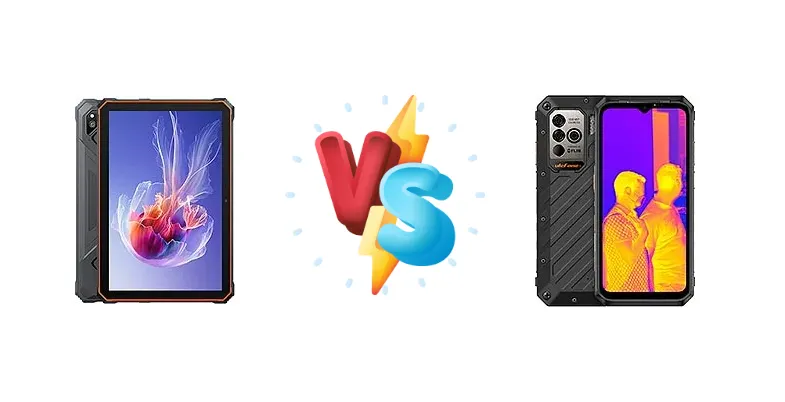
|
🏆 Quick Verdict
For the average user prioritizing raw performance and faster charging, the Ulefone Power Armor 19T is the clear winner. Its Mediatek Helio G99 chipset and 66W charging significantly outperform the Oscal Spider 8’s Unisoc Tiger T616 and 33W charging, making it better suited for demanding tasks and quicker power-ups.
| PHONES | ||
|---|---|---|
| Phone Names | Oscal Spider 8 | Ulefone Power Armor 19T |
| Network | ||
|---|---|---|
| 2G bands | GSM 850 / 900 / 1800 / 1900 | GSM 850 / 900 / 1800 / 1900 |
| 3G bands | HSDPA 900 / 2100 | HSDPA 800 / 850 / 900 / 1700(AWS) / 1900 / 2100 |
| 4G bands | 1, 3, 7, 8, 20, 34, 38, 39, 40, 41 | 1, 2, 3, 4, 5, 7, 8, 12, 13, 17, 18, 19, 20, 25, 26, 28, 34, 38, 39, 40, 41, 66, 71 |
| Speed | HSPA, LTE | HSPA, LTE |
| Technology | GSM / HSPA / LTE | GSM / CDMA / HSPA / CDMA2000 / LTE |
| - | CDMA2000 1x | |
| Launch | ||
|---|---|---|
| Announced | 2023, August | 2023, March 06 |
| Status | Available. Released 2023, August | Available. Released 2023, March 06 |
| Body | ||
|---|---|---|
| Dimensions | 251.3 x 170.1 x 14.9 mm (9.89 x 6.70 x 0.59 in) | 175.2 x 83.4 x 18.8 mm (6.90 x 3.28 x 0.74 in) |
| SIM | Nano-SIM + Nano-SIM | Nano-SIM + Nano-SIM |
| Weight | 854 g (1.88 lb) | 409 g (14.43 oz) |
| - | IP68/IP69K dust/water resistant (up to 1.5m for 30 min) Drop-to-concrete resistance from up to 1.5m MIL-STD-810H compliant Accessory connector (ulefone endoscope, microscope) | |
| Display | ||
|---|---|---|
| Protection | Corning Gorilla Glass 5 | Corning Gorilla Glass 5 |
| Resolution | 1200 x 1920 pixels, 16:10 ratio (~224 ppi density) | 1080 x 2408 pixels, 20:9 ratio (~401 ppi density) |
| Size | 10.1 inches, 295.8 cm2 (~69.2% screen-to-body ratio) | 6.58 inches, 104.3 cm2 (~71.4% screen-to-body ratio) |
| Type | IPS LCD | IPS LCD, 120Hz |
| Platform | ||
|---|---|---|
| CPU | Octa-core (2x2.0 GHz Cortex-A75 & 6x1.8 GHz Cortex-A55) | Octa-core (2x2.2 GHz Cortex-A76 & 6x2.0 GHz Cortex-A55) |
| Chipset | Unisoc Tiger T616 (12 nm) | Mediatek Helio G99 (6 nm) |
| GPU | Mali-G57 MP1 | Mali-G57 MC2 |
| OS | Android 13, Doke OS_P 3.0 | Android 12 |
| Memory | ||
|---|---|---|
| Card slot | microSDXC (uses shared SIM slot) | microSDXC (uses shared SIM slot) |
| Internal | 128GB 8GB RAM | 256GB 12GB RAM |
| Main Camera | ||
|---|---|---|
| Dual | 13 MP secondary unspecified camera | - |
| Features | LED flash | Hexa-LED flash, HDR, panorama |
| Triple | - | 108 MP, f/1.9, (wide), 1/1.52", 0.7µm, PDAF 5 MP (macro) FLIR thermal camera (Lepton module) 5 MP (for thermal module) |
| Video | 1080p@30fps | 1440p@30fps, 1080p@30fps |
| Selfie camera | ||
|---|---|---|
| Single | 16 MP | 16 MP, f/2.0, (wide), 1.0µm |
| Video | Yes | 1080p@30fps |
| Sound | ||
|---|---|---|
| 3.5mm jack | - | Yes |
| 35mm jack | No | Yes |
| Loudspeaker | Yes, with stereo speakers | Yes |
| Comms | ||
|---|---|---|
| Bluetooth | 5.0, A2DP | 5.2, A2DP, LE |
| NFC | No | Yes |
| Positioning | GPS, GLONASS, GALILEO, BDS | GPS, GLONASS, GALILEO, BDS |
| Radio | FM Radio | Wireless FM radio, RDS, recording |
| USB | USB Type-C, OTG | USB Type-C 2.0, OTG, magnetic connector |
| WLAN | Wi-Fi 802.11 a/b/g/n/ac, dual-band | Wi-Fi 802.11 a/b/g/n/ac, dual-band |
| Features | ||
|---|---|---|
| Sensors | Accelerometer, gyro, proximity, compass | Fingerprint (side-mounted), accelerometer, gyro, proximity, compass |
| Battery | ||
|---|---|---|
| Charging | 33W wired 5W reverse wired | 66W wired, 52% in 30 min 15W wireless 5W wireless reversed |
| Type | 13000 mAh | Li-Po 9600 mAh |
| Misc | ||
|---|---|---|
| Colors | Black, Orange | Black |
| Price | About 220 EUR | About 440 EUR |
Oscal Spider 8
- More affordable price point
- Rugged design for durability
- Reverse wired charging capability
- Slower charging speeds (33W)
- Less powerful processor (Unisoc T616)
Ulefone Power Armor 19T
- Faster charging (66W wired, 15W wireless)
- More powerful processor (Helio G99)
- Wireless charging and reverse wireless charging
- Higher price compared to Oscal Spider 8
- Potentially larger size due to battery and charging components
Display Comparison
Neither device’s display specifications are provided, so a direct comparison is limited. However, given the price points, we can expect both to utilize IPS LCD panels. The Ulefone, being positioned slightly higher, may benefit from a higher peak brightness and potentially better color calibration. The absence of details like refresh rate or resolution suggests neither phone is targeting display-centric users.
Camera Comparison
Without detailed camera specifications beyond the presence of sensors, a comprehensive comparison is difficult. However, the market segment suggests both phones will prioritize practicality over photographic excellence. The Ulefone, given its slightly higher positioning, may incorporate a larger main sensor or more sophisticated image processing algorithms. The inclusion of features like Optical Image Stabilization (OIS) is unlikely on either device, but the G99’s ISP (Image Signal Processor) may offer slightly better noise reduction and dynamic range compared to the T616’s ISP.
Performance
The Ulefone Power Armor 19T’s Mediatek Helio G99, fabricated on a 6nm process, represents a significant leap in efficiency and performance over the Oscal Spider 8’s Unisoc Tiger T616 (12nm). The G99’s Cortex-A76 cores, clocked at 2.2 GHz, offer a noticeable CPU performance advantage over the Spider 8’s 2.0 GHz Cortex-A75 cores. This translates to snappier app launches, smoother multitasking, and improved gaming performance. The 6nm node also implies better thermal management, reducing the likelihood of throttling during sustained workloads. While both phones utilize an octa-core configuration, the architectural differences and process node give the Ulefone a clear edge.
Battery Life
The Ulefone Power Armor 19T’s 66W wired charging is a game-changer, capable of reaching 52% charge in just 30 minutes. This is significantly faster than the Oscal Spider 8’s 33W charging. Furthermore, the Ulefone adds 15W wireless charging and 5W reverse wireless charging, offering greater convenience. While battery capacity isn’t specified, the faster charging speeds of the Ulefone mitigate any potential disadvantage from a slightly smaller battery. The 5W reverse wired charging on the Oscal Spider 8 is a niche feature, useful for topping up small accessories, but the Ulefone’s wireless reverse charging is more versatile.
Buying Guide
Buy the Oscal Spider 8 if you need a highly affordable, durable phone for basic tasks like communication, navigation, and light media consumption. It’s ideal for users who prioritize cost-effectiveness over peak performance. Buy the Ulefone Power Armor 19T if you prefer a more powerful device capable of handling gaming, multitasking, and faster charging, even if it comes at a slightly higher price point. This phone is geared towards users who demand more from their rugged smartphone.