
Oscal Spider 8 vs. Doogee S98 Pro: A Deep Dive into Rugged Smartphone Performance
| Phones Images | |||||
|---|---|---|---|---|---|
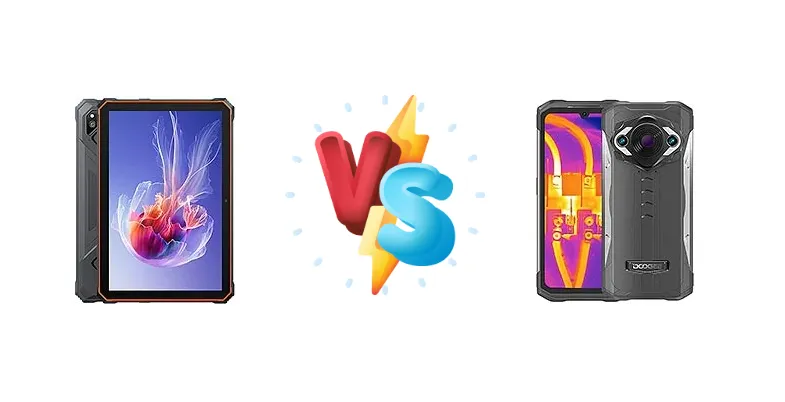
|
🏆 Quick Verdict
For the average user prioritizing a balance of affordability and solid performance, the Doogee S98 Pro emerges as the better choice. Its Helio G96 chipset offers a noticeable performance edge over the Spider 8’s Unisoc T616, and the inclusion of 15W wireless charging adds a convenience factor the Spider 8 lacks.
| PHONES | ||
|---|---|---|
| Phone Names | Oscal Spider 8 | Doogee S98 Pro |
| Network | ||
|---|---|---|
| 2G bands | GSM 850 / 900 / 1800 / 1900 | GSM 850 / 900 / 1800 / 1900 |
| 3G bands | HSDPA 900 / 2100 | HSDPA 800 / 850 / 900 / 1700(AWS) / 1900 / 2100 |
| 4G bands | 1, 3, 7, 8, 20, 34, 38, 39, 40, 41 | 1, 2, 3, 4, 5, 7, 8, 12, 13, 17, 18, 19, 20, 25, 26, 28, 34, 38, 39, 40, 41, 66 |
| Speed | HSPA, LTE | HSPA, LTE |
| Technology | GSM / HSPA / LTE | GSM / CDMA / HSPA / LTE |
| Launch | ||
|---|---|---|
| Announced | 2023, August | 2022, May 27 |
| Status | Available. Released 2023, August | Available. Released 2022, June 06 |
| Body | ||
|---|---|---|
| Dimensions | 251.3 x 170.1 x 14.9 mm (9.89 x 6.70 x 0.59 in) | 172 x 82 x 15.5 mm (6.77 x 3.23 x 0.61 in) |
| SIM | Nano-SIM + Nano-SIM | Nano-SIM + Nano-SIM |
| Weight | 854 g (1.88 lb) | 320 g (11.29 oz) |
| Display | ||
|---|---|---|
| Protection | Corning Gorilla Glass 5 | Corning Gorilla Glass |
| Resolution | 1200 x 1920 pixels, 16:10 ratio (~224 ppi density) | 1080 x 2340 pixels, 19.5:9 ratio (~409 ppi density) |
| Size | 10.1 inches, 295.8 cm2 (~69.2% screen-to-body ratio) | 6.3 inches, 97.4 cm2 (~69.1% screen-to-body ratio) |
| Type | IPS LCD | IPS LCD, 500 nits (peak) |
| Platform | ||
|---|---|---|
| CPU | Octa-core (2x2.0 GHz Cortex-A75 & 6x1.8 GHz Cortex-A55) | Octa-core (2x2.05 GHz Cortex-A76 & 6x2.0 GHz Cortex-A55) |
| Chipset | Unisoc Tiger T616 (12 nm) | Mediatek MT6781 Helio G96 (12 nm) |
| GPU | Mali-G57 MP1 | Mali-G57 MC2 |
| OS | Android 13, Doke OS_P 3.0 | Android 12 |
| Memory | ||
|---|---|---|
| Card slot | microSDXC (uses shared SIM slot) | microSDXC (dedicated slot) |
| Internal | 128GB 8GB RAM | 256GB 8GB RAM |
| Main Camera | ||
|---|---|---|
| Dual | 13 MP secondary unspecified camera | - |
| Features | LED flash | Dual-LED flash, HDR, panorama |
| Triple | - | 48 MP, f/1.8, (wide), PDAF 20 MP, f/1.8, (night vision), 2 infrared night vision lights Thermal imaging camera |
| Video | 1080p@30fps | 1440p, 1080p |
| Selfie camera | ||
|---|---|---|
| Single | 16 MP | 16 MP, f/2.0, (wide) |
| Video | Yes | 1080p |
| Sound | ||
|---|---|---|
| 35mm jack | No | Unspecified |
| Loudspeaker | Yes, with stereo speakers | Yes |
| Comms | ||
|---|---|---|
| Bluetooth | 5.0, A2DP | 5.1, A2DP, LE |
| NFC | No | Yes |
| Positioning | GPS, GLONASS, GALILEO, BDS | GPS, GLONASS, BDS, GALILEO |
| Radio | FM Radio | FM radio |
| USB | USB Type-C, OTG | USB Type-C 2.0, OTG |
| WLAN | Wi-Fi 802.11 a/b/g/n/ac, dual-band | Wi-Fi 802.11 a/b/g/n/ac, dual-band |
| Features | ||
|---|---|---|
| Sensors | Accelerometer, gyro, proximity, compass | Fingerprint (side-mounted), accelerometer, gyro, proximity, compass |
| Battery | ||
|---|---|---|
| Charging | 33W wired 5W reverse wired | 33W wired 15W wireless |
| Type | 13000 mAh | 6000 mAh |
| Misc | ||
|---|---|---|
| Colors | Black, Orange | Black |
| Price | About 220 EUR | About 470 EUR |
Oscal Spider 8
- Highly affordable price point
- Rugged build quality for durability
- 33W wired charging support
- Less powerful Unisoc Tiger T616 chipset
- Lacks wireless charging capability
- Potentially lower camera performance
Doogee S98 Pro
- More powerful MediaTek Helio G96 chipset
- 15W wireless charging support
- Potentially better camera performance
- Higher price compared to Oscal Spider 8
- May experience slightly more heat under heavy load
- Rugged design may add bulk
Display Comparison
Neither device's display specifications are provided, so a direct comparison is limited. However, given the price point of the Oscal Spider 8, it likely utilizes a standard LCD panel. The Doogee S98 Pro, positioned slightly higher in the market, may incorporate a more advanced panel with better color accuracy and viewing angles. Both devices will likely prioritize durability over display fidelity, meaning expect robust glass protection but potentially lower peak brightness compared to flagship phones.
Camera Comparison
Without detailed camera specifications, a precise comparison is difficult. However, the market segment suggests the Doogee S98 Pro likely features a more sophisticated camera system. While both phones will likely include multiple lenses, the G96’s image signal processor (ISP) is generally more capable, resulting in better image processing, dynamic range, and low-light performance. Expect the S98 Pro to offer more refined image quality, especially in challenging conditions. The inclusion of Optical Image Stabilization (OIS) on the S98 Pro, a common feature in this price range, would further enhance image clarity and stability.
Performance
The core difference lies in the chipsets. The Doogee S98 Pro’s MediaTek Helio G96 (12nm) utilizes two Cortex-A76 cores clocked at 2.05 GHz, paired with six Cortex-A55 cores at 2.0 GHz. This architecture provides a performance advantage over the Oscal Spider 8’s Unisoc Tiger T616 (12nm), which features two Cortex-A75 cores at 2.0 GHz and six Cortex-A55 cores at 1.8 GHz. The A76 cores in the G96 are more efficient and offer higher single-core performance, translating to snappier app launches and smoother multitasking. While both are 12nm chips, the architectural improvements in the G96 give it an edge. Users who intend to play graphically intensive games will find the Doogee S98 Pro a more suitable option.
Battery Life
Both devices offer 33W wired charging, providing reasonably fast charging speeds. However, the Doogee S98 Pro distinguishes itself with the addition of 15W wireless charging, a significant convenience feature for users who prefer cable-free charging. While battery capacity isn’t specified, the efficiency of the Helio G96 chipset may result in slightly better battery life on the S98 Pro, despite potentially having a similar capacity to the Spider 8. The 33W charging on both devices should deliver a full charge in approximately 90-120 minutes.
Buying Guide
Buy the Oscal Spider 8 if you need a highly affordable, durable phone for basic tasks like communication, navigation, and light media consumption. It’s ideal for users who prioritize cost-effectiveness above all else. Buy the Doogee S98 Pro if you prefer a more capable device for gaming, multitasking, and demanding applications, and value the added convenience of wireless charging. This phone is geared towards users who need a rugged phone that can also handle a heavier workload.