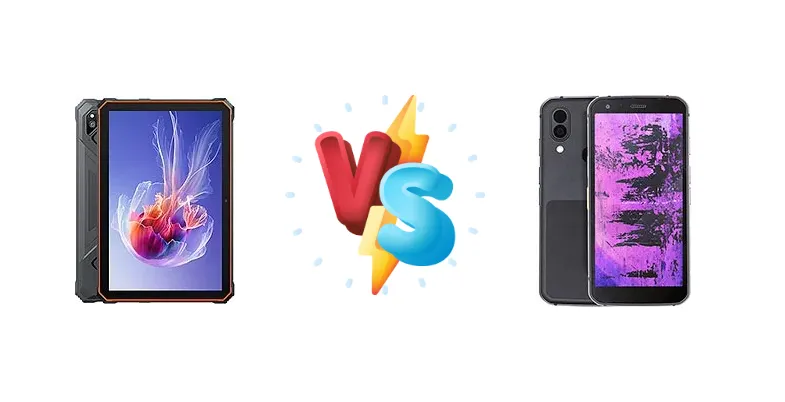
The rugged smartphone market caters to a specific need: durability. Both the Oscal Spider 8 and the Cat S62 Pro aim to deliver on that promise, but they approach it with different chipsets and price points. The Spider 8 leverages the newer Unisoc Tiger T616, while the S62 Pro relies on the Qualcomm Snapdragon 660. This comparison dissects their strengths and weaknesses to determine which device offers the best blend of performance, features, and value.
🏆 Quick Verdict
For the average user prioritizing modern efficiency and faster charging, the Oscal Spider 8 emerges as the better value. While the Cat S62 Pro benefits from Qualcomm’s established optimization, the Spider 8’s Unisoc T616 offers a competitive experience at a potentially lower price, coupled with significantly faster 33W charging.
| Network |
|---|
| 2G bands | GSM 850 / 900 / 1800 / 1900 | GSM 850 / 900 / 1800 / 1900 |
| 3G bands | HSDPA 900 / 2100 | HSDPA 850 / 900 / 1700(AWS) / 1900 / 2100 |
| 4G bands | 1, 3, 7, 8, 20, 34, 38, 39, 40, 41 | 1, 2, 3, 4, 5, 7, 8, 20, 28, 38, 40 |
| Speed | HSPA, LTE | HSPA 42.2/5.76 Mbps, LTE (2CA) Cat13 400/150 Mbps |
| Technology | GSM / HSPA / LTE | GSM / HSPA / LTE |
| Launch |
|---|
| Announced | 2023, August | 2020, June 28. Released 2020, August 17 |
| Status | Available. Released 2023, August | Discontinued |
| Body |
|---|
| Build | - | Glass front (Gorilla Glass 6), plastic back, aluminum frame |
| Dimensions | 251.3 x 170.1 x 14.9 mm (9.89 x 6.70 x 0.59 in) | 158.5 x 76.7 x 11.9 mm (6.24 x 3.02 x 0.47 in) |
| SIM | Nano-SIM + Nano-SIM | · Nano-SIM· Nano-SIM + Nano-SIM |
| Weight | 854 g (1.88 lb) | 248 g (8.75 oz) |
| | - | IP68/IP69 dust/water resistant (up to 1.5m for 35 mins)
Drop-to-concrete resistance from up to 1.8m
MIL-STD-810H compliant |
| Display |
|---|
| Protection | Corning Gorilla Glass 5 | Corning Gorilla Glass 6 |
| Resolution | 1200 x 1920 pixels, 16:10 ratio (~224 ppi density) | 1080 x 2160 pixels, 18:9 ratio (~424 ppi density) |
| Size | 10.1 inches, 295.8 cm2 (~69.2% screen-to-body ratio) | 5.7 inches, 83.8 cm2 (~69.0% screen-to-body ratio) |
| Type | IPS LCD | IPS LCD |
| Platform |
|---|
| CPU | Octa-core (2x2.0 GHz Cortex-A75 & 6x1.8 GHz Cortex-A55) | Octa-core (4x2.2 GHz Kryo 260 Gold & 4x1.8 GHz Kryo 260 Silver) |
| Chipset | Unisoc Tiger T616 (12 nm) | Qualcomm SDM660 Snapdragon 660 (14 nm) |
| GPU | Mali-G57 MP1 | Adreno 512 |
| OS | Android 13, Doke OS_P 3.0 | Android 10 |
| Memory |
|---|
| Card slot | microSDXC (uses shared SIM slot) | microSDXC (dedicated slot) |
| Internal | 128GB 8GB RAM | 128GB 6GB RAM |
| Main Camera |
|---|
| Dual | 13 MP
secondary unspecified camera | 12 MP, f/1.8, (wide), 1/2.55", 1.4µm, dual pixel PDAF
FLIR thermal camera (Lepton 3.5 module) |
| Features | LED flash | Thermal imaging, heat palettes, temp. spot meter, LED flash |
| Video | 1080p@30fps | 1080p@30fps, gyro-EIS |
| Selfie camera |
|---|
| Single | 16 MP | 8 MP |
| Video | Yes | 1080p@30fps |
| Sound |
|---|
| 3.5mm jack | - | No |
| 35mm jack | No | No |
| Loudspeaker | Yes, with stereo speakers | Yes |
| Comms |
|---|
| Bluetooth | 5.0, A2DP | 5.0, A2DP, LE |
| NFC | No | Yes |
| Positioning | GPS, GLONASS, GALILEO, BDS | GPS, GLONASS, GALILEO, BDS |
| Radio | FM Radio | FM radio |
| USB | USB Type-C, OTG | USB Type-C 2.0, OTG |
| WLAN | Wi-Fi 802.11 a/b/g/n/ac, dual-band | Wi-Fi 802.11 a/b/g/n/ac, dual-band, Wi-Fi Direct |
| Features |
|---|
| Sensors | Accelerometer, gyro, proximity, compass | Fingerprint (rear-mounted), accelerometer, gyro, proximity, compass |
| Battery |
|---|
| Charging | 33W wired
5W reverse wired | - |
| Type | 13000 mAh | Li-Ion 4000 mAh |
| Misc |
|---|
| Colors | Black, Orange | Black |
| Price | About 220 EUR | About 530 EUR |
Oscal Spider 8
- Faster 33W wired charging
- 5W reverse wired charging
- Potentially better power efficiency with Unisoc T616
- Likely more affordable price point
- Unisoc chipset may have less software support
- Camera performance is unknown
Cat S62 Pro
- Qualcomm Snapdragon 660 offers established optimization
- Potentially better long-term software support
- Rugged design and build quality
- Proven reliability of the Snapdragon platform
- Slower charging speeds
- Older 14nm chipset
- Potentially higher price
Display Comparison
Neither device’s display specifications are provided, so a direct comparison is limited. However, given the Cat S62 Pro’s age, it likely utilizes an IPS LCD panel. The Oscal Spider 8, being a newer device, *may* incorporate a more modern panel technology, but this is speculative. The user experience will likely hinge on brightness levels and color accuracy, which are currently unknown. Bezels are also a key consideration for rugged phones, as they contribute to overall durability.
Camera Comparison
Without detailed camera specifications, a thorough comparison is impossible. However, the focus should be on the main sensor’s size and aperture. Larger sensors generally capture more light, resulting in better low-light performance. Image processing algorithms also play a crucial role. Given the market segment, both phones likely prioritize practicality over photographic excellence. The presence (or absence) of Optical Image Stabilization (OIS) would be a significant differentiator, but this information is unavailable.
Performance
The core difference lies in the chipsets. The Oscal Spider 8’s Unisoc Tiger T616 (12nm) features a 2x2.0 GHz Cortex-A75 and 6x1.8 GHz Cortex-A55 configuration. The Cat S62 Pro’s Snapdragon 660 (14nm) employs a 4x2.2 GHz Kryo 260 Gold and 4x1.8 GHz Kryo 260 Silver setup. While the Snapdragon 660 boasts higher peak clock speeds on its performance cores, the Unisoc T616 benefits from a more modern architecture and a smaller manufacturing process (12nm vs 14nm), potentially leading to better power efficiency. This translates to longer battery life during sustained use. The Snapdragon 660’s Kryo cores are known for their efficiency, but the T616’s newer design could close the gap. Real-world performance will depend on software optimization.
Battery Life
Battery capacity is not specified for either device. However, the charging capabilities are a clear win for the Oscal Spider 8 with its 33W wired charging, compared to the Cat S62 Pro’s unspecified, but likely slower, charging speed. The Spider 8 also offers 5W reverse wired charging, a useful feature for topping up accessories. Faster charging significantly reduces downtime, making the Spider 8 more convenient for users who need to quickly replenish their battery. The actual battery life will depend on the battery capacity and the efficiency of the respective chipsets.
Buying Guide
Buy the Oscal Spider 8 if you need a modern, efficient processor for everyday tasks and appreciate the convenience of 33W fast charging and 5W reverse charging. It’s ideal for users who want a durable phone without breaking the bank. Buy the Cat S62 Pro if you prioritize Qualcomm’s proven software ecosystem and potentially better long-term software support, and are willing to accept slower charging speeds and a slightly older chipset.
Frequently Asked Questions
❓ Will the Unisoc Tiger T616 in the Oscal Spider 8 struggle with demanding games?
The Unisoc Tiger T616 is a capable mid-range chipset, but it won't deliver flagship-level gaming performance. It should handle most popular mobile games at medium settings, but demanding titles may require reduced graphics settings to maintain a smooth frame rate. The Snapdragon 660 is similarly positioned, so expectations should be tempered on both devices.
❓ How does the ruggedness of the Oscal Spider 8 compare to the Cat S62 Pro, given the lack of specific durability certifications?
Both phones are marketed as rugged, but without specific IP ratings or drop-test certifications for the Oscal Spider 8, it's difficult to make a direct comparison. The Cat S62 Pro, being a Cat-branded device, likely adheres to stringent durability standards. However, the Spider 8’s construction materials and design will contribute to its ruggedness, even without formal certifications.
❓ Is the 5W reverse charging on the Oscal Spider 8 useful for more than just earbuds?
While 5W reverse charging is slow, it can provide a trickle charge to other devices like smartwatches, fitness trackers, or even another smartphone in an emergency. It's not intended for quickly charging larger devices, but it's a convenient feature to have for smaller accessories.