
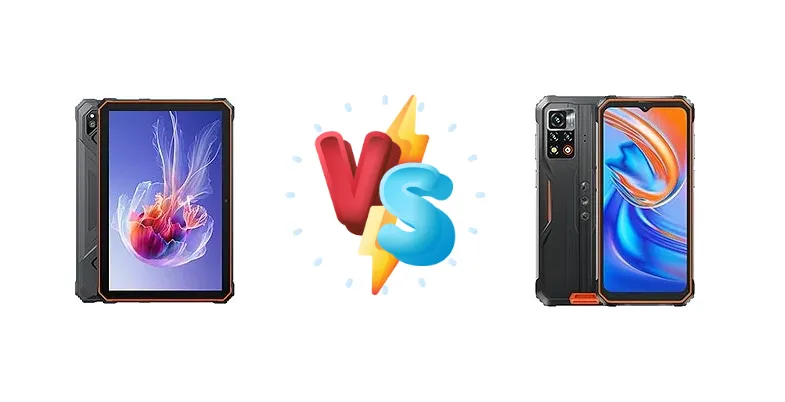
Oscal Spider 8 vs Blackview BV9200: A Deep Dive into Rugged Performance
| Phones Images | |||||
|---|---|---|---|---|---|
|
🏆 Quick Verdict
For the average user prioritizing performance and faster charging, the Blackview BV9200 is the clear winner. Its Helio G96 chipset and 66W charging significantly outperform the Oscal Spider 8’s Unisoc T616 and 33W charging. However, the Spider 8 presents a compelling value proposition for those on a tighter budget.
| PHONES | ||
|---|---|---|
| Phone Names | Oscal Spider 8 | Blackview BV9200 |
| Network | ||
|---|---|---|
| 2G bands | GSM 850 / 900 / 1800 / 1900 | GSM 850 / 900 / 1800 / 1900 |
| 3G bands | HSDPA 900 / 2100 | HSDPA 850 / 900 / 1700(AWS) / 1900 / 2100 |
| 4G bands | 1, 3, 7, 8, 20, 34, 38, 39, 40, 41 | 1, 2, 3, 4, 5, 7, 8, 12, 13, 17, 18, 19, 20, 25, 26, 28, 34, 38, 39, 40, 41, 66 |
| Speed | HSPA, LTE | HSPA, LTE |
| Technology | GSM / HSPA / LTE | GSM / CDMA / HSPA / LTE |
| - | CDMA 800 / 1900 | |
| Launch | ||
|---|---|---|
| Announced | 2023, August | 2022, December 28 |
| Status | Available. Released 2023, August | Available. Released 2023, January 09 |
| Body | ||
|---|---|---|
| Dimensions | 251.3 x 170.1 x 14.9 mm (9.89 x 6.70 x 0.59 in) | 174.5 x 81.8 x 13.6 mm (6.87 x 3.22 x 0.54 in) |
| SIM | Nano-SIM + Nano-SIM | Nano-SIM + Nano-SIM |
| Weight | 854 g (1.88 lb) | 310 g (10.93 oz) |
| - | IP68/IP69K dust/water resistant (up to 1.5m for 30 min) Drop-to-concrete resistance from up to 1.8m MIL-STD-810H compliant | |
| Display | ||
|---|---|---|
| Protection | Corning Gorilla Glass 5 | Corning Gorilla Glass 5 |
| Resolution | 1200 x 1920 pixels, 16:10 ratio (~224 ppi density) | 1080 x 2408 pixels, 20:9 ratio (~400 ppi density) |
| Size | 10.1 inches, 295.8 cm2 (~69.2% screen-to-body ratio) | 6.6 inches, 104.9 cm2 (~73.5% screen-to-body ratio) |
| Type | IPS LCD | IPS LCD, 120Hz |
| Platform | ||
|---|---|---|
| CPU | Octa-core (2x2.0 GHz Cortex-A75 & 6x1.8 GHz Cortex-A55) | Octa-core (2x2.05 GHz Cortex-A76 & 6x2.0 GHz Cortex-A55) |
| Chipset | Unisoc Tiger T616 (12 nm) | Mediatek MT6781 Helio G96 (12 nm) |
| GPU | Mali-G57 MP1 | Mali-G52 MC2 |
| OS | Android 13, Doke OS_P 3.0 | Android 12, Doke-OS 3.1 |
| Memory | ||
|---|---|---|
| Card slot | microSDXC (uses shared SIM slot) | microSDXC (dedicated slot) |
| Internal | 128GB 8GB RAM | 256GB 8GB RAM |
| - | UFS 2.1 | |
| Main Camera | ||
|---|---|---|
| Dual | 13 MP secondary unspecified camera | - |
| Features | LED flash | LED flash, HDR, panorama |
| Single | - | 16 MP, (wide), 1/3", 1.0µm |
| Triple | - | 50 MP, f/1.8, (wide), 1/2.76", 0.64µm, PDAF 8 MP, f/1.8, 120˚, (ultrawide), AF Auxiliary lens |
| Video | 1080p@30fps | 1440p@30fps, 1080p@30fps |
| Selfie camera | ||
|---|---|---|
| Single | 16 MP | 16 MP, f/2.0, (wide), 1/3", 1.0µm |
| Video | Yes | 1080p |
| Sound | ||
|---|---|---|
| 3.5mm jack | - | No |
| 35mm jack | No | No |
| Loudspeaker | Yes, with stereo speakers | Yes, with dual speakers |
| Comms | ||
|---|---|---|
| Bluetooth | 5.0, A2DP | 5.2, A2DP, LE |
| NFC | No | Yes |
| Positioning | GPS, GLONASS, GALILEO, BDS | GPS, GLONASS, GALILEO, BDS |
| Radio | FM Radio | FM radio |
| USB | USB Type-C, OTG | USB Type-C, OTG |
| WLAN | Wi-Fi 802.11 a/b/g/n/ac, dual-band | Wi-Fi 802.11 a/b/g/n/ac, dual-band |
| Features | ||
|---|---|---|
| Sensors | Accelerometer, gyro, proximity, compass | Fingerprint (side-mounted), accelerometer, gyro, proximity, compass, barometer |
| Battery | ||
|---|---|---|
| Charging | 33W wired 5W reverse wired | 66W wired 30W wireless |
| Type | 13000 mAh | 5000 mAh |
| Misc | ||
|---|---|---|
| Colors | Black, Orange | Black, Orange, Green |
| Price | About 220 EUR | About 200 EUR |
Oscal Spider 8
- More affordable price point
- Durable rugged design
- Reverse wired charging capability
- Slower processor
- Slower charging speeds
- Limited display information
Blackview BV9200
- Faster and more powerful processor
- Significantly faster charging (wired & wireless)
- Brighter and higher contrast display
- Higher price tag
- Potentially larger size/weight due to larger battery/features
- Rugged design may not appeal to all users
Display Comparison
The Blackview BV9200 offers a measurable advantage in display quality, boasting a peak brightness of 481 nits and a 1423:1 contrast ratio. While the Oscal Spider 8’s display specs are not provided, Blackview’s figures suggest a more visible screen in direct sunlight and richer colors. This benefits users working outdoors or those who consume a lot of video content. The lack of detailed display information for the Spider 8 makes a precise comparison difficult, but the BV9200’s numbers are a clear positive.
Camera Comparison
Without detailed camera specifications for the Oscal Spider 8, a direct comparison is limited. However, the rugged phone market often prioritizes durability over camera prowess. Both devices likely feature a multi-camera setup, but the BV9200’s potential for better image processing, stemming from the more powerful chipset, is a likely advantage. The presence of OIS (Optical Image Stabilization) on the BV9200, if equipped, would further enhance image quality in low-light conditions. Users should temper expectations for flagship-level photography on either device.
Performance
The Blackview BV9200’s MediaTek Helio G96 chipset, featuring two Cortex-A76 cores clocked at 2.05 GHz, provides a noticeable performance uplift compared to the Oscal Spider 8’s Unisoc Tiger T616. The G96’s Cortex-A76 cores are architecturally superior to the T616’s Cortex-A75 cores, resulting in faster single-core performance. This translates to snappier app launches and smoother multitasking. While both chips are built on a 12nm process, the G96’s more efficient design and higher clock speeds give it an edge, particularly for gaming. The Spider 8 will handle everyday tasks, but the BV9200 is better suited for demanding applications.
Battery Life
The Blackview BV9200’s 66W wired charging is a significant advantage over the Oscal Spider 8’s 33W charging. This translates to substantially faster charging times, getting you back up and running quicker. The BV9200 also adds 30W wireless charging, a feature absent on the Spider 8. While battery capacity isn’t specified for either device, the faster charging speeds of the BV9200 mitigate the impact of a potentially smaller battery, offering more convenient power top-ups throughout the day.
Buying Guide
Buy the Oscal Spider 8 if you need a highly affordable, durable phone for basic tasks and light use, prioritizing cost savings over raw performance. Buy the Blackview BV9200 if you prefer a more responsive experience for gaming and multitasking, and value the convenience of significantly faster wired and wireless charging, even at a higher price point.